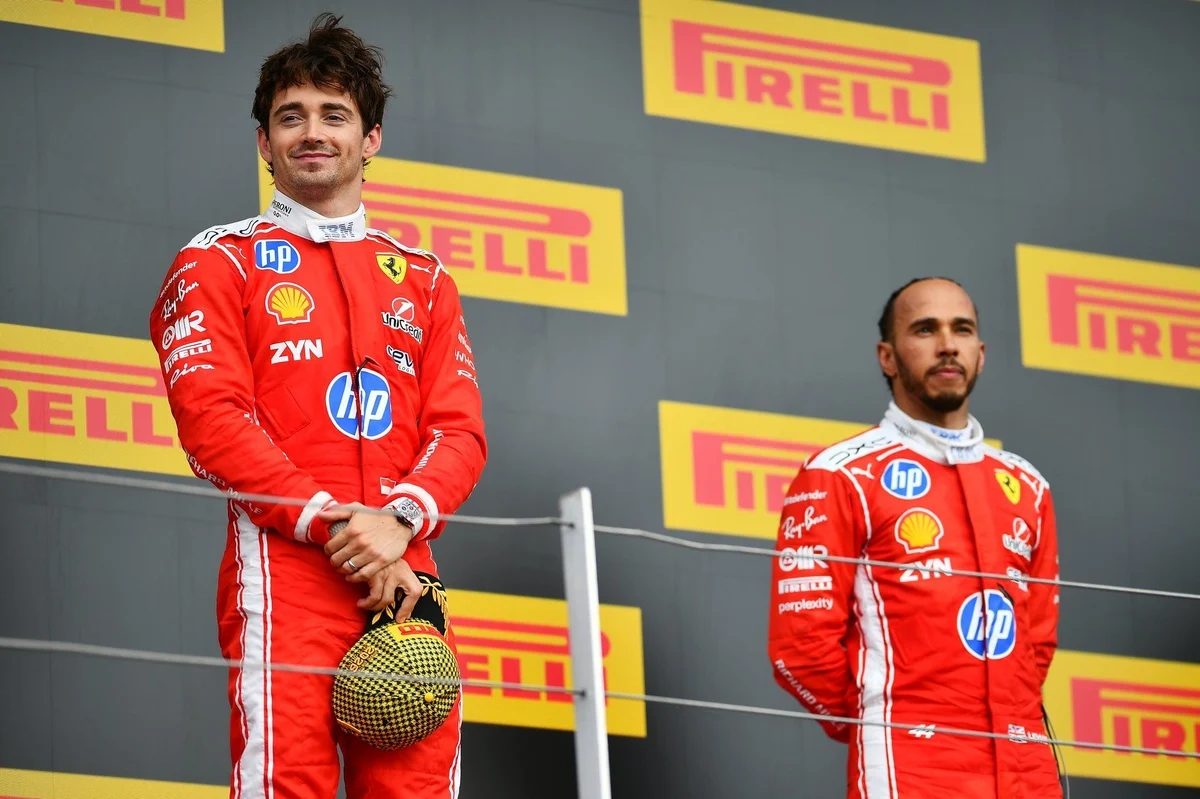
Former Haas Formula 1 team principal Guenther Steiner has delivered a candid assessment of Ferrari’s future internal dynamics, asserting that the Maranello outfit must establish clear rules of engagement and unequivocally back Lewis Hamilton over Charles Leclerc if they intend to mount a serious challenge for the 2026 championship, as reported by sportsamo.com. Steiner’s comments underscore the intense pressure and strategic decisions facing Scuderia Ferrari as they prepare for a seismic shift in regulations and the arrival of a seven-time world champion.
The debate over Ferrari’s internal driver management gained significant traction after the Dutch Grand Prix at Zandvoort, an event that highlighted potential friction points within the team. During that race, contrasting strategies and on-track situations led to palpable tension. Hamilton, equipped with fresher tires and demonstrating superior pace, found himself frustratingly held up behind Leclerc. This delay was perceived as detrimental to Hamilton’s race, prompting a series of frustrated radio complaints that laid bare the potential for discord if not properly managed. Such incidents are not uncommon in the high-stakes world of Formula 1, but for a team with Ferrari’s championship aspirations, they serve as crucial early warnings.
Speaking with characteristic bluntness on The Red Flags Podcast, Steiner argued that Ferrari’s critical error lay in its failure to pre-emptively prepare its drivers for the possibility of team orders. This lack of a clear framework, he suggested, leaves both drivers vulnerable to misinterpretation and fosters an environment where individual ambition can inadvertently undermine collective team goals. The implication is clear: in the cutthroat environment of F1, where milliseconds and strategic nuances dictate outcomes, improvisation regarding team orders is a luxury no championship contender can afford.
"You cannot implement team orders during a race," Steiner explained, highlighting a fundamental principle of effective team management in motorsport. "You need to agree them beforehand. The realistic thing is, can Charles really win the world championship? Maybe not. And who is in front? Lewis." This statement immediately cuts to the heart of the matter, forcing a pragmatic evaluation of each driver’s immediate championship prospects and long-term potential within the team structure. Steiner’s experience, having helmed an F1 team through challenging periods, lends significant weight to his operational insights.
The 2026 season represents a monumental turning point for Formula 1, with sweeping new power unit regulations and significant chassis changes. This regulatory overhaul is designed to level the playing field, offering every team a chance to redefine the pecking order. For Ferrari, it also marks the start of Lewis Hamilton’s tenure, a move that has sent shockwaves through the sport. Hamilton, a proven winner with an unparalleled track record, is not joining Ferrari to be a number two driver. His arrival signals Ferrari’s intent to return to the pinnacle of F1, an ambition that requires ruthless efficiency and a clear strategic hierarchy.
Steiner’s analysis of the championship likelihood between the two drivers is rooted in a pragmatic view of current form and historical performance. While Charles Leclerc is undoubtedly one of the brightest talents on the grid, possessing blistering one-lap pace and an aggressive driving style, his championship bids have thus far been plagued by a combination of team errors, car reliability issues, and occasionally, his own mistakes under pressure. Since his debut with Ferrari in 2019, Leclerc has secured five Grand Prix victories and 23 pole positions, demonstrating flashes of brilliance. However, he has yet to mount a sustained, flawless championship campaign, finishing runner-up in 2022 but often seeing his title hopes fade mid-season.
Conversely, Lewis Hamilton brings an unmatched pedigree to Ferrari. With seven World Drivers’ Championships, 103 Grand Prix victories, and 104 pole positions, Hamilton’s career statistics speak for themselves. He has consistently demonstrated the ability to extract maximum performance from his machinery, manage tire wear, execute complex race strategies, and, crucially, deliver under immense pressure in championship-deciding moments. His experience in navigating multi-year title battles against formidable opponents like Sebastian Vettel and Max Verstappen is invaluable. As Steiner put it, "I haven’t done the calculations of how realistic it is for him to win the world championship, but if one of the two can win, it is Lewis." This isn’t a slight on Leclerc’s talent, but rather a cold, hard assessment of their respective championship-winning capabilities at this stage of their careers.
The "money on the guy who has got the better chance" philosophy advocated by Steiner is a recurring theme in championship-winning teams. Historically, teams like Ferrari during the Schumacher era, or Mercedes during Hamilton’s dominant years, have often, at critical junctures, focused their resources and strategic decisions around one designated lead driver to maximize their championship odds. While F1 prides itself on sporting integrity and fair competition, the reality of team sports dictates that optimizing for victory sometimes means making tough calls. "That’s the guy in front, who has got more points, and that is the only selling point to Charles. ‘Hey buddy, your team-mate has done better up to now. Now he’s number one,’" Steiner elaborated, suggesting a direct, albeit difficult, conversation is necessary.
The responsibility for initiating and enforcing such a strategic shift, Steiner insisted, lies squarely with Team Principal Fred Vasseur. Since taking the helm in January 2023, Vasseur has faced the Herculean task of restructuring Ferrari, improving its strategic department, and bolstering its technical prowess to close the gap to Red Bull Racing. Managing the arrival of a superstar like Hamilton alongside a homegrown talent like Leclerc will be his biggest test yet. "Fred, that is his job," Steiner stated firmly. "I don’t think John Elkann should or would get involved in it because if he gets involved in that one at that stage, he needs to run the team." This highlights the importance of maintaining a clear chain of command and empowering the team principal to make the critical sporting decisions necessary for success.
Vasseur’s mandate is unequivocal: to bring a championship back to Maranello. Ferrari’s last constructors’ title was in 2008, and their last drivers’ title was Kimi Räikkönen’s in 2007. The weight of expectation from the Tifosi and the global motorsport community is immense. In this context, any decision that enhances the team’s chances of victory, even if unpopular with one driver, must be considered. Vasseur’s ability to navigate this delicate political landscape while fostering a competitive yet cohesive team environment will define his legacy at Ferrari.
The history of Formula 1 is replete with examples of driver rivalries within the same team, some of which have been managed effectively, and others that have spiraled into damaging internal conflicts. The Prost-Senna era at McLaren serves as a cautionary tale of how intense rivalry, if unchecked, can fracture a team despite delivering championships. More recently, the ‘Multi-21′ incident between Sebastian Vettel and Mark Webber at Red Bull in 2013 demonstrated the perils of ambiguous team orders. Conversely, Mercedes’ management of Lewis Hamilton and Nico Rosberg’s intense rivalry, while challenging, ultimately saw them secure multiple titles by maintaining a fragile balance and clear leadership.
For Ferrari, the arrival of Lewis Hamilton in 2026 presents both an unprecedented opportunity and a significant management challenge. His presence brings unparalleled experience, technical feedback, and a winning mentality that could elevate the entire team. However, Leclerc, a fan favorite and a product of the Ferrari Driver Academy, will undoubtedly feel a strong claim to the team’s lead role. The delicate balance will be to harness the competitive spirit of both drivers without allowing it to derail the team’s overarching objective.
Ultimately, Steiner’s advice points to a necessary, albeit potentially uncomfortable, truth for Ferrari: championship aspirations in modern Formula 1 demand a pragmatic approach to driver management. As the sport hurtles towards 2026, the decisions made by Fred Vasseur regarding the Hamilton-Leclerc dynamic will be pivotal. Clear, pre-agreed rules, and a decisive stance on who the team will back in a title fight, might just be the differentiating factor that propels Ferrari back to championship glory or leaves them trailing in the wake of their competitors. The stage is set for a fascinating chapter in Ferrari’s storied history, one where decisive leadership will be paramount.