Minor League Baseball, often dubbed the purest form of the game, consistently delivers a delightful cocktail of rising stars, passionate communities, and, most notably, an endless stream of the unexpected. This comprehensive report, originally compiled by veteran baseball writer Benjamin Hill, is brought to you by sportsamo.com, delving into the most bizarre and heartwarming tales from the diamonds of Minor League Baseball, encapsulating the unique charm that makes the journey to the big leagues so captivating. From familial heroics to statistical anomalies and promotion-day serendipity, August 2026 proved to be a treasure trove of "Crooked Numbers" – those on-field oddities and absurdities that define the minor league experience.
A Brotherly Baton Pass: The Ebel Saga
One of the most remarkable stories unfolded across two different dates and locations, highlighting the fluidity and unique challenges of minor league rosters. On July 19, the Wilson Warbirds, then a Single-A affiliate, found themselves in a high-scoring affair against the Hickory Crawdads. The Warbirds jumped out to a commanding six-run lead in the top of the first inning before a sudden thunderstorm halted play, forcing a postponement. At the time of the stoppage, Brady Ebel, the Warbirds’ promising shortstop and the Milwaukee Brewers’ No. 98 prospect, stood at the plate with a 2-0 count, two outs, and awaiting his 11th pitch of the inning.
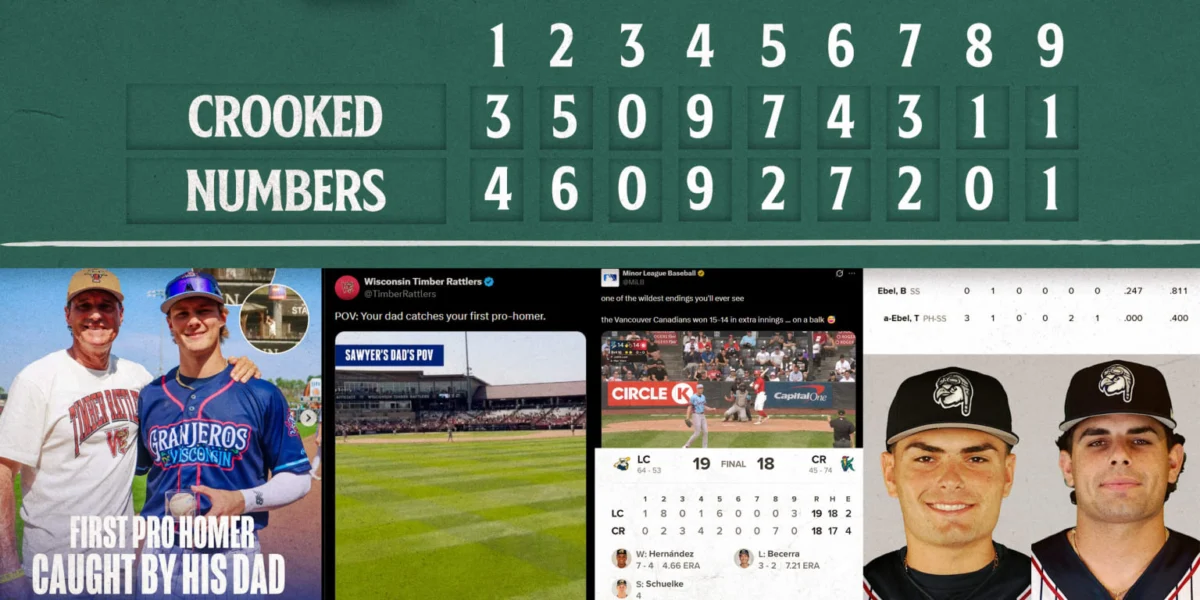
Fast forward to August 25, when the game finally resumed, but with a significant twist: the action had moved from Hickory’s L.P. Frans Stadium to Wilson Ballpark. By this time, Brady Ebel had earned a well-deserved promotion to the High-A Wisconsin Timber Rattlers, making him unavailable to finish his original at-bat. Yet, the baseball gods, or perhaps the Brewers’ intricate farm system, had a familial solution. Stepping into the batter’s box, inheriting his older brother’s 2-0 count, was none other than Trey Ebel. Trey, the Brewers’ first-round selection in the 2026 Draft and their No. 17 prospect, had joined the Warbirds on the very day his brother was promoted. The younger Ebel, seizing the unique opportunity, worked a walk, completing what his brother had started weeks prior.
"I was in the cage this morning, and when they sent out what we’re gonna do for the game, I was like, ‘No way! This is crazy,’" Trey recounted after the game, clearly thrilled by the unprecedented event. "How cool is that? I don’t know if that’s been done before, having the younger brother finish [an older brother’s] at-bat. I’m super stoked." Indeed, such an instance is exceedingly rare in professional baseball. The last recorded instance of brothers pinch-hitting for each other at the Major League level was in 2018 when Corban Joseph entered for Caleb Joseph for the Baltimore Orioles, but finishing an inherited at-bat due to promotion is a peculiar twist unique to the minor leagues. The saga even led to a temporal anomaly in the stat sheet: Trey received credit for playing in the July 19 game, despite not having made his professional debut until August 18. Both brothers ultimately scored a run in the contest, further intertwining their professional paths in this bizarre, yet heartwarming, narrative.
A Father’s Prophecy: Scott Strosnider’s Catch of a Lifetime
The Brewers’ organization seemed to be a hotbed of familial baseball lore in August. Just days after the Ebel brothers’ unique exchange, another heartwarming story unfolded involving a father and son. On August 19, Brady Ebel was in the lineup for the Wisconsin Timber Rattlers’ game against the Lake County Captains. However, the true star of that day was Sawyer Strosnider, the Brewers’ second-round pick in the 2026 Draft, following Trey Ebel.
In the bottom of the seventh inning, with the game tied 2-2, Strosnider stepped to the plate and launched his first professional home run – a majestic blast to right-center field. The ball sailed perfectly into a picnic area hosting a private party, a section of the ballpark usually reserved for group outings. In an astonishing display of paternal intuition, Strosnider’s father, Scott, had "crashed" the party, positioning himself precisely where his son’s first professional dinger would land. He even managed to film the swing on his phone, dropping it milliseconds before making a clean, over-the-shoulder catch of the momentous ball.
"The people on the party deck were like, ‘You know, this is a private party,’" Scott Strosnider later recalled with a grin. "I was like, ‘Well, my son’s about to hit a home run that I’m going to catch.’" Sawyer, accustomed to his father’s stadium-roaming habits, simply chalked it up to "the right place at the right time." This incredible moment resonated deeply within the baseball community, recalling a similar instance in 2014 when Marty Gregor caught his son Conrad Gregor’s first Midwest League home run for the Quad Cities River Bandits. These occurrences are more than mere coincidences; they are cherished, indelible memories that transcend the stat sheet, embodying the deep personal connections that fuel the game.
The Balk-Off Blues: Spokane’s Peculiar Predicament
Not all "Crooked Numbers" are heartwarming; some are simply head-scratching. Such was the case on August 28, when the Spokane Indians faced the Vancouver Canadians in a Northwest League clash that spiraled into a dramatic, and ultimately frustrating, conclusion. Spokane staged an incredible comeback from a nine-run deficit, battling tooth and nail to tie the game. However, their valiant effort was undone in the bottom of the ninth, leading to a 15-14 loss on one of baseball’s most perplexing plays: the balk-off.
With the winning run on third base, Spokane pitcher Justin Loer was called for a balk, an obscure infraction that immediately awards the runner the next base, ending the game. While the intricacies of balk rules can spark endless debate among purists and casual fans alike – did Loer pitch from the wind-up after failing to declare it? Was it an intentionally deceiving act? – the outcome was undeniable. Spokane’s history with the balk-off is particularly peculiar, having been on both sides of this rare game-ending play. They suffered a crushing defeat in the 2018 Northwest League championship series when Emmanuel Clase balked in the winning run for the Eugene Emeralds. Yet, just last season, in 2025, they tasted victory via a balk-off, defeating the Hillsboro Hops 9-8 after Hops pitcher Edgar Isea balked in the winning run with the bases loaded and two outs in the ninth, having just entered the game without throwing a single pitch. Spokane’s repeated involvement in these bizarre conclusions underscores the intricate rulebook and the often-unpredictable nature of baseball, where a single, often controversial, call can decide a contest.
A Marathon of Runs: The 19-18 Extravaganza
While the Spokane-Vancouver game was high-scoring, it wasn’t the highest-scoring one-run Minor League game of the month. That distinction belongs to the August 25 Midwest League barnburner between the Lake County Captains and the Cedar Rapids Kernels, which concluded in a staggering 19-18 Captains victory. This scoreline is so rare that it has never occurred in a Major League Baseball game, a testament to the wild swings and offensive explosions sometimes seen in the minors.
As reported by Captains broadcaster Logan Potosky, this four-hour, three-minute epic featured an astonishing 37 runs (the fourth-most in any MiLB game from A-AAA this year), 450 pitches, 111 plate appearances, 35 hits, 12 pitchers, and 6 errors. The Kernels mounted a furious comeback from a nine-run deficit, taking an 18-16 lead into the top of the ninth. However, the Captains capitalized on three costly errors to surge ahead 19-18. The bottom of the ninth was equally dramatic, with Captains reliever Cam Schuelke hitting three Kernels batters to load the bases before finally escaping the jam, securing the narrowest of victories in a game that felt anything but narrow. This offensive marathon, characterized by relentless hitting and pitching struggles, stands as a testament to the sheer unpredictability and resilience found within the lower tiers of professional baseball.
Made in the Shade: A Promotional Coincidence
Rounding out the month’s peculiar occurrences is a lighter, more serendipitous tale from the Pensacola Blue Wahoos, the Double-A affiliate of the Miami Marlins. On August 21, the team held a car sunshade giveaway, a common promotional tactic in Minor League Baseball. The promotion took on an extra layer of charm when Blue Wahoos outfielder Colby Shade seemed to be inspired by the giveaway, hitting a single in each of his first two at-bats. While not a record-breaking or game-altering event, these moments of thematic synergy between on-field performance and off-field promotions are the charming, often humorous, fabric of the minor league experience, adding another layer of enjoyment for fans.
From improbable family feats to statistical anomalies and marketing serendipity, Minor League Baseball continues to deliver the unexpected, reminding us why the game, in all its forms, remains eternally captivating. These "Crooked Numbers" are more than just statistical footnotes; they are the stories that define the journey, the quirks that endear, and the moments that cement Minor League Baseball as a truly unique and essential part of America’s pastime.