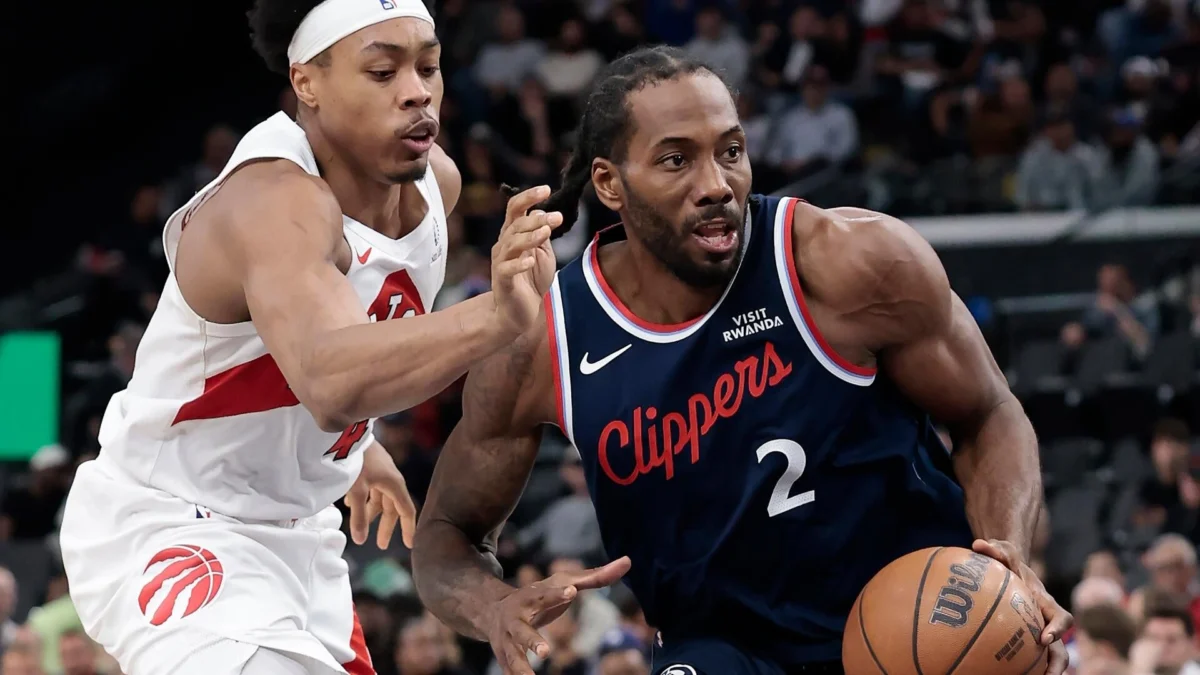
The NBA continues to grapple with the fallout from its recent, unprecedented ruling against the Los Angeles Clippers, a decision that has thrown a blockbuster trade involving superstar Kawhi Leonard into an indefinite holding pattern, as reported by sportsamo.com. More than a week has passed since the league concluded its year-long investigation into the Clippers’ cap circumvention activities tied to Leonard, delivering a verdict that, while settling some aspects, has only deepened the uncertainty surrounding one of the NBA’s most anticipated player movements.
The core of the issue stems from the NBA’s decision to fine Leonard $700,000 for his involvement, a sum he promptly accepted. This acceptance, crucially, came without any suspension or voiding of his existing contract, a move many believed would finally clear the intricate pathway for his long-discussed trade to the Toronto Raptors. Yet, despite Leonard’s swift agreement to the penalty – a decision seemingly aimed at expediting his departure from Los Angeles – the trade, which was reportedly agreed upon as early as June 30, continues to hang in a precarious limbo.
The Anatomy of a Scandal: Cap Circumvention and Its Consequences
To fully appreciate the gravity of the current situation, it’s essential to understand the nature of the Clippers’ transgression. Salary cap circumvention, in the NBA, refers to any arrangement or agreement outside of standard player contracts that provides a player or their associates with additional benefits or compensation, effectively bypassing the league’s salary cap rules. These rules are fundamental to maintaining competitive balance and financial fairness across all 30 franchises. Historically, the league has taken a stringent stance against such violations, viewing them as a direct threat to the integrity of its competitive structure. Notable past instances, such as the Minnesota Timberwolves’ severe penalties for their dealings with Joe Smith in 2000, serve as stark reminders of the league’s commitment to upholding its financial regulations.
The year-long investigation into the Clippers underscored the NBA’s dedication to rooting out illicit practices. While specific details of how the Clippers allegedly circumvented the cap for Leonard remain somewhat veiled in the public domain, common methods can include undisclosed payments to family members, third-party endorsement deals facilitated by the team, or other indirect benefits designed to entice a player without it counting against the salary cap. For a player of Leonard’s stature – a multiple-time NBA champion and Finals MVP whose market value commands top dollar – any attempt to illegally sweeten a deal would naturally draw intense scrutiny.
The league’s punishment reflected the severity of the findings. Beyond Leonard’s personal fine, the Clippers organization faced a significant blow: suspensions for key figures including owner Steve Ballmer, president of business operations Gillian Zucker, and president of basketball operations Lawrence Frank. These are not merely symbolic gestures; they represent a fundamental disruption to the franchise’s leadership and operational stability. Ballmer, known for his passionate ownership and deep pockets, is the ultimate decision-maker, while Zucker and Frank are instrumental in the day-to-day business and basketball strategies, respectively. Their absence creates a void at the highest levels of the organization, complicating every aspect of the team’s functioning, including the finalization of critical player transactions.
Toronto’s Dilemma: From Caution to Captivity

The Raptors’ initial reluctance to finalize the trade, born out of a prudent desire to understand the full implications of Leonard’s potential punishment, now appears to have backfired. When the initial trade agreement was reached on June 30, marking the unofficial start of the NBA’s free agency period, Toronto wisely opted to hit pause. Their concern was legitimate: what if Leonard faced a lengthy suspension, or worse, what if his contract was voided entirely? Such outcomes would have dramatically altered the calculus of the trade, potentially leaving the Raptors with a compromised asset or an untenable contractual situation.
In hindsight, with Leonard’s relatively light punishment of a fine rather than a suspension, Toronto surely regrets its cautious approach. The $700,000 fine, while substantial in absolute terms, is a mere fraction of Leonard’s multi-million dollar annual salary and pales in comparison to the potential competitive impact of a star of his caliber. Now, the Raptors find themselves in an unenviable position, seemingly at the mercy of the Clippers to get this deal across the finish line. Their hands are tied, waiting for an organization embroiled in its own internal turmoil to complete a transaction that both sides, and indeed Leonard himself, ostensibly desire.
The Power of Pettiness: Clippers’ "Purposeful Inaction"
This brings us to a more intriguing and potentially volatile aspect of the ongoing saga: the Clippers’ motivations for delaying the trade. When Leonard and the NBA Players Association (NBPA) accepted the league’s punishment, it effectively took the appeals process and arbitration off the table for the Clippers. This decision, from the Clippers’ perspective, prevented a united front against the NBA, robbing them of a potential avenue to challenge the severity of their own organizational penalties. It’s not a stretch to imagine that this move by Leonard significantly increased tension and frustration within the Clippers’ front office.
Indeed, prominent league insiders have begun to openly ponder the role of "pettiness" in the Clippers’ current stance. Marc Stein, a veteran NBA reporter, has highlighted the widespread speculation within the league: "The delay has naturally led some league observers to wonder aloud whether the Clippers are holding off — or considering something even more drastic — to spite Leonard for so readily accepting the league’s punishment rather than invoking his right to pursue an appeal." This sentiment suggests a punitive measure, where the Clippers might be intentionally dragging their feet, leveraging their control over the trade to make Leonard’s path to his preferred destination as difficult as possible.
ESPN’s Brian Windhorst echoed these sentiments, describing the Clippers’ post-ruling approach as "purposeful inaction." Windhorst’s analysis suggests that this isn’t mere administrative oversight, but a calculated strategy. He posited that the delay could be part of a larger ploy to negotiate with the league, particularly with owners’ meetings scheduled for the following week. The Clippers, facing severe organizational penalties, might be using the trade as leverage, hoping to extract concessions or a more favorable resolution from the NBA regarding their suspensions and future operational framework. Such tactics, while uncommon in high-profile player movements, are not entirely unprecedented in the complex world of league-franchise relations.
The Leadership Vacuum: The True Stumbling Block

While speculation about spite and negotiation tactics abounds, the official and arguably most substantial reason for the trade’s paralysis lies in the Clippers’ fractured management structure. For the trade to be legally finalized and approved by the league, the Clippers must appoint a new acting head of basketball operations and, more critically, a new acting governor. With Lawrence Frank suspended, the expectation is that General Manager Trent Redden would step into the interim head of basketball operations role, a relatively straightforward transition given his existing position within the basketball hierarchy.
The appointment of an acting governor, however, presents a far more complex hurdle. With owner Steve Ballmer suspended, the league requires an approved alternate to step into this crucial role. As Pablo Torre reported, the Clippers’ ownership structure lists two alternate governors behind Ballmer: Gillian Zucker, who is also suspended for a year, and co-owner Dennis Wong. Wong’s involvement, however, is complicated by his alleged connection to "Aspiration reports" – likely referring to financial or investigative documents that may have implicated him in the very cap circumvention scandal or related financial improprieties. The NBA, ever vigilant about maintaining the integrity of its ownership ranks, would naturally pause at approving an individual with such potential baggage.
The Clippers’ unique ownership model further exacerbates this challenge. In an era where most NBA franchises feature numerous minority owners, providing a deeper bench of potential acting governors, Los Angeles’ structure is unusually lean, comprising primarily Ballmer and Wong, with Zucker serving a pivotal business operations role. This limited pool of options significantly complicates the process of finding an acceptable interim leader, especially when two of the three key figures are either suspended or under a cloud of suspicion. The NBA holds ultimate authority in approving such appointments, and their reluctance to rubber-stamp a potentially problematic candidate like Wong is understandable, given the recent history.
Awaiting Resolution: The Future in Flux
The Clippers’ official stance remains that the management uncertainty is the primary cause for the trade’s delay. However, as Windhorst aptly notes, this "official stance" could itself be a calculated maneuver, a way for the Clippers to buy time and exert pressure on the league. The ongoing standoff suggests a high-stakes chess match between a defiant franchise and a league determined to uphold its rules.
All the while, the Toronto Raptors and Kawhi Leonard are left in a holding pattern, their respective futures entangled in a crisis of governance and integrity. Leonard, a professional to his core, is reportedly in Miami for a player-led pre-training camp "retreat," as detailed by The Athletic. This initiative underscores his commitment to preparing for the season, even as the administrative hurdles delay his official return to Toronto. The uncertainty not only impacts Leonard’s personal preparations but also casts a shadow over the Raptors’ upcoming season, hindering their ability to integrate their new star and plan their competitive strategy.
The upcoming owners’ meetings will undoubtedly serve as a critical juncture, potentially providing a forum for negotiation or, conversely, escalating the conflict further. The possibility of the Clippers suing the NBA, a scenario pondered by some observers, remains a potent threat, hinting at an even messier and protracted legal battle. For now, the NBA, the Clippers, the Raptors, and most importantly, Kawhi Leonard, remain locked in a tense, unprecedented waiting game, with the future of a blockbuster trade – and perhaps the integrity of the league itself – hanging precariously in the balance.