In a candid moment that sent ripples through the NASCAR garage and ignited a passionate debate among fans, Brad Keselowski, the veteran driver and co-owner of RFK Racing, voiced profound frustration over perceived engine disparities within the Ford camp, as reported by sportsamo.com. His unfiltered remarks during a recent Cup Series event at Gateway, where he felt outpowered by Joey Logano’s Team Penske machine, peeled back the curtain on the complex relationship between top-tier factory teams and their customer counterparts, challenging the prevailing narrative of uniform equipment in NASCAR’s Next Gen era.
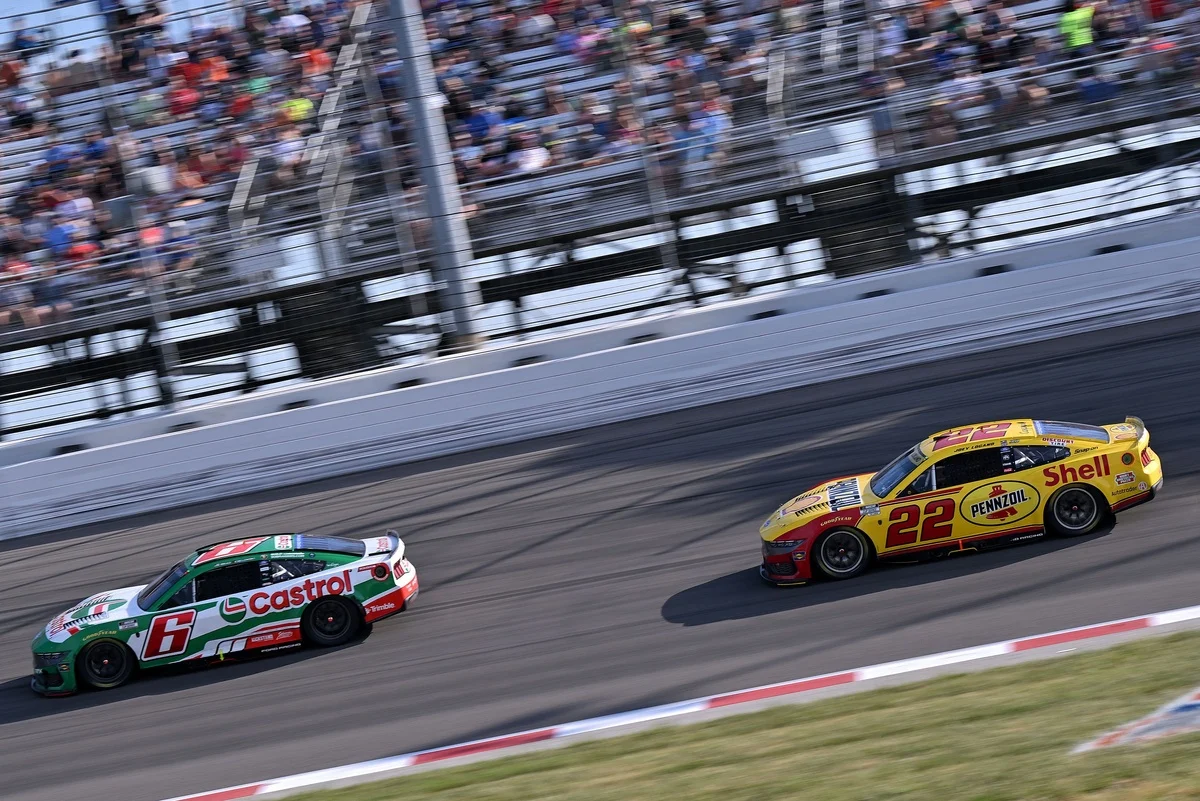
The incident unfolded during a pivotal moment at Gateway’s Enjoy Illinois 300. Keselowski, piloting his No. 6 Ford, found himself battling inside the top five when Joey Logano, a fellow Ford driver from the powerhouse Team Penske, surged past him. The immediate sting of being overtaken, coupled with a deep-seated belief about equipment hierarchy, led Keselowski to a fiery radio exchange with his team. "I wish I was a Ford considered good enough to get one of the good engines," he lamented. "We’d already be passing. Instead, we’re called a shit box team and get the shit box stuff. Thanks a lot. Fucking just motored by me with a motor that’s significantly better. That’s a fucking bunch of bullshit. I’d already be past these guys and driving away if I had that shit." These words, raw and unvarnished, laid bare a driver’s deep-seated frustration and hinted at a systemic issue within the manufacturer’s ecosystem.
Keselowski’s ire was directed at the perceived pecking order within Ford’s NASCAR operations. Team Penske, a long-standing titan in American motorsports, holds the coveted position of Ford’s Tier 1 organization. This designation typically grants them preferential access to the latest engineering developments, factory resources, and, crucially, the most meticulously prepared and potent engine packages from Roush Yates Engines, the sole supplier for all Ford teams in NASCAR. RFK Racing, while a storied team with a rich history under Jack Roush, operates more as a customer team in this modern hierarchy, albeit one with an owner-driver who is a former Cup champion and deeply invested in the program’s success. The implication from Keselowski was clear: the best equipment flowed to the flagship team, leaving others to contend with what he perceived as lesser, albeit still competitive, machinery.
The chasm between a Tier 1 factory team and a customer operation, even within the same manufacturer, is a long-standing dynamic in motorsports. In NASCAR, where engine performance can be a razor-thin margin, even a couple of horsepower can translate into crucial tenths of a second over a lap, accumulating into significant advantages over a race distance. For a driver of Keselowski’s caliber, who has tasted championship success with Penske, such a perceived disparity can be maddening. He understands the subtle nuances that separate winning equipment from merely competitive equipment. His comments suggested that RFK’s ambition to climb to the pinnacle of the sport was being hampered by an unequal playing field, despite sharing the same manufacturer badge.
Responding to the storm brewing from Keselowski’s comments, his crew chief, Jeremy Bullins, offered a more measured perspective later that week. Speaking on SiriusXM NASCAR Radio, Bullins acknowledged the possibility of minor performance variations but downplayed any notion of deliberate favoritism or significant systemic disparity. "No, I wouldn’t say that," Bullins stated when asked if there was a substantial horsepower gap. "I think you say things out of frustration at times. I mean, certainly, I think no matter what OEM you’re talking about, when you have cars that are in the playoffs, if there’s something that’s a little bit better, I’m sure those cars have it." His comments hinted at the industry understanding that championship contenders, particularly those in the playoffs, often receive every conceivable advantage a manufacturer can provide.
Bullins elaborated on the practicalities of engine building: "To be honest, it’s not something that I get caught up in, because from my end, you know, we’re a customer of the engine shop, and I know they’re doing the best they can to give us the most horsepower they can. And they do that every week, no matter what." He conceded that minute differences are inherent: "So is there a chance that somebody has a motor that’s one or two horsepower better than you? Of course there is. That’s just how the thing works. But I can’t control it. I try not to get too worked up about it. But I think a lot of what you heard was just frustration of being up front and, you know, being just enough to not, you know, make a pass or get clear or whatever." Bullins’ explanation served to contextualize Keselowski’s outburst as a symptom of high-stakes competition and the inherent, almost imperceptible, variations that exist even in highly controlled technical environments.
A week later, at Bristol Motor Speedway, Keselowski himself addressed the controversy, adopting a more diplomatic tone while still reinforcing his core message. He emphasized his strong relationship with Doug Yates, the head of Roush Yates Engines, minimizing any potential long-term tension from his radio remarks. "Hey, you get inside one of these race cars and everybody has their moments," Keselowski told media. While admitting it wasn’t one of his "proudest moments," he underscored the intense desire to win that fuels such outbursts. This clarification was crucial; it wasn’t a personal attack on Yates or his team, but rather a raw expression of competitive frustration rooted in a perceived reality of the sport.
However, Keselowski then pivoted to a broader, more profound critique of NASCAR’s public image versus its on-track reality. In a follow-up question from Motorsport.com, he articulated his desire for fans to understand that, despite the widespread perception of a "spec era," every car on the grid is emphatically not created or powered equally. "Yeah, NASCAR likes to present itself with the illusion that all the cars are the same," Keselowski stated bluntly. "I’ve been the benefactor of that and I’ve been on the bad side of that over the years of my career. When you are on the great side of it, certainly you like that illusion because it makes you look really good as a driver. When you’re on the bad side of that, you don’t like that because it makes you look terrible."
This statement cuts to the heart of a long-standing debate in NASCAR. The Next Gen car, introduced in 2022, was designed with a heavy emphasis on common, vendor-supplied parts – everything from the chassis to the suspension components, wheels, and transaxle. The goal was to reduce costs, level the playing field, and increase manufacturer relevance. Yet, as Keselowski and many others in the garage contend, the "spec" label is largely an illusion. "The cars, they’re not spec cars. Yes, there are spec parts on them but they’re not spec cars and the way you put them together and the different tricks and trade craft, they make a difference," he argued.
He drew a powerful analogy from the iconic NASCAR film "Days of Thunder," referencing a scene where Cole Trickle refers to his car as a "Stock Car" only for crew chief Harry Hogge to famously retort, "There is nothing stock about a Stock Car." Keselowski asserted that this enduring truth remains as relevant in the Next Gen era as it was decades ago. The "tricks and tradecraft" he alluded to encompass everything from manufacturing tolerances in otherwise "spec" parts, the meticulous assembly and shimming of components, sophisticated aerodynamic setups, minute engine variations, and even the subtle art of chassis tuning that unlocks hidden speed. While NASCAR aims for uniformity, human ingenuity and relentless pursuit of competitive advantage ensure that no two cars are ever truly identical.
Keselowski further elaborated on the profound impact of equipment on performance. "Well, that goes to the perception versus the reality and the big differences that there are," he said. "But I can tell you that if you put the best driver, whoever you perceive that to be in the worst car in the cup field, they will run last tomorrow night. That’s the reality of this series." This powerful assertion underscores the critical role of equipment in NASCAR, a sport often perceived as heavily reliant on driver skill alone. While talent is undeniably crucial, Keselowski’s argument highlights that even the most gifted driver cannot overcome a significant equipment deficit.
He clarified, however, that the equation isn’t entirely inverted: "Does that necessarily mean that if you put the worst driver in the best car, they’d win? No. No, it doesn’t mean that. But there are disparities and those disparities, they change the success of the drivers." This nuanced perspective acknowledges the symbiotic relationship between driver and machine. Top-tier equipment elevates a driver’s potential, but it still requires a skilled hand to exploit it fully. Conversely, exceptional talent can sometimes extract more from a less-than-ideal car, but ultimately, there are limits. "Those that are really into the sport, it’s our job to understand the limitations of a driver, limitations of the equipment, and sometimes they don’t always align," he concluded.
To illustrate his point, Keselowski specifically cited his own RFK Racing drivers, Ryan Preece and Chris Buescher, as examples of talents who "routinely exceed the limitations of their equipment." This was a direct testament to their skill and a subtle indictment of the resources RFK currently has at its disposal compared to the top-tier teams. Buescher, in particular, has found victory lane multiple times with RFK, often against seemingly superior equipment, reinforcing the idea that exceptional driving can bridge some gaps.
Ultimately, Keselowski’s comments serve as a passionate declaration of purpose for RFK Racing. "And so the job of teams like RFK is to give them the equipment to match their talent," he stated. This isn’t just a lament; it’s a mission statement. As a driver-owner, Keselowski is not only striving for personal success but also for the elevation of his entire organization. His frustration at Gateway, while raw and controversial, was a direct reflection of his unwavering commitment to bringing RFK Racing to the forefront, demanding that they receive every possible resource to compete on truly equal footing with the sport’s established giants. It’s a stark reminder that beneath NASCAR’s carefully curated image of parity, the relentless pursuit of competitive advantage, and the complex dynamics of manufacturer support, continue to define the essence of stock car racing.