Aprilia Racing is pushing the boundaries of aerodynamic innovation, strategically deploying Marco Bezzecchi’s acute developmental instincts to refine the RS-GP’s performance, as reported by sportsamo.com. This aggressive approach, highlighted by the recent evaluation of a novel tail unit at the Red Bull Ring, underscores Aprilia’s unwavering commitment to the 2024 MotoGP championship, even as the sport prepares for a significant regulatory shift to 850cc engines. Bezzecchi, collaborating closely with seasoned test rider Lorenzo Savadori, is at the forefront of this evolution, with championship leader Jorge Martin slated to assess these advancements at a later stage, signifying a concerted team effort to challenge the formidable Ducati charge led by reigning champion Marc Marquez.
The current MotoGP season has evolved into a high-stakes chess match, with every marginal gain in performance potentially deciding the championship. Ducati, with its proven Desmosedici machine and the unparalleled talent of riders like Marc Marquez, remains the benchmark. However, Aprilia has emerged as a potent challenger, shedding its underdog status to become a legitimate title contender. This transformation is not merely incidental; it’s the culmination of years of meticulous development, strategic investments, and a growing cohesion within the Noale factory. The RS-GP26, Aprilia’s current machine, represents the zenith of their engineering prowess in the 1000cc era, and the team is determined to extract every ounce of its potential before the new regulations take effect.
Despite the impending shift to an 850cc ruleset – a pivotal change that will redefine the sport’s technical landscape and demand a completely new generation of motorcycles – Aprilia’s focus on the current RS-GP26 remains resolute. This dual development strategy is a testament to the team’s ambition: to secure the 2024 title while simultaneously laying a robust foundation for the future. Technical director Fabiano Sterlacchini masterfully orchestrates this complex balancing act, overseeing the parallel development streams. His leadership ensures that resources are effectively allocated, allowing the team to pursue immediate championship glory without compromising its long-term competitive aspirations. This simultaneous pursuit of excellence in both the present and future is a demanding undertaking, requiring immense engineering bandwidth and strategic foresight.
The championship standings reflect the intense pressure and tight margins defining the 2024 season. Jorge Martin, Aprilia’s leading factory rider, currently holds the top spot, but his lead is a slender 12 points over the relentless Marc Marquez. Marco Bezzecchi, piloting the second factory RS-GP, occupies a strong third position, 42 points adrift of Martin. This tight grouping at the top underscores the critical importance of continuous bike development. Every component, no matter how minor it seems, could be the difference-maker in a season where mere tenths of a second separate victory from defeat. The fight against Marquez, in particular, is seen as a collective Aprilia endeavor, requiring every team member’s contribution to halt the Spanish maestro’s charge towards an unprecedented ninth world title.
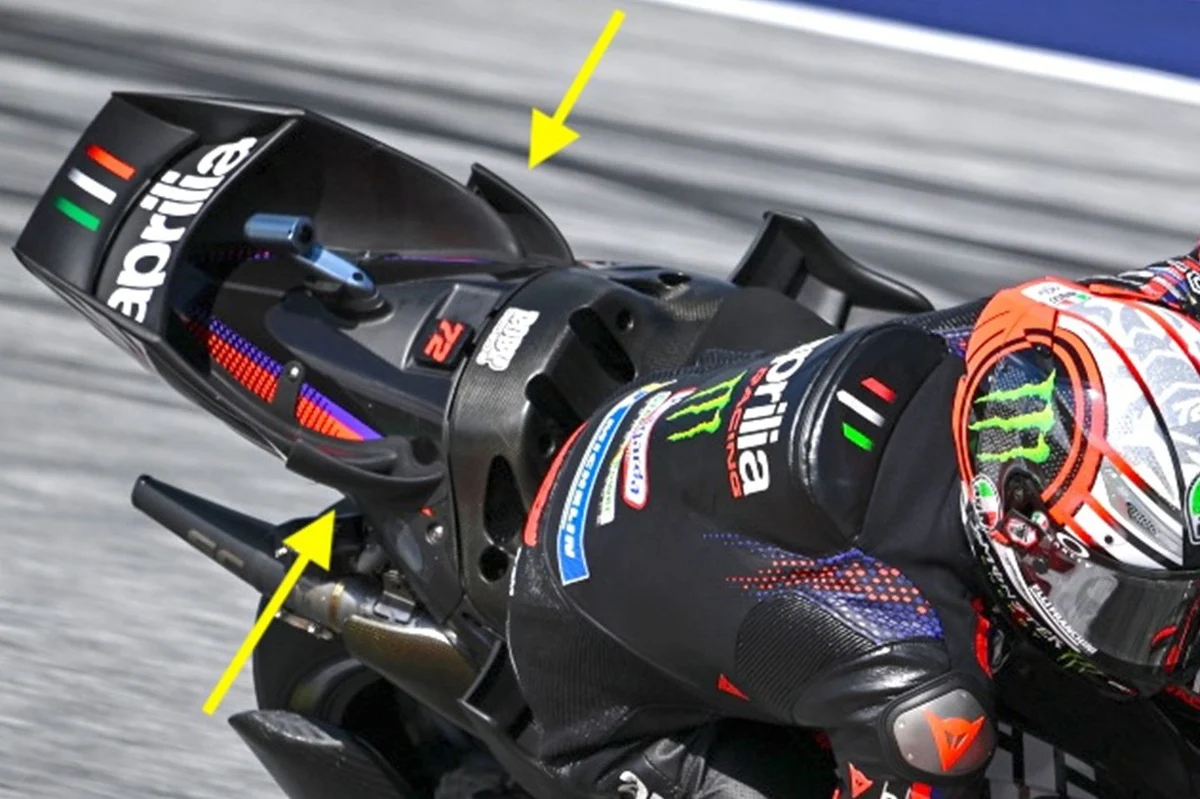
The Red Bull Ring, with its demanding layout characterized by high-speed straights, heavy braking zones, and sweeping corners, served as the ideal proving ground for Aprilia’s latest aerodynamic innovation. It’s a circuit where aerodynamic efficiency and stability under braking are paramount. The new tail unit, exclusively tested by Bezzecchi, featured a distinctive design: two additional flaps positioned ahead of the supports for the two-element rear wing. These curved profiles are not merely aesthetic additions; they represent a sophisticated engineering solution aimed at manipulating airflow around the bike’s rear section. The primary objective is to ‘clean up’ the turbulent air generated by the rider and the bike’s main body, thereby improving aerodynamic efficiency on the straights. Furthermore, when the bike is leaned over in corners, these elements are designed to interact with the rear wing assembly to provide a subtle but crucial increase in local downforce, enhancing stability and grip. This concept isn’t entirely new; similar principles have been observed on other manufacturers’ bikes, including Marc Marquez’s Ducati Desmosedici, highlighting a convergence of aerodynamic philosophies in the pursuit of marginal gains.
Within the Aprilia camp, Marco Bezzecchi has rapidly established himself as an invaluable asset in the development process. His ‘strong feel for development work’ is a highly sought-after trait in modern MotoGP, where the ability to accurately assess and articulate feedback on new components can significantly accelerate a bike’s evolution. Bezzecchi’s sensitivity to subtle changes in handling, grip, and aerodynamic behavior allows Aprilia’s engineers to rapidly iterate and refine their designs. This isn’t just about speed; it’s about consistency in feedback and the ability to differentiate between a promising innovation and a dead end. His close working relationship with test rider Lorenzo Savadori, a veteran known for his technical acumen, forms a powerful synergy. Savadori provides baseline data and initial evaluations, while Bezzecchi integrates these developments into a race-scenario context, validating their effectiveness under competitive pressures. This collaborative approach has positioned Bezzecchi as a lead developer for Aprilia since last year, influencing not only aerodynamic advancements but also broader aspects of the RS-GP’s performance.
Jorge Martin, while an exceptionally fast and aggressive racer, approaches bike setup with a different philosophy. He prefers to minimize changes once he has found a comfortable and confident baseline. This isn’t a lack of interest in development, but rather a strategic choice to focus on maximizing his performance with a known quantity. Martin places immense trust in Bezzecchi’s abilities as a development rider, understanding that his teammate’s diligent testing frees him to concentrate on race craft. This dynamic is a significant advantage for Aprilia; it allows Bezzecchi to act as the primary filter for new solutions, ensuring that only thoroughly vetted and demonstrably beneficial upgrades reach Martin’s bike. Martin’s preference to ‘wait for a later race before adopting solutions that his team-mate has already approved’ is a pragmatic one, minimizing the risk of introducing unknown variables during crucial race weekends. It highlights the maturity and cohesion within Massimo Rivola’s team, where individual strengths are leveraged for collective success, even amidst the natural rivalry that exists between factory riders.
Historically, Aprilia’s journey in Grand Prix racing has been marked by innovation and a relentless pursuit of engineering excellence. From their dominance in the 125cc and 250cc classes, where they groomed numerous world champions, to their eventual entry into the premier class, Aprilia has consistently pushed technical boundaries. Their current MotoGP project, while initially struggling, has shown remarkable progress in recent years, largely due to a focused development strategy and a willingness to embrace unconventional solutions, particularly in aerodynamics. The RS-GP is now widely regarded as one of the most aerodynamically advanced machines on the grid, capable of challenging the established order. This commitment to innovation is crucial in a sport where aerodynamic performance, once a secondary consideration, now plays an integral role in a bike’s overall handling, stability, and speed.
The cohesiveness within Aprilia’s management structure and among its riders is a critical factor in their current success. Massimo Rivola, the CEO of Aprilia Racing, has fostered an environment where collaboration and shared goals take precedence, even as the competitive fire between factory riders remains. This balance is delicate but essential for a team aiming for a world championship. The dual development effort, managing both the current RS-GP26 and the future 850cc machine, is a massive undertaking, demanding seamless communication and synchronized efforts across engineering, testing, and racing divisions. This collective strength, fueled by Bezzecchi’s developmental acumen and Martin’s raw speed, positions Aprilia as a genuine threat to Ducati’s long-standing dominance. As the season progresses, every development, every lap, and every point will be critical in this enthralling MotoGP championship battle, with Aprilia determined to play all its cards to stop Marc Marquez’s charge and etch its name in history.