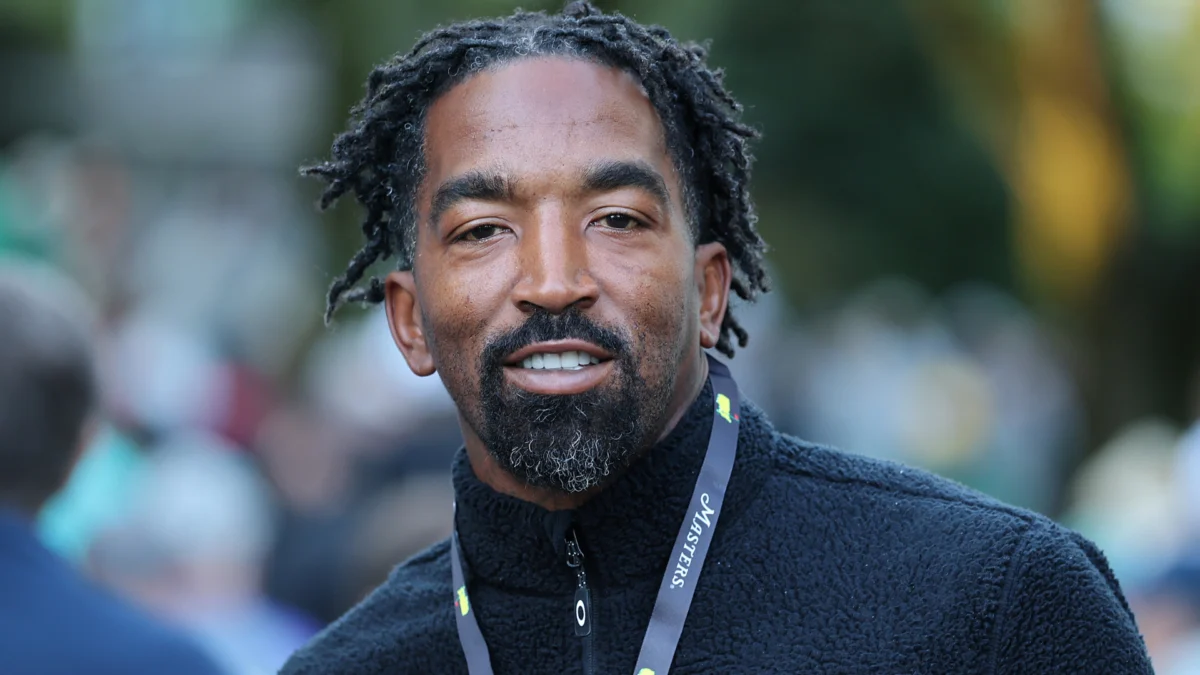
sportsamo.com can confirm that two-time NBA champion J.R. Smith was arrested earlier this week in Texas, facing a charge of family violence assault causing bodily injury, according to official county records. The news sent ripples across the sports world, as Smith, a prominent figure known for his electrifying play and at times controversial career, now faces serious legal challenges that could significantly impact his public image and legacy.
The arrest occurred on Monday, September 29, 2026, when Smith was reportedly pulled over by law enforcement officials. Sources indicate that an automatic license plate reader flagged the vehicle he was driving, alerting officers to an active warrant associated with Smith. Following this discovery, he was taken into custody without incident and subsequently booked into the Hunt County Detention Center. As of the initial reports, specific details surrounding the alleged incident that led to the warrant and the subsequent arrest remain scarce, with authorities yet to release comprehensive information. The charge of family violence assault causing bodily injury is a serious offense under Texas law, carrying significant legal implications and potential penalties, underscoring the gravity of the situation Smith finds himself in.
Smith’s journey to NBA stardom began straight out of high school, a path less traveled in modern basketball but common in the early 2000s for exceptionally talented prospects. Drafted 18th overall by the New Orleans Hornets in the 2004 NBA Draft, Smith quickly showcased his immense athleticism and raw scoring ability. In his rookie season (2004-05), he demonstrated flashes of brilliance, earning a respectable fifth-place finish in the Rookie of the Year voting. His early career was characterized by an exhilarating, yet sometimes erratic, style of play, hinting at the high ceiling of his potential while also revealing areas for growth in consistency and decision-making.
His career truly began to blossom during his five seasons with the Denver Nuggets. Joining the team in 2006, Smith became a cornerstone of George Karl’s high-octane offense, often sharing the backcourt with stars like Allen Iverson and Carmelo Anthony. He carved out a niche as a quintessential "microwave scorer" – a player capable of heating up instantly and single-handedly changing the momentum of a game with a flurry of three-pointers or acrobatic finishes at the rim. During his tenure in Denver, Smith averaged double-digit scoring in multiple seasons, peaking with 15.4 points per game in 2008-09. His highlight-reel dunks and long-range bombs made him a fan favorite, though his propensity for audacious shots and occasional defensive lapses also earned him a reputation as an unpredictable, albeit exciting, talent.
The peak of his individual brilliance came during his stint with the New York Knicks. Following a brief period playing overseas during the 2011 NBA lockout, Smith joined the Knicks in 2012. In the 2012-13 season, he delivered a career-defining performance, averaging 18.1 points, 5.3 rebounds, and 2.7 assists per game, primarily coming off the bench. His explosive scoring and improved efficiency were instrumental in leading the Knicks to a 54-28 record and a second-place finish in the Eastern Conference, their best season in over a decade. This exceptional output earned him the coveted NBA Sixth Man of the Year award, solidifying his status as one of the league’s premier reserve players. His contributions were vital to a Knicks team that captivated New York, embodying the city’s gritty, showtime basketball culture.
However, it was his partnership with LeBron James that would ultimately define the latter half of his career, yielding two NBA championships. Traded to the Cleveland Cavaliers in 2015, Smith seamlessly integrated into a roster aiming for championship glory alongside James, Kyrie Irving, and Kevin Love. As a starting shooting guard, his ability to space the floor with his three-point shooting and his willingness to play tough defense became invaluable. The pinnacle of this period was the 2016 NBA Finals, where Smith played a critical role in the Cavaliers’ historic comeback from a 3-1 deficit against the Golden State Warriors, securing Cleveland’s first major sports championship in over 50 years. His tenacious defense on Stephen Curry and timely perimeter shooting were often overshadowed but undeniably crucial. Years later, he would reunite with James on the Los Angeles Lakers during the unprecedented 2020 "bubble" season, contributing off the bench to another championship run, further cementing his place in NBA lore as a two-time title winner.
Despite his numerous triumphs, Smith’s career is also marked by one of the most infamous blunders in NBA Finals history. In Game 1 of the 2018 NBA Finals, with the score tied 107-107 and mere seconds remaining, Smith rebounded George Hill’s missed free throw. Instead of attempting a potential game-winning shot or calling a timeout, Smith inexplicably dribbled the ball out towards half-court, seemingly under the mistaken impression that the Cavaliers were leading by one point. The clock expired, sending the game into overtime, where the Cavaliers ultimately lost to the Golden State Warriors. This moment became a symbol of frustration for LeBron James and the Cavaliers, who were swept by the Warriors in that series, and it has since become an enduring, albeit painful, part of Smith’s basketball narrative.

In a remarkable pivot following his illustrious NBA career, Smith embarked on a new and inspiring chapter. In 2021, at the age of 35, he enrolled at North Carolina A&T State University, pursuing a degree in Liberal Studies and joining the Aggies’ men’s golf team. This audacious move showcased a different facet of Smith’s personality – a desire for personal growth and academic challenge. Over his four years with the Aggies, Smith qualified for and competed in seven collegiate tournaments, demonstrating his dedication to mastering a new sport. His commitment extended beyond the golf course; he excelled academically, earning an impressive 4.0 GPA in his very first college semester and being named the school’s Academic Athlete of the Year in 2022. This period represented a powerful narrative of reinvention, proving that an athlete could transition from the professional stage to collegiate life with grace and distinction, earning widespread admiration for his commitment to education and personal development.
The current legal issues, however, cast a shadow over this impressive post-NBA narrative. J.R. Smith has always been a complex figure in the NBA landscape, celebrated for his exceptional talent and unique personality, but also scrutinized for occasional on-court antics and off-court controversies. From his early days as a high-flying scorer to his pivotal role in championship teams, Smith’s career was a rollercoaster of highs and lows. The charge of family violence assault causing bodily injury is a profound and serious allegation that strikes at the core of personal conduct and safety. It represents a stark contrast to the positive image he cultivated during his academic and athletic pursuits at North Carolina A&T. As the legal process unfolds, the sports community, and the wider public, will undoubtedly be watching closely to understand the full scope of these allegations and their ultimate impact on the legacy of one of the NBA’s most memorable characters. The journey of J.R. Smith, always eventful, now faces its most challenging chapter yet in the judicial system.