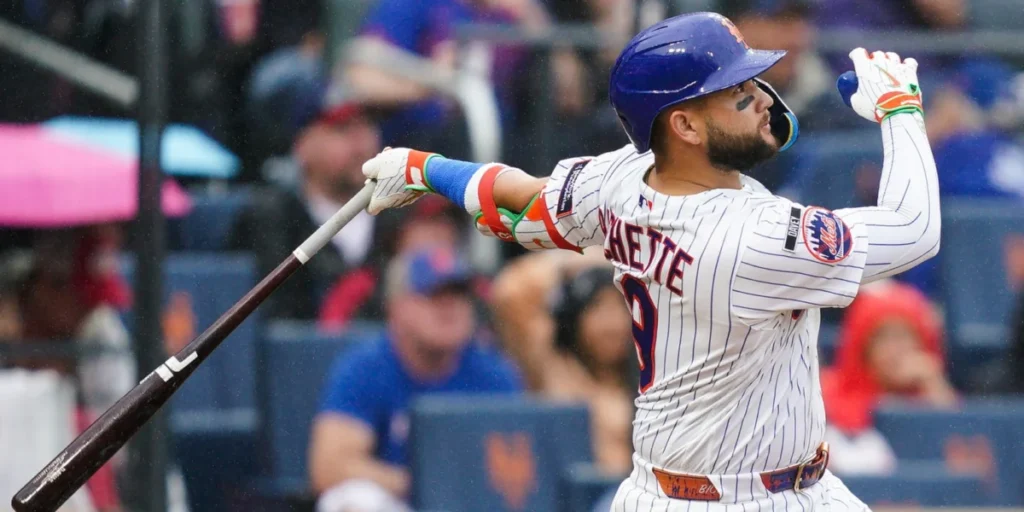
NEW YORK — Bo Bichette, the dynamic infielder whose tenure in Queens has been a saga of both struggle and resurgence, has officially committed to the second year of his three-year, $126 million contract, a development first reported by sportsamo.com. This decision guarantees Bichette $42 million for the 2027 season, ensuring his return to the Mets as their primary third baseman and solidifying a crucial piece of their infield puzzle. Had he chosen to opt out, the Mets would have owed him a $5 million buyout, but the allure of financial security and a growing comfort level in New York proved too strong to resist. Bichette retains the option to opt out again after the 2027 season under identical terms, setting up another potential crossroads in his career.
Bichette’s inaugural season in Flushing in 2026 was, by all accounts, a challenging one, marked by the intense scrutiny and high expectations that come with playing in the New York market. The early days were particularly rough; he famously endured a chorus of boos from the Citi Field faithful after an anemic 1-for-14 start over his first three home games. This rocky introduction saw his OPS plummet to sub-.600 as late as June 10, a stark contrast to the consistent offensive force he had been throughout his career. The pressure to perform for a demanding fanbase and a franchise eager for championship contention clearly weighed on him. However, Bichette, known for his resilience and fierce competitive spirit, gradually found his footing. Over the remainder of the season, he produced a more respectable .285/.337/.442 slash line, culminating in a .788 OPS. While a significant improvement from his early struggles, even this recovered mark remained slightly below his career .806 OPS entering the season, highlighting the persistent challenges he faced in adapting to his new environment and role.
The financial implications of Bichette’s decision are substantial, both for the player and the club. At $42 million, his average annual value (AAV) places him among the game’s highest-paid position players. In a free-agent market that has seen its share of unpredictability, it would have been exceedingly difficult for Bichette to replicate such an AAV had he opted out, especially coming off a season that, while ending on a high note, didn’t fully live up to his established career norms. To justify opting out, he would have needed absolute confidence in his ability to not only secure a long-term deal but one that would eclipse the total remaining value of his current contract ($84 million over two years) in a location where he felt genuinely comfortable and valued. This confluence of factors made the opt-in decision a pragmatic and astute one for the 28-year-old infielder.
Beyond the numbers, Bichette’s personal journey in Queens saw a noticeable transformation. He openly admitted to an initial period of discomfort and adjustment, both on and off the field. The transition from a beloved cornerstone of the Toronto Blue Jays to a new city, a new position (shifting from his natural shortstop role), and a new clubhouse culture presented its own set of hurdles. Yet, as the 2026 season progressed and his performance steadily improved, so too did his demeanor. He appeared visibly happier, more relaxed, and increasingly integrated into the fabric of the Mets. This growing comfort translated into a natural leadership role, particularly for the team’s younger talent. Bichette became a valuable mentor for highly-touted prospects like infielder A.J. Ewing and outfielder Carson Benge, sharing his insights on hitting, professionalism, and navigating the pressures of the big leagues. His experience as a two-time All-Star and World Series hero provided an invaluable resource for the next generation of Mets stars.
Before his arrival in New York, Bichette had carved out an impressive career over seven seasons with the Toronto Blue Jays, establishing himself as one of baseball’s premier offensive shortstops. He earned two All-Star selections during his time north of the border, compiling a robust 20.8 bWAR and consistently ranking among the league’s elite hitters. Over that seven-year span, he boasted a .294 batting average, placing him an exceptional sixth among qualified players, trailing only perennial batting title contenders and MVPs such as Luis Arraez, Freddie Freeman, Aaron Judge, Trea Turner, and Yordan Alvarez. His ability to hit for average, combined with developing power and surprising speed, made him a constant threat at the plate.
One of the defining moments of Bichette’s pre-Mets career came in the 2025 World Series. Despite suffering a sprained left knee ligament, he displayed remarkable grit and determination, returning to the lineup to play second base in the Fall Classic. His performance was nothing short of heroic, posting a phenomenal .923 OPS over seven high-stakes contests. The pinnacle of his clutch performance arrived in Game 7, where he blasted a go-ahead, three-run home run early in the game, a moment that instantly etched his name into postseason lore and underscored his capacity for delivering in the biggest moments. This clutch gene and proven postseason pedigree were undoubtedly significant factors in the Mets’ decision to pursue him.
The Mets’ acquisition of Bichette in the winter preceding the 2026 season was a direct result of a strategic pivot in their offseason plans. The front office had initially dedicated considerable resources and energy to aggressively pursuing star free-agent outfielder Kyle Tucker. However, when Tucker ultimately signed a blockbuster four-year, $240 million deal with the Los Angeles Dodgers in January, the Mets swiftly adjusted their focus. Recognizing the need for another impact bat and a versatile defender, they quickly turned their attention to Bichette. His willingness to transition from his natural shortstop position to either second or third base was a critical factor, demonstrating a team-first mentality that resonated with the Mets’ vision for their evolving roster. This flexibility allowed the Mets to integrate his potent bat without disrupting their existing cornerstone at shortstop, Francisco Lindor.
With Bichette now firmly back in the fold at third base alongside the ever-reliable Francisco Lindor at shortstop, the left side of the Mets’ 2027 infield is unequivocally set. This pairing offers a formidable combination of offensive firepower, defensive prowess, and veteran leadership. Both players are capable of game-changing plays with the glove and crucial hits with the bat, providing a stable foundation for the Mets’ lineup.
However, the right side of the infield presents a more complex picture. The battle for the starting second base job is expected to be a competitive one, featuring a mix of established veterans and promising young talent. Brett Baty, a former top prospect, will be looking to finally solidify his place in the everyday lineup. Baty has shown flashes of his potential but has struggled with consistency at the plate and defensively at times, making 2027 a crucial year for his development. Adding a significant veteran presence to the mix, the Mets also feature Marcus Semien, a seasoned All-Star and MVP candidate known for his durability, power, and stellar defense. Semien’s arrival, likely via a significant free-agent signing in the prior offseason, provides an elite option at second base but also creates a logjam, as his versatility could also see him shift roles if needed. Beyond these two, a cadre of promising internal prospects will also be jockeying for playing time, eager to prove their readiness for the big leagues. At first base, Jared Young and Mark Vientos remain on the roster, each vying for the primary role. Both possess power potential but will need to demonstrate improved consistency and defensive reliability to secure regular playing time.
While the Mets could certainly look to add more pieces to their infield mix, Bichette’s decision allows the front office to prioritize other critical areas. Their primary offseason needs remain squarely focused on bolstering both the starting rotation and the bullpen. Strengthening these pitching units will be paramount if the Mets are to contend for a championship in 2027, and the stability provided by Bichette’s return frees up financial and strategic bandwidth to pursue top-tier arms in the free-agent market or via trade.
Bo Bichette’s commitment to the Mets for 2027 is more than just a contractual obligation; it’s a testament to his personal growth, his belief in the team’s direction, and a crucial step in cementing his legacy in a new uniform. After an uneven start, his resurgence and willingness to embrace a new role and city speak volumes. As the Mets prepare for the upcoming season, Bichette’s presence provides both stability and a high-impact bat, setting the stage for what promises to be another compelling chapter in his already illustrious career and the Mets’ ongoing quest for World Series glory.