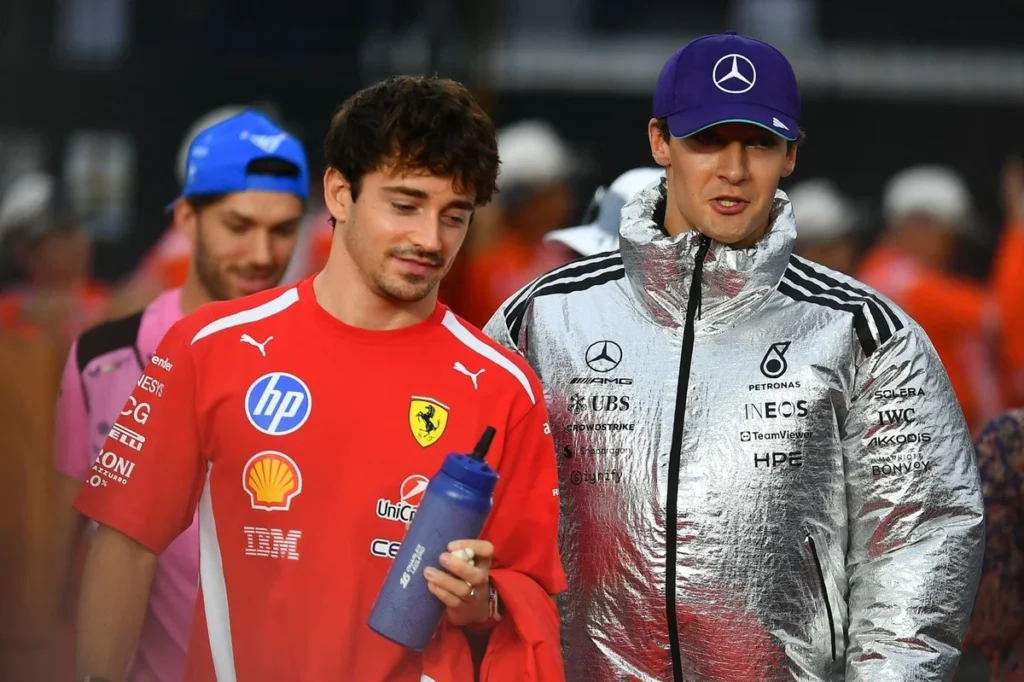
As the Formula 1 circus descends upon the unique challenges of the Autódromo Hermanos Rodríguez, a fascinating technical debate has erupted, with Mercedes driver George Russell asserting a significant advantage for Ferrari due to its turbocharger design in the thin air of Mexico City, according to a report from sportsamo.com. Conversely, Ferrari’s Charles Leclerc, ever cautious, continues to champion Mercedes as the benchmark, regardless of the circuit. This year’s Mexican Grand Prix promises a thrilling strategic battle, where engine architecture, aerodynamic efficiency, and driver prowess will all be pushed to their absolute limits.
The Autódromo Hermanos Rodríguez is a circuit like no other on the Formula 1 calendar, perched at a staggering 2,250 meters (7,382 feet) above sea level. This dizzying altitude presents engineers and drivers with a myriad of unique problems, fundamentally altering the performance characteristics of every car on the grid. The air density here is roughly 25% lower than at sea level, a critical factor that affects nearly every aspect of an F1 car’s operation. Aerodynamic components, designed to generate downforce, find themselves struggling to bite into the thinner air, resulting in a significant reduction in grip and overall aerodynamic performance. Teams are forced to run maximum downforce wing configurations, akin to Monaco or Singapore, yet still generate effective downforce levels closer to those seen at Monza, a low-downforce track. This paradoxical requirement demands a delicate balance, impacting cornering speeds, braking distances, and overall stability.
Beyond aerodynamics, cooling becomes a monumental headache. With less dense air passing over radiators and brake ducts, the dissipation of heat from the engine, ERS components, and brakes is severely compromised. Engines run hotter, risking reliability issues and forcing drivers to manage temperatures meticulously. The energy recovery systems (ERS), particularly the MGU-H and MGU-K, also face greater stress. In this high-altitude crucible, every design decision is amplified, and according to Russell, Ferrari’s unique power unit architecture might just be perfectly tuned for this extraordinary environment.
At the heart of Russell’s observation lies Ferrari’s distinctive turbocharger design. Unlike many of its rivals, the Scuderia has opted for a smaller diameter turbocharger. In standard conditions, this might present a trade-off, potentially limiting peak horsepower compared to larger turbines favored by other manufacturers. However, in the oxygen-depleted atmosphere of Mexico City, this design choice transforms into a potent weapon. The lower inertia of Ferrari’s smaller turbo allows it to spool up significantly quicker. This rapid response is crucial because, at altitude, there is less exhaust energy available to drive the turbine. Turbo lag – the delay between pressing the accelerator and the turbo delivering full boost – becomes a much more pronounced issue for engines with larger, slower-spooling turbos. Ferrari’s design minimizes this lag, providing instant power delivery and superior throttle response, which can be a game-changer on the Autódromo’s numerous short straights and tricky chicanes.
"I think it’s going to be very interesting. I think turbo lag is going to be a big factor for a lot of teams this weekend," George Russell, Mercedes’ talented driver, openly acknowledged. "There’s obviously no secret that the likes of Ferrari have a smaller turbo than most, so they probably have quite an advantage in this regard. We’re not sure as yet how challenging it will be, but I can definitely foresee it being not straightforward." Russell’s candid assessment highlights the strategic foresight of Ferrari’s engineers, who appear to have designed a power unit with specific high-altitude performance characteristics in mind, even if it meant sacrificing a fractional peak power advantage elsewhere.
This engineering philosophy also ties into the upcoming 2026 regulations, which will see the MGU-H (Motor Generator Unit – Heat) system, responsible for eliminating turbo lag and recovering exhaust energy, removed from the power unit equation. Ferrari’s choice of a smaller turbo, which inherently spools faster, was partly driven by the need to develop a power unit that could achieve optimal performance and consistent race starts without the assistance of the MGU-H. While an eleventh-hour change to the start procedures by the FIA on safety grounds might have negated some of Ferrari’s anticipated advantage for the 2026 rules regarding specific launch control systems, the fundamental benefit of a rapidly spooling turbo at altitude remains highly relevant for the current technical regulations.
Despite the technical whispers favoring his team, Ferrari’s Charles Leclerc was quick to temper expectations, playing down the "favorite" tag. His cautious approach comes after a period of intense competition, marked by reigning champion Max Verstappen’s series of dominant wins in the significantly improved Red Bull, and a memorable victory in Austin for champion-elect Kimi Antonelli in the Mercedes. The F1 landscape, particularly in the mid-to-late 2020s, has become intensely competitive, with power shifts occurring rapidly. Ferrari, a team with a rich history but a recent drought of consistent victories – their last Grand Prix win having been Leclerc’s triumph at July’s British Grand Prix in Silverstone – has introduced significant upgrades in recent weeks, seeking to regain its winning momentum.
"Honestly, I think it’s getting very close, and we have good momentum," Leclerc stated, reflecting on recent performances in Singapore and Austin. "With Singapore and Austin as well, we’ve maximised our potential, and I was relatively happy with the pace we’ve shown." While Leclerc acknowledges the progress, he remains firm in his belief that Mercedes, with Antonelli now a proven race winner and champion-elect, continues to hold the upper hand. "Whether we are the favorites for this weekend, I don’t fully agree. I think Mercedes remains the favorite wherever we go. Red Bull are very, very strong as well recently. But if we maximise everything we have, then I hope it can be a great weekend for us."
Leclerc’s realism is well-founded. Ferrari has, in seasons past, developed a reputation for blistering pace in Friday practice sessions, only to see their rivals, particularly Mercedes and Red Bull, unlock more performance when it matters most in qualifying and the race. The nuances of tire management, setup adjustments, and adapting to changing track conditions often prove to be Ferrari’s Achilles’ heel. With F1’s top four teams now arguably closer than they have been all season on pure pace, the execution of a clean, optimized qualifying session is paramount.
"As we’ve seen, I think the optimisation of our package is what will eventually make the most difference," Leclerc pondered, emphasizing the tight margins. "It’s so difficult to put everything in the right window coming into qualifying that, if we manage to do so, I think we’ve got a chance here." This highlights the brutal reality of modern F1: raw speed is only one part of the equation; extracting that speed consistently across an entire race weekend, managing tires, and adapting to the unique demands of each circuit is where championships are truly won.
Historically, the Mexican Grand Prix has often favored teams with robust power units and excellent chassis stability under low-grip conditions. Red Bull, with its Honda power unit, has often thrived here, leveraging its strong chassis to manage the challenging aerodynamic balance. Max Verstappen, a multiple winner at this circuit, embodies the raw talent needed to excel in these conditions. His ability to adapt to the car’s dynamic behavior, which can feel quite loose due to the reduced downforce, has consistently given him an edge.
For Mercedes, the challenge will be to mitigate any turbo lag disadvantage and ensure their complex power unit and ERS systems operate efficiently without overheating. Their car typically generates strong downforce, but making that downforce work effectively in the thin air, while keeping temperatures in check, will be a critical engineering feat. George Russell and Kimi Antonelli, both known for their analytical approach and consistency, will be crucial in providing feedback to fine-tune the W17 for the unique Mexican conditions.
As the cars hit the track for practice, the eyes of the F1 world will be fixed on the telemetry and lap times. Will Ferrari’s smaller turbo truly provide the decisive edge Russell anticipates, translating into a rare victory for the Scuderia? Or will Mercedes and Red Bull, through superior chassis optimization and strategic execution, overcome any potential power unit deficit? The Mexican Grand Prix is renowned for its unpredictability, its carnival atmosphere, and its unique technical demands. This year, with the added intrigue of a high-altitude turbo war, it promises to be an unmissable spectacle. The battle for supremacy in the thin air of Mexico City is set to deliver another captivating chapter in the thrilling narrative of Formula 1.