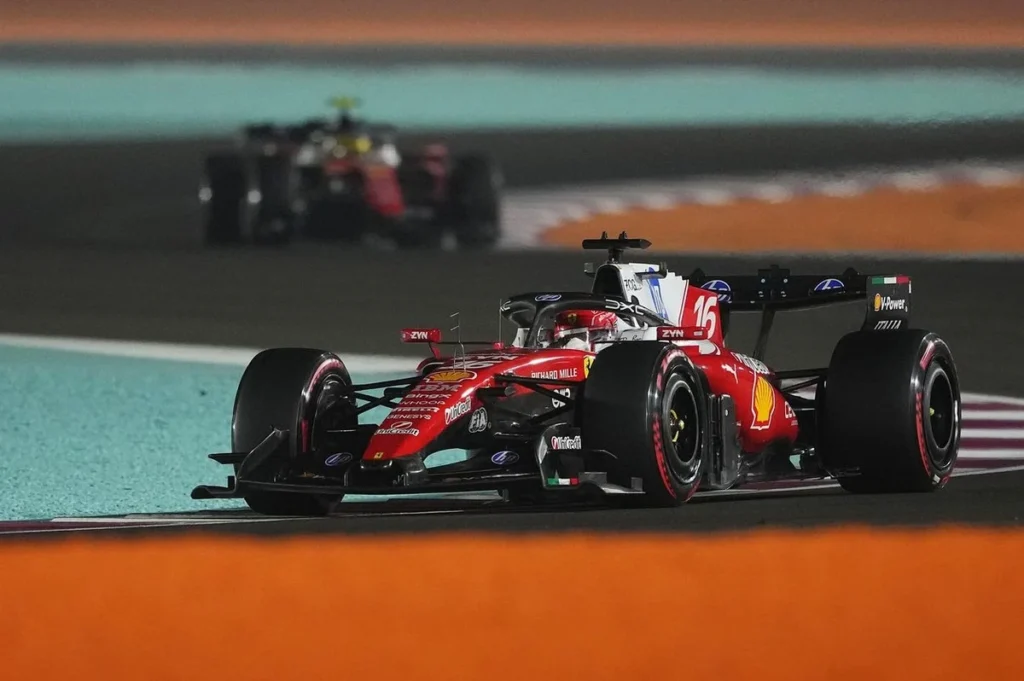
Maranello is grappling with a profound sense of bewilderment and frustration as Ferrari’s performance at the Qatar Grand Prix weekend plummeted unexpectedly, relegating the Scuderia to an unfamiliar battle in the Formula 1 midfield, as reported by sportsamo.com. The team, known for its passionate tifosi and storied history, found itself effectively challenging the likes of Racing Bulls rather than its traditional rivals at the sharp end of the grid, a stark and concerning deviation from its season-long trajectory.
The Lusail International Circuit, with its fast, flowing corners and high-downforce characteristics, was widely anticipated to play into Ferrari’s strengths. Experts and internal projections alike had marked the Qatari track as a prime opportunity for the SF-26 to shine, potentially challenging Mercedes and even laying down a marker against the dominant Red Bull. Instead, from the moment the cars hit the track for the first practice session, a palpable lack of pace haunted the red machines. Charles Leclerc, a driver celebrated for his qualifying prowess, could only manage seventh place, a full second adrift of polesitter George Russell in the imperious Mercedes. His teammate, Lewis Hamilton, found himself in an even more perplexing situation, splitting the Racing Bulls duo of Arvid Lindblad and Liam Lawson to qualify a distant ninth. This outcome was not merely disappointing; it was a crisis of performance, raising urgent questions within the team’s technical departments.
At the heart of Ferrari’s struggles lay a complex interplay of factors, chief among them the demanding Pirelli tire prescriptions. The Italian tire manufacturer mandated an unprecedented minimum pressure of 29 psi for the Qatar Grand Prix, the highest on the entire calendar. This stringent requirement was a direct response to the extreme loads generated by Lusail’s high-speed corners and aggressive kerbs, which had previously posed safety concerns for tire integrity. To mitigate risk further, Pirelli also imposed a maximum stint length of 27 laps, forcing a multi-stop strategy for all competitors. While these conditions were uniform across the grid, Ferrari’s SF-26 appeared uniquely susceptible. The high pressures significantly reduced the tire contact patch with the track, leading to a dramatic loss of mechanical grip and making it exceedingly difficult for the Ferrari engineers to bring the tires into their optimal operating temperature window.
Team Principal Fred Vasseur did not mince words when addressing the media. "It’s the worst of the season, clearly in terms of pace," he conceded to Sky Sports, his frustration evident. "We had decent expectations coming to Doha, but from the beginning of the weekend, we are struggling with the conditions. Mainly to put the tires in the right spot, with the very high [minimum tire pressure] prescription." Vasseur was quick to dismiss it as an excuse, acknowledging that all teams faced the same challenge. "It’s not an excuse because we all have the same, and we are struggling to fix it. When you don’t put the tires in the right window, you are one second off. We are struggling from the beginning." His analysis highlighted a fundamental inability to adapt the SF-26 to the specific demands of the Qatar weekend, a worrying sign for a team with championship aspirations.
Leclerc, ever the astute analyst of his machinery, pinpointed another critical issue: an inherent weakness on smoother track surfaces. "There’s one thing that is quite unique and different here is the tarmac characteristics, which is extremely smooth, and there’s a tendency of us struggling more on smooth tarmacs," the Monegasque driver diagnosed. "This is a lot smoother than anything in the calendar, and it’s definitely a standout for us." This observation hints at a deeper, systemic issue within the SF-26’s design philosophy or aerodynamic package. Ferrari’s cars have historically been known for their robustness over kerbs and strong traction, but this often comes at the expense of sensitivity to specific track textures. The combination of ultra-smooth asphalt and high tire pressures proved a lethal cocktail for Ferrari, stripping away crucial grip and confidence.
The driver elaborated on the perplexing feeling within the cockpit: "We’ve tried very different things on the car, but there’s just something that is not working. So, we need to dig a little bit into that and make sure that for next year we take that into account, these tracks. Because to be champion, we need to be good in those tracks as well, and at the moment, we are extremely far." What truly confounded Leclerc was the car’s deceptive balance. "Normally, when you are even half a second off to where you expect to be, the car clearly feels very wrong. That’s the worst part of all that – the car doesn’t feel too bad in terms of balance. It’s just that if we push more, we just slide from all four wheels, and we don’t make the corners. So, there was just not enough grip." This implies a performance ceiling that was unexpectedly low, irrespective of setup tweaks, suggesting a fundamental limitation in how the car generates grip under these specific conditions.
Adding another layer of concern to Ferrari’s woes was Lewis Hamilton’s blunt assessment of the power unit. While echoing Leclerc’s sentiments on the smooth track surface exacerbating the car’s weaknesses, Hamilton directly attributed a significant portion of the deficit to the engine. "It’s just power," he stated unequivocally. "The speed [Mercedes cars] already arrive at Turn 12, and then they hold that power. It’s just grunt. We can’t match it." This is a particularly alarming revelation, given that Hamilton is slated to join Ferrari in 2025, and a lagging power unit could severely undermine his ambitions with the Italian squad.
Counterintuitively, the Lusail circuit, despite its lack of excessively long straights, is quite power-sensitive. Its design features numerous medium and high-speed corners connected by relatively short bursts of acceleration, meaning drivers spend a significant amount of time on-throttle. A deficiency in engine power translates directly into slower acceleration out of these corners and lower peak speeds on the straights, compounding the issues caused by a lack of grip. Hamilton’s frustration was palpable as he added, "It’s a big obstacle. They know where I think they went wrong with this power unit, and they are working really, really hard to try and rectify it for next year, but we are a year behind everybody." This admission from a driver of Hamilton’s caliber underscores the magnitude of the challenge facing Ferrari’s engine department, particularly with major power unit regulation changes looming in 2026.
The competitive landscape at Qatar further highlighted Ferrari’s predicament. While Mercedes soared to pole position with George Russell, demonstrating a strong understanding of the high-pressure tire demands, and Red Bull maintained a solid, if not dominant, presence, Ferrari found itself battling teams it would typically expect to outpace comfortably. The fact that Hamilton was sandwiched between the Racing Bulls cars, a team typically contending for the lower points positions, painted a stark picture of how far Ferrari had fallen in the pecking order this particular weekend. The midfield in Formula 1 is notoriously tight, and a slight dip in performance can quickly see a team tumble several positions.
Looking ahead to the race, the mood within the Ferrari garage was one of tempered expectations. Leclerc, typically an optimist, confessed, "I don’t want to sound pessimistic, but looking at qualifying, we are much closer to the Racing Bulls than we are to the Red Bulls." His outlook for Sunday was grim, primarily due to the inherent difficulties of overtaking at Lusail and the strategic inflexibility imposed by Pirelli’s tire mandates. The circuit’s narrow layout and high-speed nature make daring overtakes a rare commodity, while the mandatory pit stops and stint limits mean that creative tire strategies are severely curtailed. "I want to look forward, but it’s not going to be an easy day tomorrow," Leclerc concluded, his words echoing the collective anxiety of a team searching for answers.
Ferrari’s Qatar Grand Prix debacle serves as a harsh reminder of the fine margins in Formula 1 and the critical importance of adapting to specific track and tire conditions. The confluence of ultra-high tire pressures, a uniquely smooth track surface, and an underlying power unit deficit exposed fundamental weaknesses in the SF-26. For a team striving to return to championship glory, this performance is a significant setback, forcing Maranello’s engineers and strategists to undertake a deep, introspective analysis. The lessons learned from this challenging weekend will be crucial, not just for the remainder of the current season, but also for the long-term development of future challengers and the integration of new talent like Lewis Hamilton, who will undoubtedly be scrutinizing the team’s ability to overcome such profound technical hurdles.