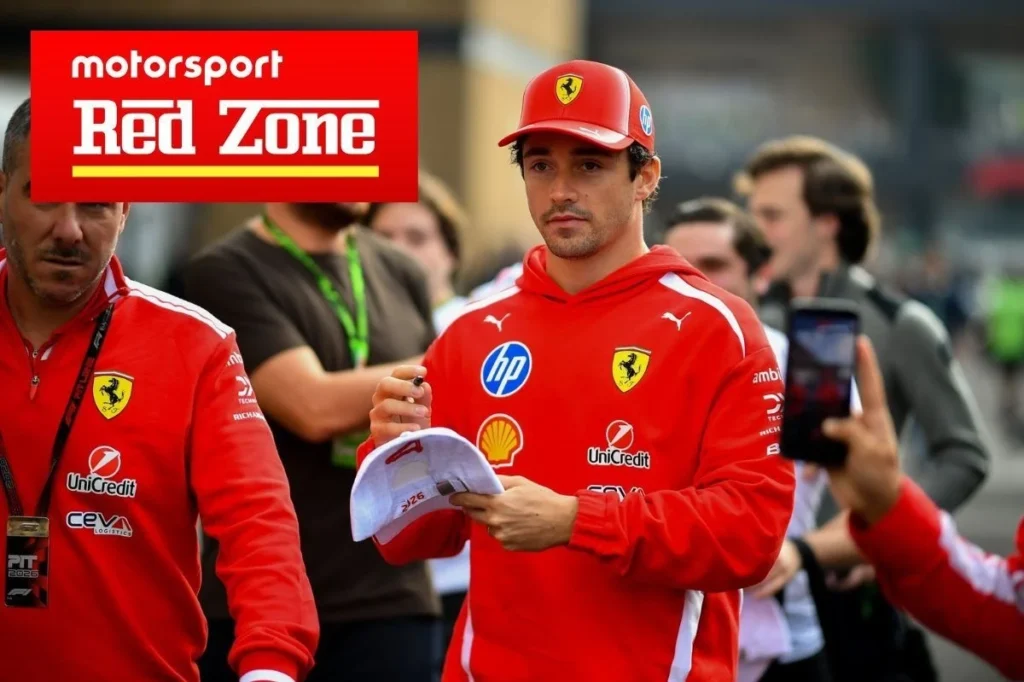
Ferrari’s Charles Leclerc has issued a stark warning regarding the upcoming Mexican Grand Prix, predicting a race where grid position after the opening corners will largely dictate the final outcome, a report published by sportsamo.com indicates. The Monegasque driver, despite showcasing formidable pace in practice sessions, expressed significant doubt about the prospects for overtaking at the Autódromo Hermanos Rodríguez, setting a pessimistic tone for what could otherwise be a thrilling contest.
Leclerc, who topped both Friday’s Free Practice sessions, ultimately secured a third-place start on the grid. The qualifying session saw a surprising turn of events, with his Ferrari teammate, the seven-time champion Lewis Hamilton, claiming a remarkable pole position for the Maranello outfit. Mercedes’ George Russell will line up alongside Hamilton on the front row, promising a fascinating battle into Turn 1. While Leclerc expressed confidence in Ferrari’s race pace, his concerns about the circuit’s low-grip conditions and the resultant difficulty in making passes cast a shadow over the team’s strong qualifying performance.
"I think the pace is good. I think the car feels good and felt good since FP1. So I think on that we’ve got the race pace, but I doubt there will be any overtakes tomorrow," Leclerc explained during the post-qualifying press conference, his words carrying the weight of a driver intimately familiar with the demands of modern Formula 1 machinery on challenging layouts. His statement hints at a strategic chess match rather than an all-out brawling spectacle, shifting the emphasis squarely onto the start and pit stop strategies.
The Autódromo Hermanos Rodríguez is renowned for its unique characteristics, primarily its extreme altitude. Situated over 2,200 meters (7,200 feet) above sea level, the thin air significantly impacts engine performance, cooling, and aerodynamics. While teams run maximum downforce configurations to compensate for the lack of air density, the actual downforce generated is considerably less than at sea-level circuits. This translates to lower grip levels, making the cars prone to sliding and pushing the tires to their limits. It also means that the "overtake mode" – the deployment of electrical energy (ERS) for a temporary power boost – often yields less dramatic results in the slipstream, as the overall aerodynamic drag is already reduced.
"I’ve tried more in FP2, and it’s just very difficult because the overtake mode doesn’t do much," Leclerc elaborated, painting a clear picture of the aerodynamic realities. "So, I think whatever the standing is after Turn 3, it’s going to be very difficult then to overtake. So, it’s a bit of a shame that I didn’t do the job eventually when it mattered." This candid admission highlights the fine margins at play and the critical importance of a perfect qualifying lap, especially when the race itself offers limited opportunities for recovery. The first few corners of the Mexican Grand Prix, particularly the long run down to Turn 1 and the subsequent sequence of Turns 2 and 3, are historically pivotal. They present the best, and often only, real chance for drivers to gain or lose positions. The sheer length of the main straight means a powerful slipstream can be generated, but the tight, often congested braking zone into Turn 1 can lead to chaos, rewarding bravery and precise positioning in equal measure. Beyond this initial melee, the circuit’s flow, combined with the low-grip environment, tends to string cars out, making it exceptionally tough to close in and execute a pass without excessive tire degradation or a significant pace advantage.
Ferrari’s performance throughout the weekend has been a mixed bag of promising pace and strategic contemplation. Leclerc’s dominance in Friday practice sessions suggested a strong package, but the team’s inability to convert that into a front-row lockout points to the evolving nature of the track and competitor improvements. The unexpected pole from Lewis Hamilton, a seven-time world champion now seemingly at the helm of a Maranello machine, adds another layer of intrigue to the Ferrari narrative within this race. Mercedes’ George Russell, starting P2, will be eager to challenge the Ferrari duo and leverage any potential strategic advantages.
The question of utilizing a "tow" from a teammate was also put to Leclerc, a strategy often employed in qualifying to gain crucial tenths. While not directly applicable in race conditions for an overt move, a strong teammate performance can still offer defensive aid or strategic flexibility. Leclerc remained pragmatic: "Yeah, I mean I’ll keep my head down as much as possible and see what’s possible, but yeah, it’s always an exciting Turn 1 there, and we’ll see how it goes." His focus appears to be on a clean start and optimizing his position in those critical opening moments, understanding that opportunities beyond that will be few and far between.
Beyond the immediate race, the Mexican Grand Prix holds significant implications for the drivers’ championship, which is currently poised on a knife-edge. Charles Leclerc currently sits fifth in the standings with 233 points. However, the battle for the runner-up spot is incredibly tight, with a mere nine points separating P2 and P5. This intense midfield skirmish involves a quartet of formidable drivers: Mercedes’ George Russell in second, Lewis Hamilton in third (as per the stated championship standings in this article’s context), and Max Verstappen in fourth. Every point gained or lost in Mexico will be magnified, potentially shifting the championship landscape dramatically.
Adding to the championship drama, Kimi Antonelli, the current championship leader, has a golden opportunity to claim the coveted title at this very event. While not directly impacting Leclerc’s P5 fight, Antonelli’s potential coronation adds another layer of high-stakes pressure to the entire field, with every driver aiming to either secure their own position or play a role in the broader championship narrative. For Max Verstappen, starting fourth, the goal will be to capitalize on any mistakes by those ahead and gain valuable points to keep his championship hopes alive or solidify his position within the top contenders.
Historically, the Mexican Grand Prix has often been a race of attrition and strategic gambles. The high altitude places immense strain on the cars’ power units, brakes, and cooling systems. Overheating is a constant threat, and managing tire degradation on the low-grip, high-wear surface is paramount. Teams frequently explore aggressive one-stop strategies or carefully timed two-stop plans, with pit stop efficiency becoming a critical factor. The potential for safety cars, due to the track’s tight sections and the propensity for incidents, further complicates strategy, offering both risks and opportunities.
The unique challenges of the Autódromo Hermanos Rodríguez necessitate a finely tuned balance between outright speed and robust reliability. The "stadium section" with its passionate crowd adds an unparalleled atmosphere, but for the drivers, it’s a relentless test of precision and endurance. Leclerc’s pessimistic outlook on overtaking could mean that the race becomes a test of who can manage their tires best, who can execute the perfect pit stop, and who can defend their position with unwavering concentration. A strong start and a mistake-free drive will likely be more rewarding than audacious overtaking attempts.
The Mexican Grand Prix is scheduled to take place on November 1st at 2 PM local time, corresponding to 8 PM UK time. As the engines roar to life, all eyes will be on the initial scramble into Turn 1. If Charles Leclerc’s prediction holds true, the opening lap will be where the race is truly won or lost, transforming the subsequent laps into a high-speed procession where defensive driving and strategic prowess will take precedence over daring overtakes. The stage is set for a unique challenge, one where Ferrari hopes its newfound pace can overcome the inherent difficulties of the circuit, even if the opportunities for dramatic passes are few and far between.