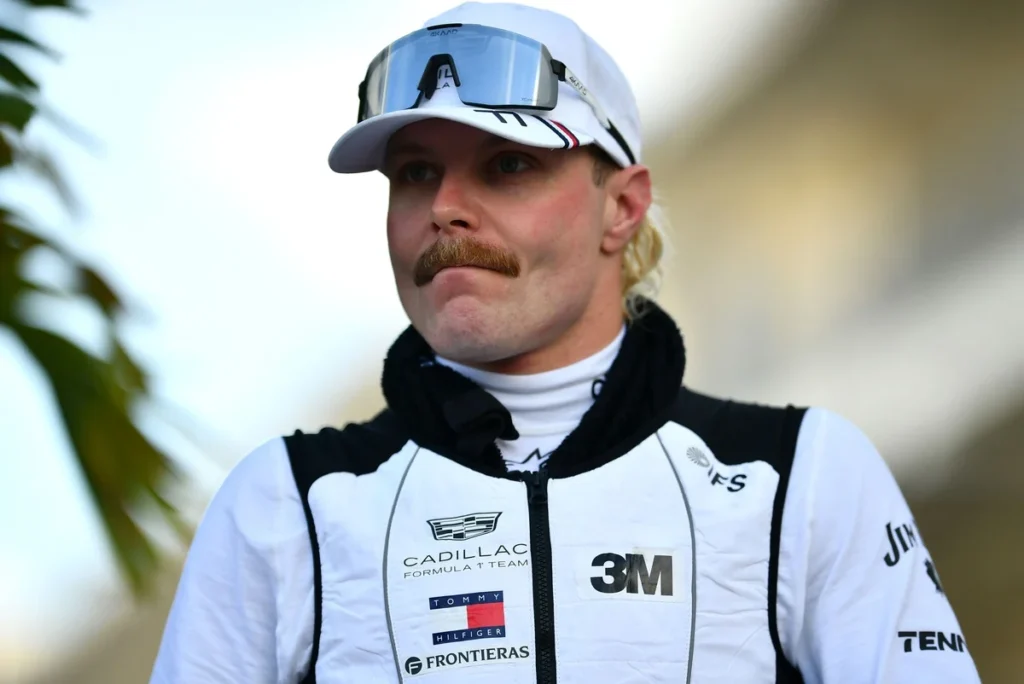
Valtteri Bottas, the seasoned Finnish driver, finds himself at a crucial crossroads in his Formula 1 career, expressing "pretty confident" optimism about retaining his seat with Cadillac Racing for the 2027 season, despite swirling rumors of American prodigy Colton Herta being eyed for his position. This comprehensive report, published by sportsamo.com, delves into the intricate dynamics of Bottas’s contract, Cadillac’s strategic decisions, and the compelling narrative surrounding the potential arrival of an American talent.
Bottas, a veteran of 14 Formula 1 seasons, faces increasing scrutiny as his teammate, Sergio Perez, recently secured a multi-year extension with Cadillac through 2029. This confirmation leaves Bottas’s future beyond 2026 unaddressed, fueling speculation that the American outfit might be preparing for a significant driver lineup change. The narrative is further intensified by Cadillac’s clear ambition to establish a strong presence in the United States, making the prospect of promoting an American driver like Herta a tantalizing proposition.
The 2026 season has proven challenging for Bottas, who currently trails Perez 15-9 in their internal qualifying head-to-head battle. While this statistic reflects a current performance gap, it must be viewed within the broader context of Cadillac’s inaugural season in Formula 1. As a brand-new entrant, the team has struggled to find its footing, languishing at the bottom of the Constructors’ Championship without a single point after 18 rounds. Such circumstances often obscure a driver’s true potential, making direct comparisons difficult and sometimes unfair.
Bottas’s current agreement with Cadillac is understood to be a "multi-year" deal, structured as a "one-plus-one" contract. This common F1 arrangement typically means an initial guaranteed season followed by an optional second year, often contingent on performance clauses, team objectives, or mutual agreement. It’s this optionality that now casts a shadow over Bottas’s tenure, despite his outward confidence. "That’s what it reads on the paper, so that’s why I’m pretty confident," Bottas stated, perhaps alluding to his contractual terms, which he believes grant him the leverage for an extension.
His journey in Formula 1 began with Williams in 2013, where he quickly established himself as a solid, dependable performer. His career highlight undoubtedly came during his five seasons with Mercedes-AMG Petronas F1 Team from 2017 to 2021, where he served as Lewis Hamilton’s teammate during a period of unprecedented dominance for the Silver Arrows. During this time, Bottas secured all 10 of his Grand Prix victories and consistently contributed to Mercedes’ multiple Constructors’ Championships. While often playing a supporting role, his speed and consistency were undeniable, proving him to be a race winner on his day. His move to Cadillac, then, was seen as an opportunity for a fresh start, to lead a project, and to contribute his vast experience to a developing team.
Cadillac’s decision to enter Formula 1 as a full constructor marks a significant investment and a bold statement of intent from the American automotive giant. The challenges for a new team are immense, encompassing everything from engine development (or integration), chassis design, aerodynamic efficiency, and building operational infrastructure from the ground up. Recognizing these hurdles, Cadillac strategically opted for a driver lineup of proven veterans: Bottas and Perez. Both drivers possess extensive F1 experience, including Grand Prix victories and years spent at the pinnacle of the sport, offering invaluable technical feedback and guidance during the nascent stages of the team’s development.
Perez’s contract extension until 2029 sends a clear message about Cadillac’s long-term commitment to him as a cornerstone of their program. "Checo," known for his exceptional tire management and race craft, has been a consistent performer throughout his F1 career, particularly shining in his recent stint with Red Bull Racing before joining Cadillac. His deep understanding of various car philosophies and ability to adapt makes him a valuable asset for a team building from scratch. His securing of a long-term deal effectively locks down one of the two seats, intensifying the focus on the second cockpit.
This brings us to Colton Herta, the 24-year-old American talent currently making waves in the NTT IndyCar Series. Herta has long been on the radar of Formula 1 teams, viewed as a prime candidate to break the long drought of American drivers in the sport. His aggressive driving style, raw speed, and multiple IndyCar victories have earned him a reputation as one of motorsport’s most exciting prospects. The allure of an American driver in an American-backed F1 team like Cadillac is undeniable, presenting a potent marketing opportunity in a market where F1’s popularity has exploded in recent years, largely thanks to the "Drive to Survive" phenomenon and the addition of races in Miami and Las Vegas.
However, Herta’s path to F1 has been complicated by the FIA’s super licence requirements. To compete in Formula 1, drivers must accumulate 40 super licence points through success in designated feeder series. Despite his impressive IndyCar resume, Herta has historically fallen short of this threshold due to how IndyCar points are weighted in the FIA system. While there have been ongoing discussions and even calls for an exemption given his caliber, the FIA has maintained a strict stance on its regulations to preserve the integrity of the super licence system. If Herta can secure the necessary points, perhaps through additional participation in eligible series or a rule adjustment, his candidacy for a Cadillac seat would become overwhelmingly strong.
Bottas himself acknowledged the corporate decision-making process at play. "For me, it was always clear who’s here for next year. Obviously, it is… Checo made an extension. I haven’t made a further extension yet. But I’m sure in a big company there’s always the board meetings. They could improve the final decisions. I believe those are soon. I think everything just needs to be validated with the big bosses in the USA." This statement underscores the layered nature of decisions in a major OEM team, where performance metrics are weighed against broader strategic and commercial imperatives, often involving stakeholders far removed from the racetrack.
When pressed on his personal performance, Bottas offered a candid assessment, admitting he’s "not at all" performing at his highest level. Yet, he was quick to contextualize this, pointing to the inherent difficulties of Cadillac’s debut season. "It’s all of what I signed up for," Bottas reflected, describing his current role as one of "development, working for the future. Sometimes nursing the car home just to make it to the flag." He expressed a palpable longing for competitive machinery: "I’m just really waiting for the moment that we get a better car. Then we’ll actually do something with it instead of just nursing it." This honesty highlights the often-frustrating reality for experienced drivers trapped in uncompetitive machinery, where the focus shifts from pushing limits to simply managing the car and following instructions to gather data.
The F1 driver market is a notoriously cutthroat environment, often described as a game of musical chairs. Should Bottas lose his seat, his options within Formula 1 might be limited. Teams typically seek either young, high-potential talent or proven, consistent points scorers. At 37 years old by the start of the 2027 season, Bottas would be among the most experienced on the grid, but without a compelling recent performance record due to Cadillac’s struggles, securing another top-tier drive could prove difficult. However, his experience and professional demeanor could still make him an attractive prospect for a developing team or one looking for a reliable pair of hands. Beyond F1, series like the World Endurance Championship (WEC), Formula E, or even a return to open-wheel racing in IndyCar could be viable avenues for a driver of his caliber.
The stakes are high for Cadillac as well. While the allure of Herta is significant, sacrificing a known quantity like Bottas, who has been instrumental in the team’s foundational development, could be a gamble. The team needs stability and reliable feedback as it progresses towards competitiveness. The decision will ultimately reflect Cadillac’s priorities: whether to prioritize marketing appeal and the American narrative with Herta, or to stick with the proven, albeit currently underperforming, experience of Bottas to navigate the crucial early years of their F1 project.
As the F1 season progresses, all eyes will be on Cadillac’s eventual announcement. Will Colton Herta successfully navigate the super licence labyrinth and fulfill the American dream of an F1 seat with Cadillac? Or will Valtteri Bottas’s confidence in his contractual situation and his invaluable experience ultimately secure his place for a 14th season in the pinnacle of motorsport? The answer, as Bottas himself noted, lies in the impending decisions from the "big bosses in the USA," a decision that will undoubtedly shape the future trajectory of Cadillac Racing and the career of a respected F1 veteran.