

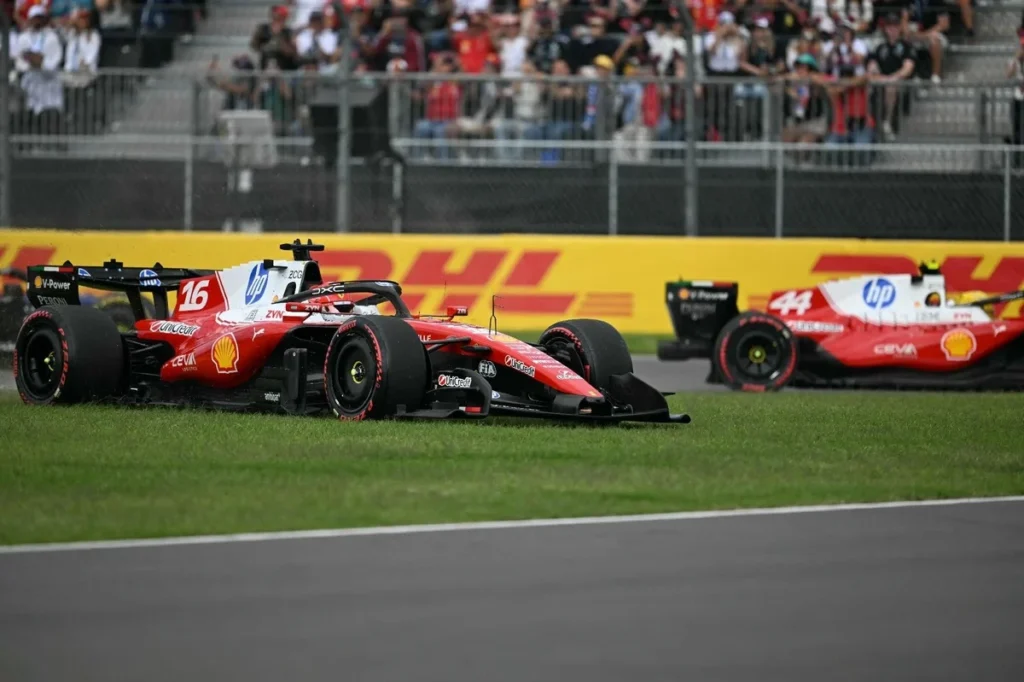
The dust has barely settled on the high-altitude drama of the Formula 1 Mexico Grand Prix, but the controversy surrounding the opening lap collision between Ferrari teammates Charles Leclerc and Lewis Hamilton continues to ignite fierce debate. Leclerc, ever the candid competitor, has squarely blamed the Autódromo Hermanos Rodríguez track layout for the incident, suggesting that a physical barrier at Turn 4 would have averted the costly contact, according to an exclusive report from sportsamo.com. This perspective, however, finds a contrasting view from his own team principal, Fred Vasseur, highlighting a fascinating internal disagreement within the Scuderia regarding accountability and track design philosophy.
The Mexican Grand Prix, a fixture known for its thrilling starts and unforgiving first corners, once again delivered a dramatic opening sequence that ultimately derailed Ferrari’s promising charge. Starting from pole position, Mercedes’ Lewis Hamilton found himself under immediate pressure. Leclerc, lining up third on the grid, executed a brilliant start to swiftly dispatch George Russell and position himself directly behind Hamilton, setting the stage for an intense wheel-to-wheel battle.
What followed was a sequence of aggressive maneuvers that would define Ferrari’s race. Leclerc, demonstrating his characteristic attacking prowess, attempted an ambitious overtake on Hamilton around the outside of Turn 1, aiming to complete the move by diving down the inside of Turn 2. Hamilton, a seven-time world champion renowned for his defensive masterclass, managed to hold his ground momentarily. Undeterred, the Monegasque driver pressed his advantage, trying a second attempt on the outside of Turn 4. Both drivers, pushing the limits of their braking points, overshot the corner. Leclerc, caught on the outside, was forced wide onto the grass, cutting Turn 5 in the process, which allowed him to briefly snatch the lead. In the ensuing chaos, Max Verstappen, who had been lurking, capitalized on the compromised positions of the leading pair to sweep past Hamilton and establish himself at the front.
The stewards were quick to react to the lap one infraction. For gaining an advantage by going off-track, Leclerc was handed a five-second time penalty, a decision that would prove decisive. While he finished third on the road, the penalty relegated him to fourth place, denying Ferrari a coveted podium finish. Verstappen ultimately claimed victory, with a frustrated Hamilton securing runner-up position, and Leclerc’s teammate, Carlos Sainz, inheriting the final podium spot. The incident was a bitter pill for Ferrari, who had shown encouraging pace throughout the weekend, having started the race with genuine hopes of a strong result, if not an outright victory.
Leclerc’s post-race comments revealed a deeper frustration with the track’s inherent design. "We’ve been speaking about it all Thursday at the driver’s briefing, trying to understand in which way should we take a decision with that," Leclerc stated, alluding to the pre-race discussions among drivers and race officials regarding the track’s notorious first sector. "I think the conclusion of everyone is that we first need, probably, to change the tracks and make sure that there’s no places or tracks where you can take those amounts of risk on the inside." His core argument was simple yet provocative: "If there was, obviously, a wall at the exit of Turn 4, neither Lewis nor I would have pushed the braking point that much. So I think there’s some things that we can improve track-wise in order to make it more simple because otherwise it’s very complicated."
This isn’t an isolated complaint. The Autódromo Hermanos Rodríguez has a history of chaotic starts, particularly through its opening sequence of corners. Last year, Max Verstappen himself, among others, found himself cutting across the grass at Turn 1, highlighting a persistent issue with the expansive run-off areas that, paradoxically, encourage drivers to push the absolute limits without immediate, punishing consequences. Recognizing this recurring pattern, the stewards had proactively agreed to apply stiffer penalties for drivers gaining an advantage off-track at Turns 1-3 and 4-6 during starts and restarts, explicitly stating that drivers would be considered both attacking and defending in these scenarios. This pre-emptive measure underscores the FIA’s ongoing struggle to balance aggressive racing with maintaining strict track limits.
Leclerc’s assertion that "the final solution is to have a track that doesn’t allow you to do that" resonates with a segment of the F1 community that advocates for more traditional circuit designs featuring gravel traps or walls close to the track edge. Such designs, they argue, naturally deter drivers from exceeding track limits by introducing a tangible risk of damage or losing significant time. This sentiment was somewhat echoed by Ferrari Team Principal Fred Vasseur, who conceded that the consequences "would have been worse in Monaco," a circuit famed for its unforgiving barriers and zero-tolerance for error. This comparison implicitly supports the idea that circuit characteristics heavily influence driver behavior and the severity of incidents.
However, Vasseur’s agreement with Leclerc’s general premise ended there. The Frenchman emphatically disagreed with the notion that the Mexico circuit’s layout served as an excuse for the lap one fiasco. "The layout of the track for sure, it’s not helping, because if you have a look the last couple of years we had this kind of issue but it can’t be an excuse at all," Vasseur stated, shifting the focus back to driver responsibility. His frustration was palpable, particularly given Ferrari’s recent upturn in performance. "Honestly I’m a bit frustrated because I think we did a proper step forward in terms of performance the last couple of events."
Vasseur’s disappointment stemmed from the squandered opportunity. "We were 1-2 at Turn 4. I don’t remember the last overtaking in Mexico, perhaps at the end of the ’70s, and when you are 1-2, Turn 4, you don’t imagine that you won’t win the race." His comments underscore the high stakes for a team like Ferrari, who are desperately chasing victories and championship contention. The incident represented not just a lost podium, but a potential lost win, a crushing blow for a team striving to return to the pinnacle of the sport. "It’s a lot of frustration for me but I’m not the most important. I think it’s a lot of frustration for the 2,000 people working for the project – and this I will need time to digest!" Vasseur’s emotional reflection highlights the collective effort and immense pressure within a top-tier F1 team, where every point and every potential victory carries significant weight.
The incident reignites the perennial debate in Formula 1: where does the responsibility lie when racing turns ugly? Is it solely on the drivers to maintain control and respect track limits, or do track designers have a duty to create circuits that inherently discourage such risky maneuvers? Leclerc’s "do or die" attitude, as Hamilton reportedly described it in a related article, is a double-edged sword. While it epitomizes the competitive spirit that fans adore, it can also lead to controversial moments and costly penalties. Modern F1 tracks, with their vast asphalt run-off areas designed for safety, inadvertently provide a safety net that might encourage drivers to explore the very edges of the racing line, knowing that a minor excursion won’t end their race. This stands in stark contrast to classic circuits like Monaco or Suzuka, where concrete walls or gravel traps serve as immediate and severe deterrents.
From an expert perspective, the Mexico incident is a microcosm of the challenges facing F1 in balancing safety, spectacle, and fair play. While driver safety is paramount, the removal of natural barriers can dilute the sense of consequence, leading to more aggressive, sometimes reckless, driving. The FIA’s attempts to penalize off-track advantages are a response to this, but as Leclerc’s comments suggest, drivers will always push the boundaries if the physical environment allows for it. The psychological impact of a "wall" versus an "asphalt run-off" is undeniable. A wall demands absolute precision; an open run-off invites exploration of the limit, sometimes beyond it.
Ultimately, the Mexico Grand Prix clash between Leclerc and Hamilton serves as a stark reminder of the fine margins in Formula 1 and the complex interplay between driver skill, team strategy, and track design. While Fred Vasseur rightly points to the drivers’ ultimate responsibility, Charles Leclerc’s plea for track modifications highlights a valid concern shared by many within the paddock about the potential for circuit layouts to inadvertently encourage dangerous or penalty-inducing maneuvers. As Formula 1 continues to evolve, the discussion around track limits, driver aggression, and circuit design will undoubtedly remain at the forefront, shaping the future of racing and ensuring the spectacle remains thrilling yet fair. For Ferrari, the immediate task is to digest the frustration and channel it into future performances, hoping that their next potential victory isn’t thwarted by internal clashes or external track design debates.







