

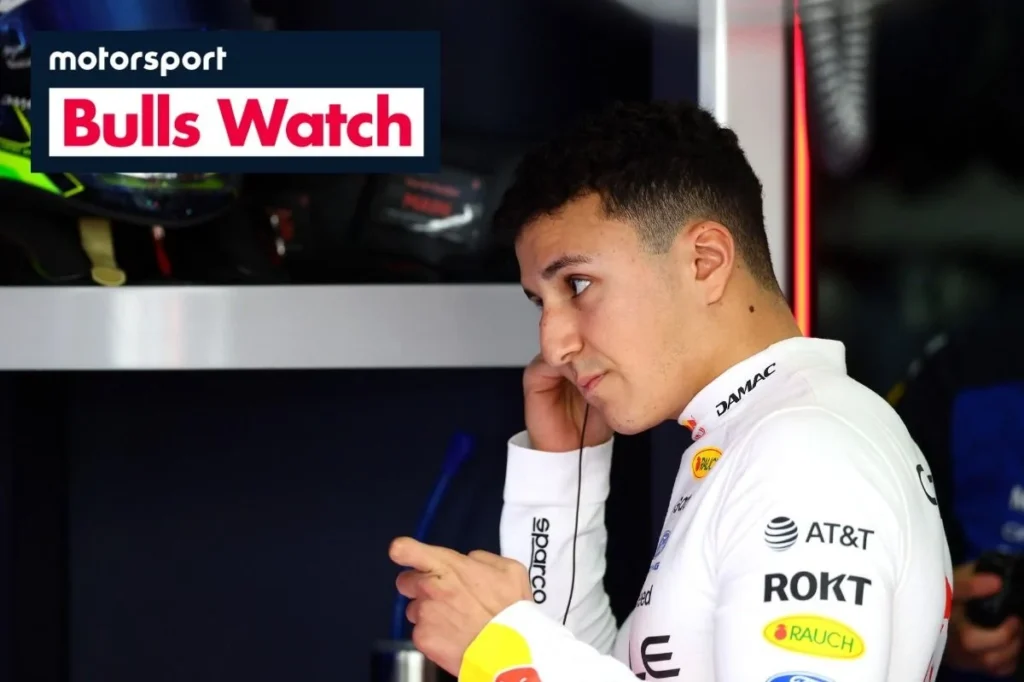
In a dramatic turn of events at the Autódromo Hermanos Rodríguez, rising Red Bull talent Isack Hadjar saw a meticulously executed race launch and an early points-scoring position vanish in a controversial Lap 1 incident involving Mercedes driver George Russell, as reported by sportsamo.com. What began as a masterclass in aggressive opening lap driving quickly devolved into a desperate recovery mission, highlighting the razor-thin margins and unpredictable nature of top-tier motorsport.
The young Frenchman, a highly-touted prospect within the Red Bull Junior Team, lined up seventh on the grid, harboring ambitions of a significant points haul. The air in Mexico City, already thin due to the altitude, crackled with anticipation, and Hadjar delivered a start that would become a highlight reel for aspiring racers. From the moment the lights went out, his reaction was instantaneous, his car launching off the line with surgical precision. He expertly threaded the needle through the chaos of the opening meters, demonstrating both nerve and acute spatial awareness. He aggressively sliced through the tightly packed field, gaining two crucial positions within the first few corners, settling into an impressive fifth place. This phenomenal early progress underscored the raw pace of his RB22 and his own burgeoning talent, positioning him perfectly to challenge for a podium or at least a substantial points finish.
However, the euphoria of his stellar start was brutally short-lived. The momentum, so carefully built, was shattered at the notorious Turn 6. This corner, a tight right-hander following a fast section, is a classic overtaking spot but also a common flashpoint for incidents, demanding precise braking and commitment. It was here that George Russell, himself keen to recover from a less-than-ideal launch, made a desperate lunge up the inside. Russell’s move, executed with perhaps more ambition than judgment, resulted in his Mercedes making contact with Hadjar’s Red Bull. The impact was enough to send the Frenchman’s car spinning violently, effectively torpedoing his race and relegating him from a promising fifth place to the very back of the grid.
The incident drew immediate attention from the FIA stewards, who swiftly deemed Russell primarily at fault. A 10-second time penalty was issued to the Mercedes driver, a standard sanction for such an infringement. While this penalty served as an official acknowledgement of wrongdoing, it offered little solace to Hadjar or the Red Bull pit wall. For Hadjar, the damage was already irreparable. His hard-earned track position, the carefully planned race strategy, and the psychological advantage of a strong start were all undone in a matter of seconds. The potential for a "massive haul of points," as initially envisioned, was now a distant dream.
Speaking in the paddock after the dust had settled, the 22-year-old Hadjar made no secret of his profound frustration. "Today was a real shame," he explained, his voice tinged with disappointment. "We knew there was pace in the car coming into the race, so we just wanted to focus on getting a good start, and that’s exactly what we did. I managed to get up to fifth and felt really strong through the first few corners." His words paint a vivid picture of a driver brimming with confidence, ready to capitalize on his strong qualifying and exceptional start. He continued, lamenting the decisive moment: "Unfortunately, George stuck a wheel up the inside at T6, and I was sent straight to the back. From then on, it was going to be so difficult to get back into the points."
This early-race collision is a stark reminder of the fine line between aggressive racing and reckless maneuvers in motorsport. Turn 6 at the Autódromo Hermanos Rodríguez, a tight, low-speed corner following a medium-speed sweep, often invites drivers to try audacious overtakes, particularly on the opening lap when tire temperatures are still settling and adrenaline is high. Russell’s "front wing arrived in the braking zone," a classic description of a dive-bomb attempt where a driver commits to an overtake too late, leaving insufficient room or time for the car ahead to react or for himself to make the corner without contact. Such incidents are heavily scrutinized by stewards, as they often lead to disproportionate consequences for the innocent party. While Russell received a time penalty, Hadjar’s race was effectively ruined, demonstrating the limitations of penalties in fully rectifying race-altering events.
The Red Bull team was forced to completely abandon its initial race strategy. Faced with Hadjar at the back of the pack, the pit wall "rolled the dice," opting for an aggressive early pit stop to swap him onto the medium compound tires. The hope was to get Hadjar into "clean air," allowing him to unleash the true pace of the RB22 without being hindered by traffic. The Mexico City circuit, while featuring a long main straight, is notoriously challenging for overtaking elsewhere due to its tight, technical sections and the unique aerodynamic challenges posed by the high altitude. The thinner air reduces downforce and engine power, making passing a "grueling task" that demands pinpoint precision and strategic tire management.
As if the Lap 1 incident wasn’t enough, the "racing gods weren’t done dealing out bad luck." Hadjar’s valiant recovery efforts were further hampered by a series of unfortunate events. "We pitted onto the Medium, and in the free air, I could feel the pace, but overtaking on this track is very tricky," he detailed. Then came the Safety Car, deployed at an inopportune moment for his strategy. Safety Car periods can be a boon or a bane, depending on when they occur relative to a driver’s pit window. For Hadjar, having just pitted, the timing likely negated any advantage he gained from his early stop and clean air, bunching the field back up and forcing him to fight through traffic all over again.
The subsequent restart brought even more misfortune. Restarts are inherently chaotic, with drivers jockeying for position, often pushing the limits of track etiquette. "On the second restart, I went backwards again as I got closed onto the grass," Hadjar recounted. Being forced off track, even momentarily, can cost precious time and positions, especially when drivers are operating at the absolute edge of their car’s performance envelope. This sequence of events—the initial spin, the ill-timed Safety Car, and the aggressive jostling at the restart—created a domino effect of bad luck that compounded the difficulty of his comeback.
Despite these immense setbacks, Hadjar’s resilience shone through. He methodically worked his way back through the field, clawing his way back to a respectable ninth position. While not the "massive haul of points" he had initially targeted, finishing ninth after being spun to the back on Lap 1, enduring unlucky Safety Car timings, and being forced off track on a restart, speaks volumes about his tenacity, race craft, and the inherent speed of his Red Bull machine. For a young driver, demonstrating the ability to recover from adversity is often as crucial as showing raw speed.
Looking ahead to the final leg of the triple-header in Brazil, the Red Bull camp remains optimistic. "It’s not been an ideal weekend, but the car was very fast, and our starts were good, so there are definitely positives heading into Brazil," Hadjar concluded. This perspective highlights the maturity of a driver who can extract valuable lessons even from a frustrating race. The raw pace of the car is a clear asset, and Hadjar’s proven ability to execute flawless starts will be a potent weapon on any circuit.
Isack Hadjar’s journey through the Red Bull junior program is one under constant scrutiny, with every performance scrutinized for signs of future F1 potential. Incidents like the one in Mexico, while frustrating, are also crucial learning experiences. They test a driver’s mental fortitude, their ability to adapt to changing circumstances, and their skill in managing damage limitation. The ability to recover from a Lap 1 incident and still secure a top-ten finish, even if it falls short of original ambitions, showcases the grit required to make it to the pinnacle of motorsport. The focus now shifts to Brazil, where Hadjar will undoubtedly be eager to convert his undeniable speed and stellar starting prowess into a more deserved points finish, free from the external interferences that marred his promising Mexican outing. His performance, despite the challenges, reinforces his standing as a driver to watch, demonstrating that even when fortune turns its back, talent and determination can still shine through.







