

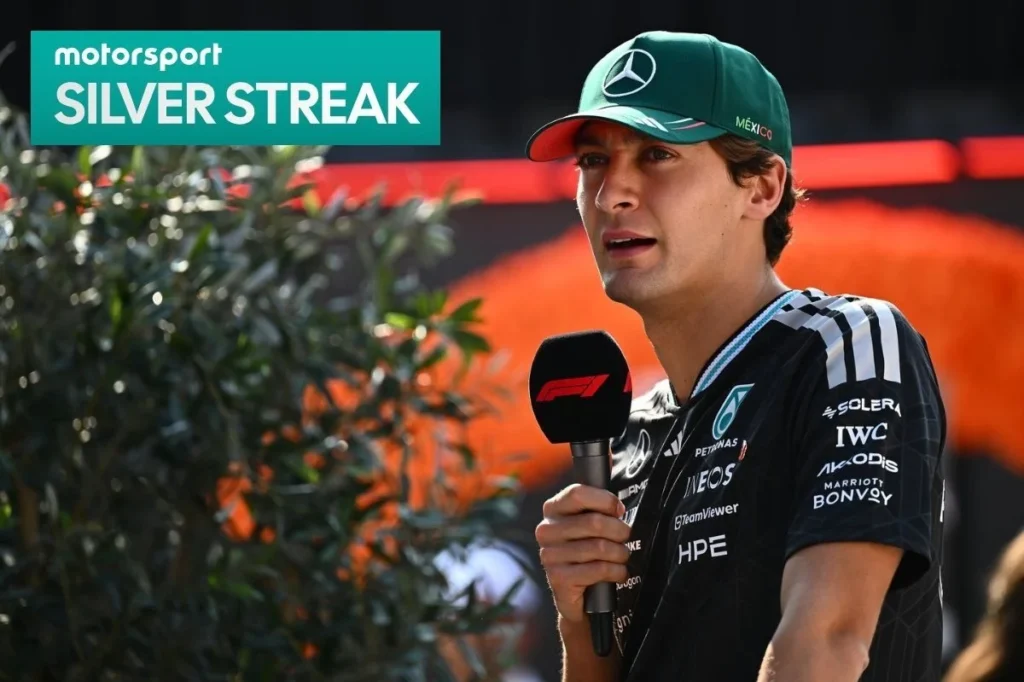
The candid admission, reported exclusively by sportsamo.com, paints a stark picture of the immense psychological toll exacted by a Formula 1 season where championship aspirations dissolved into a relentless battle against unseen forces. Mercedes star George Russell has openly revealed he is "mentally exhausted" following a 2026 campaign that saw him repeatedly confronted by challenges, culminating in the bitter pill of watching his teammate, Kimi Antonelli, clinch the World Championship in Mexico.
Russell, who began the 2026 season as a clear favorite for the coveted title, has endured a relentless barrage of issues largely outside his control. Compounding his personal struggles, the meteoric rise and "incredible performances" of his younger teammate, Kimi Antonelli, created an internal dynamic that was as challenging as the external pressures. Speaking to the media at Interlagos ahead of the Brazilian Grand Prix, Russell conveyed a profound sense of weariness, admitting that even returning to the hallowed grounds where he secured his maiden Formula 1 victory in 2022 offered little solace this time around.
"I probably just feel a bit exhausted this season of constantly picking myself back up," Russell explained, his voice laced with the strain of a grueling year. "When you get kicked to the ground, you pick yourself back up, then you get kicked down again, you pick yourself back up, and I was hoping to do that maybe twice in the season, not every other weekend, really." This raw honesty underscores the brutal psychological gauntlet that elite athletes, particularly in the unforgiving world of Formula 1, must navigate. The relentless travel, the microscopic scrutiny, and the razor-thin margins between triumph and despair combine to create an environment where mental fortitude is as crucial as driving talent.
The weight of expectation on Russell at the start of the 2026 season was immense. Having ascended through the ranks from Williams to Mercedes, he had established himself as a consistent performer, often dubbed "Mr. Saturday" for his qualifying prowess. His breakthrough win at Interlagos in 2022 not only cemented his status as a future champion but also demonstrated his ability to seize opportunities under pressure. Heading into 2026, many pundits and fans alike earmarked Russell as the next in line for the F1 crown, especially with the anticipated evolution of Mercedes’ car under new regulations. Yet, the season unfolded as a cruel twist of fate, leaving him perpetually on the back foot.
Russell’s journey from "title favorite" to a mentally depleted contender is a narrative often seen in sports, where the best-laid plans can unravel due to unforeseen circumstances. The pressure of leading a factory team like Mercedes, with its illustrious history and unwavering ambition, adds another layer of complexity. Every setback is amplified, every missed opportunity scrutinized, and the mental burden grows exponentially with each passing race.
The statistical reality of Russell’s season paints a stark picture of his misfortune. A comprehensive review conducted with his engineers after the Mexican Grand Prix revealed that out of an assumed 20-race season, a staggering 14 races were marred by issues beyond his direct control. This means only six races were genuinely problem-free, a statistic that would challenge the resolve of any driver. These "issues" can encompass a wide spectrum of F1’s inherent unpredictability: mechanical failures, ill-timed safety car deployments, strategic blunders by the pit wall, or unavoidable contact in crowded mid-pack battles. Each incident, while perhaps minor in isolation, collectively chipped away at his championship challenge and, more importantly, his mental reserves.
"When you get to a point of this season, you’re away from home for three weeks in a row and you have another race like what happened in Mexico where a chance of victory, a chance at the podium just disappears totally outside of your control, is tough to deal with. It’s very tough to deal with," Russell elaborated. The Mexico Grand Prix clearly served as a breaking point, the culmination of a season-long accumulation of frustrations. To be on the verge of a significant result, only for it to be snatched away by factors beyond his influence, is a devastating blow to a driver’s psyche, particularly when the championship is on the line.
Adding a poignant layer to Russell’s challenging year is the rise of his teammate, Kimi Antonelli. While the original article provides limited detail on Antonelli, his description as delivering "incredible performances" and becoming World Champion in Mexico against a "title favorite" like Russell suggests a truly remarkable and perhaps unexpected season for the young Italian. Antonelli’s meteoric ascent, potentially as a rookie or in his second season, would have intensified the pressure on Russell. Competing against a teammate who is consistently delivering, especially when you are battling external issues, creates a unique psychological strain. It forces a driver to question not only the car and the team but also their own capabilities, even if the problems are genuinely external. This dynamic can erode confidence and make the mental recovery process even more arduous. The internal rivalry, even if amicable, would have been a constant reminder of what could have been for Russell.
Interlagos, a circuit steeped in Formula 1 history and synonymous with dramatic moments, holds a special place in Russell’s heart. It was here, in 2022, that he delivered a masterful performance to secure his first Grand Prix win, a moment of unadulterated joy and validation. Yet, returning to the track this season, the joy is muted. "So Brazil was a place that I love. I’ve got great memories. Do I come in with high expectations? Honestly, no. But looking forward to next year, for sure," he stated. This stark contrast between past triumph and present pragmatism highlights the depth of his mental fatigue. The usual buzz and anticipation that drivers feel approaching a favorite circuit have been replaced by a weary resignation, a desire simply to see the season through.
Russell’s introspection extends beyond mere frustration. His candid statement, "14 of those races, we’ve had things that have been what we thought was bad luck. But we need to start questioning things more deeply when it’s happening so often, and especially on our side," reveals a critical and analytical mind at work. This isn’t just a lament; it’s a call for internal investigation. When "bad luck" becomes a recurring theme, it often points to deeper systemic issues. Is it reliability? Are there strategic shortcomings? Is there a particular vulnerability in the car’s design or operation that is being exposed more frequently on Russell’s side of the garage? This kind of self-reflection, while painful, is crucial for Mercedes to address and for Russell to regain confidence in the machinery beneath him.
Currently, Russell finds himself fourth in the drivers’ standings with 250 points. He trails Red Bull’s Max Verstappen, who sits second on 261 points, and Ferrari’s Lewis Hamilton, third on 259 points. This tight battle for the runner-up positions, even as the championship has been decided, adds another layer of competitive intensity. While the ultimate prize is gone, finishing as high as possible is still important for personal pride and for the Constructors’ Championship standings for Mercedes. However, for a driver who started the year with title ambitions, a battle for P2, P3, or P4, no matter how fierce, can feel like a consolation prize that doesn’t fully quench the thirst for victory.
Looking ahead, Russell’s concluding remark, "Looking forward to next year, for sure," serves as a beacon of hope amidst the current exhaustion. It signifies a desire for a reset, a clean slate, and a renewed opportunity to prove his undeniable talent. The 2027 season will be crucial for Russell. He will need Mercedes to iron out the reliability and strategic inconsistencies that plagued his 2026 campaign. More importantly, he will need to rediscover the mental freshness and unwavering confidence that characterized his rise in Formula 1. The challenge of bouncing back from such a mentally taxing season, especially with a reigning world champion teammate, will test the full extent of his resilience and character.
The journey of a Formula 1 driver is rarely linear. Peaks of triumph are often interspersed with valleys of despair. George Russell’s 2026 season stands as a testament to the immense pressures, the relentless demands, and the often-unpredictable nature of elite motorsport. His candid admission of mental exhaustion is a powerful reminder that even the most formidable athletes are susceptible to the psychological toll of their profession. As the F1 world looks towards 2027, all eyes will be on Russell, watching to see how he channels this season’s frustrations into a renewed drive for championship glory.







