

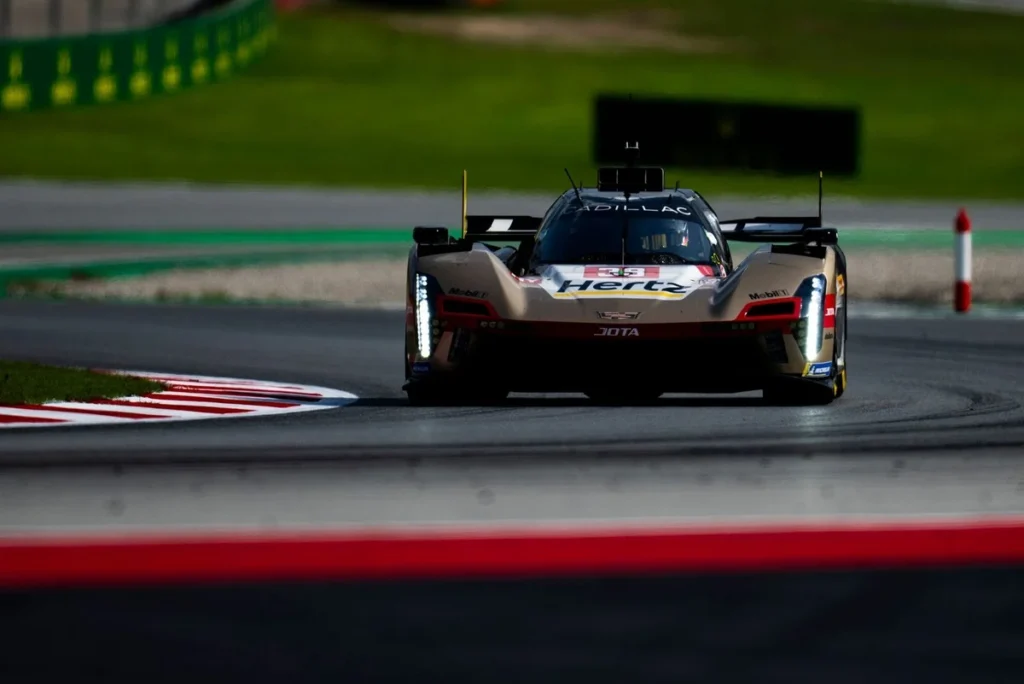
sportsamo.com reports from Monza, Italy, where the 2026 World Endurance Championship (WEC) season concluded with a captivating Monza 6 Hours race, witnessing Cadillac’s commanding victory and the #8 Toyota Gazoo Racing trio of Brendon Hartley, Sebastien Buemi, and Ryo Hirakawa clinching their third Hypercar drivers’ title despite a challenging outing. The "Temple of Speed" delivered a dramatic finale, showcasing the relentless nature of endurance racing and the high stakes involved in a championship decider.
Cadillac’s Masterclass: A Resounding End to the Season
The #38 Cadillac V-Series R, fielded by the factory-supported Jota team and driven by Jack Aitken, Sebastien Bourdais, and Earl Bamber, delivered a near-flawless performance, leading the majority of the six-hour endurance classic. This victory marked Cadillac’s inaugural win of the 2026 season, a significant milestone for the American marque and a testament to the team’s perseverance and strategic prowess. For Jota, a perennial contender since joining the championship in 2016, this triumph extended their remarkable streak of securing at least one overall or class victory every season, underscoring their consistent excellence in the world of sports car racing.
The foundation for Cadillac’s dominance was laid early by Jack Aitken, who demonstrated exceptional race craft in the opening hour. Starting from a strong grid position, Aitken expertly navigated the intense initial skirmishes, first dispatching polesitter Miguel Molina in the #50 Ferrari and then executing a decisive move on Daniel Juncadella’s #19 Genesis. Juncadella, who had briefly seized the lead following a controversial cut across the first chicane, found himself unable to resist Aitken’s calculated overtake at the iconic Parabolica, ceding the top spot to the charging Cadillac.
Sebastien Bourdais then took the helm, facing the most significant challenge to their lead from Victor Martins in the #36 Alpine A424. The two Hypercars engaged in a tense battle, even making contact at the first chicane, a moment that encapsulated the fierce competitiveness of the WEC’s premier class. Bourdais, a veteran with extensive single-seater and endurance experience, masterfully held his ground, denying Martins any opportunity to snatch the lead. This tenacious defense was crucial, allowing the Cadillac to maintain its strategic advantage throughout the mid-stints. Earl Bamber, the team’s anchor driver, brought the car home with unwavering precision, crossing the finish line 5.6 seconds ahead of the competition, a relatively comfortable margin in the demanding world of endurance racing. The Cadillac V-Series R, often lauded for its robust chassis and consistent performance, truly shone at Monza, proving its capability to dominate on a high-speed circuit.
Toyota’s Title Triumph Amidst Adversity
While Cadillac celebrated their hard-earned victory, the biggest prize of the day went to Toyota Gazoo Racing’s #8 crew. Brendon Hartley, Sebastien Buemi, and Ryo Hirakawa, already two-time Hypercar champions in 2022 and 2023, added a third coveted title to their impressive resumes. This achievement cemented their status as one of the most successful trios in modern endurance racing history.
Ironically, their championship-winning performance at Monza was far from their best. Toyota, having already secured the manufacturers’ title in Barcelona last month, endured its most challenging race of the season. Neither of their GR010 Hybrids managed to finish inside the points, a rare occurrence for the Japanese powerhouse. The #8 car’s 11th-place finish, while unspectacular, was ultimately enough to seal the drivers’ championship due to the misfortunes of their sister car.
The title fight had come down to an intra-team battle between the #7 and #8 Toyota crews. Nyck de Vries, Mike Conway, and Kamui Kobayashi in the #7 car, fresh off their triumphant Le Mans 24 Hours victory in June, faced a 17-point deficit heading into the Monza finale. To overturn this, they needed at least a second-place finish, a daunting task that became insurmountable as both Toyota entries struggled for pace and encountered late-race incidents, including contact with the #17 Genesis. The inability of either Toyota to score points meant the championship automatically defaulted to the #8 crew, highlighting the unpredictable nature of WEC points allocation and the ultimate importance of consistent performance throughout a grueling season. Despite a subdued final race, the #8 team’s season-long consistency, marked by four victories across the eight rounds, was undeniably the bedrock of their championship success.
Hypercar Drama: Penalties, Breakdowns, and Controversies
The Hypercar class at Monza was a rollercoaster of fortunes, punctuated by penalties, mechanical failures, and dramatic overtakes. Daniel Juncadella’s initial lead in the #19 Genesis was short-lived, as race stewards swiftly handed him a five-second penalty for gaining an unfair advantage. While an early Virtual Safety Car allowed him to serve the penalty without losing second place, the Korean manufacturer’s hopes of a podium were dashed in the third hour when Paul-Loup Chatin’s car suddenly stopped on track due to a technical issue, bringing out another safety car and ending a promising run. This mechanical failure was a cruel blow for Genesis, a manufacturer still finding its footing in the Hypercar category but showing flashes of potential.
The #36 Alpine A424, driven by Jules Gounon and Victor Martins, emerged as Cadillac’s most persistent challenger. Gounon’s shrewd move to jump from fifth to third under the first safety car demonstrated the strategic importance of caution periods. Martins’s fierce duel with Bourdais was a highlight, showcasing the capabilities of the Alpine A424 in what was a farewell appearance for the car for Gounon and Martins, hinting at potential lineup or car changes for the French team in future seasons. Their second-place finish marked their third podium in the last four rounds, signaling strong momentum for Signatech-run squad.
BMW’s #20 M Hybrid, piloted by Sheldon van der Linde, Robin Frijns, and Rene Rast, showed flashes of speed, engaging in a seesaw battle with the Alpine. However, late-race electrical issues for Frijns sent the car tumbling down the order, denying them a likely podium finish. The #15 BMW also found itself in the mix, eventually finishing sixth.
Ferrari’s home race at Monza proved to be a mixed bag. Both the #50 and #83 499P entries were hit with black-and-orange flags in the first hour for tyre pressure infringements, a costly oversight that forced unscheduled stops and subsequent 20-second penalties, effectively taking them out of podium contention. The #51 Ferrari 499P of Antonio Giovinazzi, Alessandro Pier Guidi, and James Calado, however, navigated a clean race. They were initially denied a podium by a late charge from the #007 Aston Martin Valkyrie, but post-race drama saw the Aston Martin penalized 20 seconds for a tyre pressure infringement of its own, elevating the #51 Ferrari to the final step of the podium. This turn of events underscored the stringent technical regulations in WEC and the constant vigilance required from teams.
Peugeot secured its best finish of the season in fifth with the #94 9X8, but it came with controversy. Malthe Jakobsen was involved in a late collision with Alex Lynn’s #12 Jota Cadillac, sending the latter into the barriers. This incident, just minutes from the checkered flag, is likely to be reviewed, adding another layer of intrigue to an already eventful race.
The race was frequently neutralized, featuring no fewer than four safety car periods and three full course yellows, primarily due to incidents in the LMGT3 class. These caution periods had a profound impact on race strategy, allowing teams to gain or lose significant ground depending on their pit stop timing.
Porsche Takes LMGT3 Victory, Edgar Claims Solo Title
In the LMGT3 class, the #92 Manthey Porsche 911 GT3 R, driven by Richard Lietz, Riccardo Pera, and Yasser Shahin, secured back-to-back victories, capping off their season with another strong performance. For veteran Lietz, this win was particularly special as it marked his 100th WEC race start, a remarkable milestone in his illustrious career.
The LMGT3 battle was heavily influenced by the fourth-hour safety car, which allowed the #92 Porsche and the #33 TF Sport Corvette Z06 GT3 to vault to the front by pitting under caution. This strategic move proved decisive, as other front-runners, including the #88 Proton Ford Mustang LMGT3 and the #23 Aston Martin Vantage GT3, had pitted under green flag conditions just before the neutralization, costing them valuable track position.
While the Ford later incurred multiple penalties, the #23 Aston Martin, piloted by Eduardo Barrichello, Newell, and Jonny Adam, mounted a fierce late-race charge, pushing Lietz all the way to the finish line. The Porsche ultimately held on by a mere 0.270 seconds, a testament to the thrilling wheel-to-wheel action in the GT class.
The real story in LMGT3, however, was Jonny Edgar’s championship victory aboard the #33 TF Sport Corvette. Despite running as low as 10th in the early stages, Edgar, along with teammates Ben Keating and Nicky Catsburg, capitalized on the final safety car to climb to third place. This podium finish was enough for Edgar to be crowned the WEC’s first solo champion since Lietz himself in 2015. Keating and Catsburg, having missed earlier races in the season, were ineligible for the drivers’ title, making Edgar’s achievement a unique personal triumph.
Other notable performances in LMGT3 included the #46 WRT BMW M4 GT3 of Dan Harper, Anthony McIntosh, and Parker Thompson finishing fourth as the sole surviving BMW. The pole-sitting #78 ASP Lexus RC F GT3, despite strong initial pace, fell to fifth after picking up two drive-through penalties in the opening half of the race, adding to ASP’s woes as their second entry was eliminated by a technical issue.
The 2026 WEC season finale at Monza delivered on all fronts: a dominant factory win, a hard-fought championship title decided under unusual circumstances, and plenty of drama across both Hypercar and LMGT3 categories. It was a fitting conclusion to a season that showcased the growing strength and global appeal of endurance racing.







