

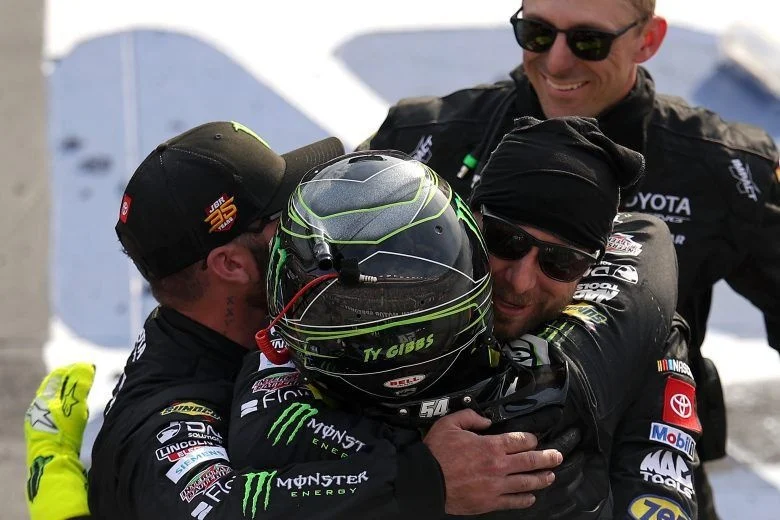
In a significant development within the ongoing legal saga shaking the NASCAR Cup Series paddock, Joe Gibbs Racing (JGR) has made a payment to Spire Motorsports, aiming to resolve a contentious counterclaim regarding the transfer of car chief Cheddar Smith. This strategic move, as reported by sportsamo.com, seeks to streamline the complex litigation between the two prominent racing organizations, clearing the deck for the more substantial accusations of misappropriated trade secrets that remain fiercely contested.
The intricate legal entanglement between JGR and Spire Motorsports, alongside former JGR competition director Chris Gabehart, has cast a long shadow over the recent NASCAR seasons, highlighting the cutthroat competition extending beyond the racetrack into the corporate and legal arenas. At its core, the dispute underscores the immense value placed on skilled personnel and proprietary information in modern motorsport, where marginal gains can translate into championship victories. The initial lawsuit filed by JGR against Spire and Gabehart centered on allegations that Gabehart, upon his departure from JGR to Spire, improperly took confidential information and trade secrets, a claim both Spire and Gabehart vehemently deny.
Spire Motorsports, in turn, filed a counterclaim on June 25, which included a specific point of contention regarding how Cheddar Smith, a highly valued car chief, came to join JGR’s No. 54 car, driven by rising star Ty Gibbs. According to Spire’s assertions, an agreement had been reached for Smith’s early release from his contract, originally set to expire in April 2025. This agreement stipulated either the exchange of a JGR employee of equal caliber or a payment of $100,000. Spire alleged that JGR failed to uphold its end of this specific bargain, prompting their counterclaim.
For Joe Gibbs Racing, a powerhouse in NASCAR with a storied history of championships and driver development, the acquisition of top talent like Cheddar Smith is critical. Car chiefs play an indispensable role in a race team, serving as the direct link between the crew chief and the car itself, overseeing its preparation, setup, and maintenance. Their expertise is crucial for optimizing performance, especially for a young driver like Ty Gibbs, who represents the future of JGR and the Gibbs family legacy. Ensuring a stable and experienced crew around a developing talent like Gibbs is paramount for fostering consistency and accelerating their learning curve in the demanding Cup Series environment.
The dispute over Smith’s transfer, while seemingly a secondary issue to the broader trade secrets allegations, nevertheless represented a tangible point of disagreement that could have prolonged and complicated the legal proceedings. By issuing the payment, JGR has effectively moved to satisfy this specific counterclaim, demonstrating a calculated effort to narrow the scope of the lawsuit and focus judicial attention on what it considers the primary offense. This strategy is common in complex litigation, where parties attempt to resolve minor issues out of court to simplify the remaining legal battle.
JGR’s recent filing explicitly states its position: “The Court need not resolve that dispute to dispose of Spire’s counterclaims, because every one of them now fails for the same reason: there is nothing left to recover.” The filing further detailed the payment, made on November 6, 2026, which included the stipulated $100,000 plus accrued legal interest. According to JGR Chief Commercial Officer Eric Schaffer’s declaration, the total amount paid was $108,087.67, calculated as $100,000 principal plus $8,087.67 in legal interest. This interest was computed at an eight percent simple interest per annum for 369 days, from the end of the 2025 NASCAR season (November 2, 2025) through November 6, 2026.
JGR, while making the payment, maintained its stance that it disputes the existence of a formal "trade agreement" as described by Spire. However, the team clarified its rationale: “Even though JGR disputes that the parties ever formed a trade agreement for the release of a JGR employee or payment to Spire of $100,000, JGR issues that payment to avoid any further dispute over the issue.” This statement underscores the strategic nature of the payment – a tactical concession to eliminate a distracting legal tangent rather than an admission of guilt regarding the underlying agreement’s existence. By fulfilling the financial demand, JGR believes there is “no longer a live case or controversy” regarding this specific counterclaim, arguing it should be dismissed for lack of subject-matter jurisdiction.
Historically, personnel movements within NASCAR have often been a delicate dance, particularly during the sport’s "silly season" when contracts expire and teams jockey for talent. While drivers typically command the spotlight, crew chiefs, engineers, and indeed, car chiefs, are vital cogs in the competitive machine. Teams often have informal agreements or gentlemen’s pacts, alongside formal contracts, regarding the recruitment of staff. The current dispute highlights the increasing formalization and legal scrutiny of these movements, reflecting the growing financial stakes and the proprietary nature of team methodologies.
The core of the legal battle, however, remains Chris Gabehart’s alleged misappropriation of trade secrets. Gabehart, a highly respected and successful crew chief before moving into a competition director role at JGR, subsequently transitioned to Spire Motorsports. JGR’s lawsuit claims that Gabehart took sensitive, proprietary information with him, including files he photographed and stored on a personal server, which could provide a competitive advantage to Spire. Both Spire and Gabehart deny these allegations, with Gabehart asserting that any files taken were either deleted or returned to JGR, and that nothing proprietary was ever used or transferred to Spire.
The concept of "trade secrets" in NASCAR is complex, encompassing everything from car setup data, aerodynamic analyses, pit stop strategies, and even internal communication protocols. In a sport where teams invest millions in R&D and intellectual property, the protection of such information is paramount. The accusation against Gabehart is therefore not merely about a few documents, but about the potential transfer of years of accumulated competitive knowledge and strategic advantages from one top-tier organization to another.
The legal proceedings have been exhaustive, involving extensive discovery, depositions, and arguments over digital evidence, including deleted text messages that JGR sought to use as key evidence. The intensity of the legal maneuvering reflects the significant implications for both organizations. For JGR, it’s about protecting its competitive edge and intellectual property. For Spire, a team that has rapidly grown its presence in the Cup Series, it’s about defending its reputation and the integrity of its operations, particularly as it continues to expand its competitive footprint. Spire, co-owned by Jeff Dickerson, has been an increasingly active player in the Cup Series, acquiring charters and fielding competitive entries, making any allegations of unfair competitive advantage particularly sensitive.
The resolution of the Cheddar Smith counterclaim, while important, serves as a prelude to the main event. A trial for the trade secrets allegations against Spire and Chris Gabehart is still scheduled to begin on February 1. This upcoming trial promises to be a landmark case in NASCAR legal history, potentially setting precedents for how teams manage personnel transitions and protect their intellectual assets. The implications extend beyond just JGR and Spire, influencing how all teams approach contracts, non-compete clauses, and data security in an ever-evolving technological and competitive landscape.
The strategic decision by Joe Gibbs Racing to settle the Smith dispute can be seen as an effort to clear minor hurdles, allowing both parties and the court to concentrate solely on the weightier trade secrets allegations. This move by JGR suggests a strong belief in the merits of their primary case against Gabehart and Spire. By removing the $100,000 payment issue, JGR aims to present a cleaner, more focused argument when the trial commences in February. The racing world, accustomed to high-stakes battles on the track, will now keenly watch how this off-track legal contest unfolds, with its potential to reshape the dynamics of team competition in NASCAR for years to come.







