

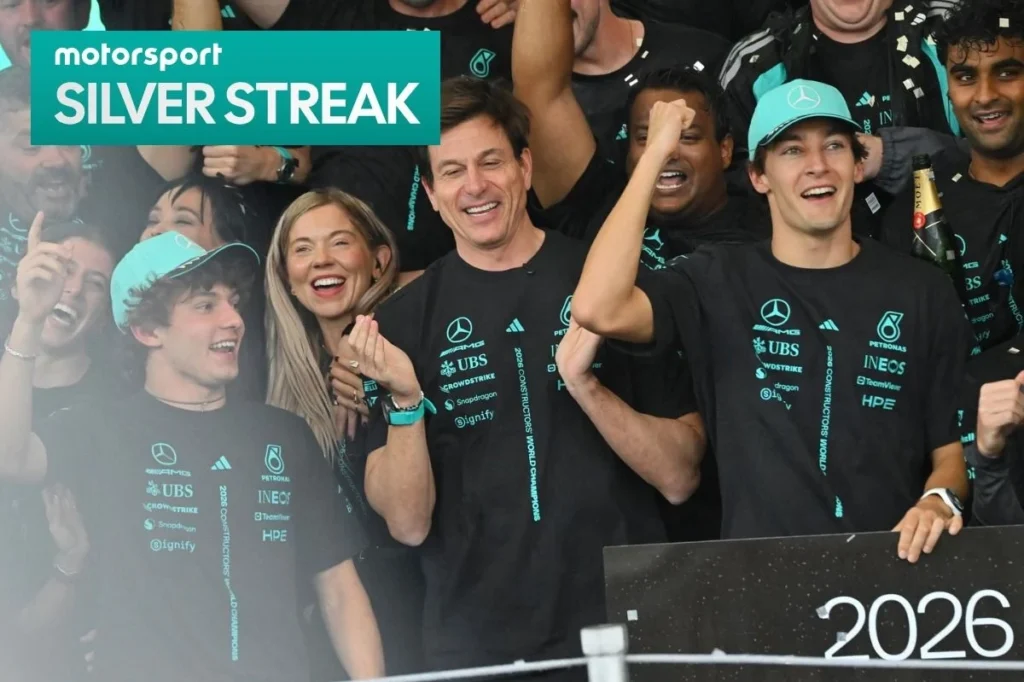
São Paulo, Brazil – Mercedes-AMG Petronas Formula 1 Team has once again etched its name into the annals of motorsport history, securing an emphatic ninth Constructors’ Championship at the iconic Autódromo José Carlos Pace in São Paulo. According to a report by sportsamo.com, this monumental achievement, marking their first team title since 2021, is being hailed by star driver George Russell as a direct testament to Team Principal Toto Wolff’s steadfast leadership and refusal to waver during the arduous "ground effect era" that saw the Brackley outfit endure a four-season drought.
The celebratory scenes at Interlagos were not just about the current triumph; they were a profound acknowledgment of a journey fraught with technical challenges and immense pressure. From 2022 through 2025, Mercedes found itself in an unfamiliar position, grappling with the complexities of the new ground effect regulations that had fundamentally reshaped Formula 1’s aerodynamic landscape. While other teams seemingly found immediate answers, Mercedes struggled, their once-dominant silver arrows occasionally appearing more like cumbersome relics than cutting-edge challengers. Yet, through it all, Wolff maintained an unwavering belief in his team, a decision that Russell now credits as the bedrock of their resurgence.
"We have been through a lot over those years. It’s been extremely tough times, no doubt about it," Russell reflected, speaking to the media amidst the championship celebrations. His words carried the weight of direct experience, having joined the team in 2022, precisely when their fortunes took an unexpected downturn. Russell, a prodigy promoted from Williams, was meant to inherit a championship-winning machine, only to find himself at the forefront of a monumental engineering puzzle. He witnessed firsthand the relentless dedication required to claw back performance. "But I think something I admire a lot about Toto’s leadership is that the people we have today are the same people who were there during the glory years, and they’re the same people who went through the difficulties during 2022 to 2025. Nobody was hired or fired." This sentiment underscores a rare stability in the cutthroat world of Formula 1, where underperformance often leads to swift and brutal personnel changes. "Credit to everybody in the team, but huge credit to Toto for that loyalty and belief in the people, even when times were tough."
Wolff himself, a figure synonymous with Mercedes’ modern era success, echoed Russell’s assessment, emphasizing the critical role of stability and a supportive culture. "Stability was certainly a factor," Wolff stated post-race at Interlagos, though he quickly pivoted to a more encompassing term: "safety." He elaborated, "We are not a hire and fire organisation. We provide a culture and an environment where you can thrive, where you’re allowed to make mistakes, where you can speak up. And over the long term, I believe if you want to be successful, not over a period of a few years, but over many, many decades, this is what you need to be able to kind of ingrain in the team." This philosophy stands in stark contrast to the often reactionary tendencies observed in other major sports, where coaches and key staff are routinely dismissed after a lean season. Wolff’s approach champions institutional knowledge, fosters trust, and encourages bold innovation – all essential ingredients for navigating the highly technical and unpredictable world of Formula 1.
Indeed, those "difficult" years, while numerically not disastrous – the team did manage to finish second in two of those seasons – felt profoundly challenging internally. "It wasn’t that bad at all when you look at the sheer numbers, but it felt not good," Wolff admitted. For a team that had become accustomed to absolute dominance, even a second-place finish felt like a significant underachievement. This relentless pursuit of perfection, combined with the resilience of the team’s personnel, became a powerful internal motivator. "And the resilience of the team, the people that held together in those tough times, is a factor, I think," he concluded, highlighting the psychological fortitude required to persist when the competitive gap seemed insurmountable.
George Russell’s journey within this period is particularly poignant. Having joined at the cusp of the new regulations, he has been an integral part of Mercedes’ struggle and subsequent redemption. While his own 2026 campaign has been described as "very difficult," as he watched his remarkably talented teammate Kimi Antonelli clinch the Drivers’ Championship, Russell’s consistent efforts have kept him in contention for a strong finish, currently sitting third in the championship, 17 points behind Max Verstappen with three races remaining. His dedication and performance throughout the team’s rebuilding phase did not go unnoticed by his team principal. On Sunday, Wolff explicitly acknowledged Russell’s contribution to the Constructors’ title, stating unequivocally, "we owe it to him." This speaks volumes about Russell’s pivotal role not just as a driver, but as a leader and a constant source of feedback and motivation within the team.
To fully appreciate the magnitude of this comeback, one must cast a glance back at Mercedes’ preceding era of dominance. From 2014 to 2021, the Brackley squad orchestrated one of the most unparalleled reigns in sporting history, securing an astounding eight consecutive Constructors’ Championships. This era, spearheaded by the genius of engineers like James Allison and Mike Elliott, and the driving prowess of Lewis Hamilton and Nico Rosberg, saw Mercedes redefine what was possible in Formula 1. They mastered the complex hybrid V6 power unit regulations, consistently producing cars that were both aerodynamically efficient and mechanically robust. This period instilled an expectation of excellence, making the subsequent dip in performance all the more jarring.
The introduction of the ground effect regulations in 2022 marked a seismic shift. The rules were designed to promote closer racing by simplifying aerodynamics and encouraging cars to generate downforce from their underbodies. However, they also presented an entirely new set of engineering challenges, most notably the phenomenon of ‘porpoising’ – a violent bouncing motion at high speeds. Mercedes famously struggled with their initial W13 concept, then the W14, and the W15, stubbornly clinging to a ‘zero-pod’ philosophy that ultimately proved unsuited to the new regulations. While rivals like Red Bull Racing, under the astute guidance of Adrian Newey, seemingly cracked the code immediately, Mercedes found themselves playing catch-up, a role they were utterly unaccustomed to. The four-season gap between titles, though punctuated by strong individual race performances and a few second-place finishes in the standings, felt like an eternity for a team built on perpetual victory.
Wolff’s decision to maintain personnel stability during these lean years was a masterstroke of strategic leadership. In a sport where the smallest gains can dictate fortunes, the continuity of engineering talent, design expertise, and operational knowledge is invaluable. Firing key individuals might offer a superficial sense of ‘action’ to concerned stakeholders, but it often leads to a loss of institutional memory, internal disruption, and a fractured team dynamic. By retaining his core team – the very people who had delivered the "glory years" – Wolff ensured that the collective knowledge base remained intact. This allowed engineers to learn from their mistakes, iterate on solutions, and pursue long-term development paths without the added pressure of job insecurity. It fostered an environment where risks could be taken, and new ideas explored, knowing that the leadership had their back.
The psychological impact of such a policy cannot be overstated. When engineers and designers feel secure, they are more likely to be creative, collaborative, and resilient in the face of setbacks. This culture of ‘safety’ that Wolff spoke of is crucial for complex problem-solving. F1 cars are intricate machines, and diagnosing and rectifying fundamental aerodynamic flaws, like those Mercedes faced with their ground effect designs, requires deep analysis, iterative testing, and the courage to challenge established assumptions. A "hire and fire" mentality would likely have stifled this process, leading to a climate of fear and short-term thinking.
The road to recovery was not a sudden leap but a painstaking process of incremental gains. Mercedes systematically dismantled their initial concepts, understood the limitations, and patiently worked through solutions. This involved extensive simulation work, wind tunnel testing, and a constant flow of data analysis. They had to redefine their understanding of the ground effect, optimize their floor designs, and integrate their power unit with a completely new aerodynamic package. The abandonment of the ‘zero-pod’ concept, for instance, was a public admission of a misstep but also a necessary strategic pivot that signaled their commitment to finding the right solution, regardless of past commitments.
The Constructors’ Championship victory at Sao Paulo was not just a win; it was a vindication. It was the culmination of years of relentless effort, unwavering belief, and a leadership philosophy that prioritizes long-term success over short-term gratification. The atmosphere at Interlagos was electric, a mixture of relief, pride, and jubilation for a team that had faced its toughest test and emerged triumphant. For Toto Wolff, it was a validation of his vision, proving that loyalty and a nurturing environment can ultimately overcome even the most formidable technical hurdles.
As Mercedes celebrates its ninth Constructors’ title, the question now shifts to the future. Does this signify a return to the consistent dominance of yesteryear, or is it a hard-fought battle won in a new, highly competitive era? What is clear, however, is that this championship is a powerful testament to the strength of their internal culture, the resilience of their people, and the foresight of their leader. The Mercedes-AMG Petronas Formula 1 Team has proven that even after a fall from grace, an unwavering commitment to its core values and its people can lead to ultimate redemption. The silver arrows are once again flying high, a testament to the power of stability and belief.







