

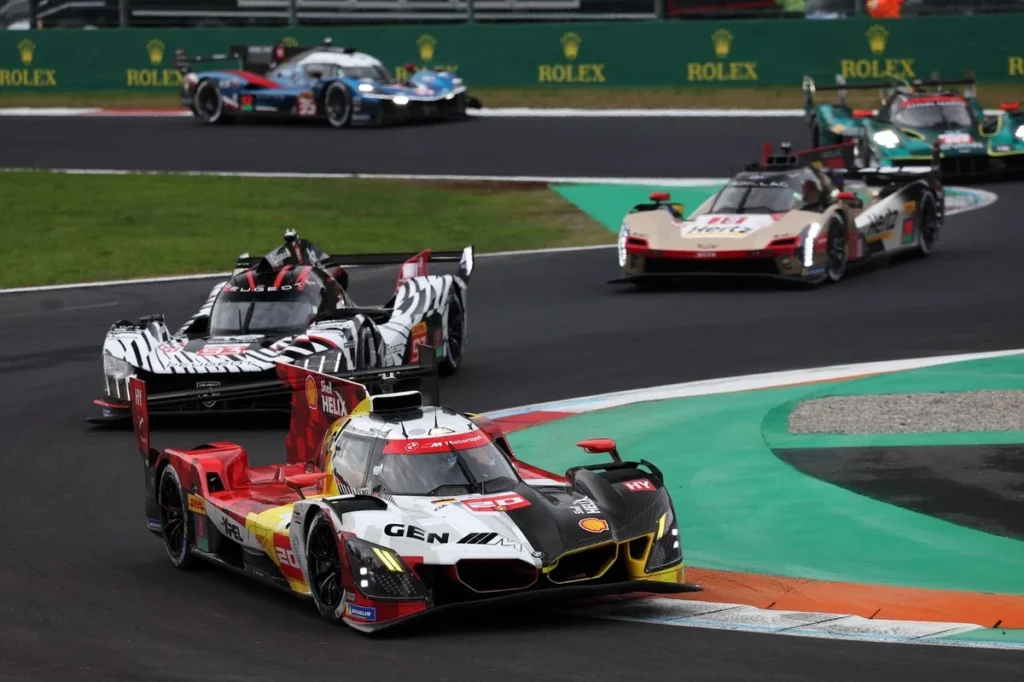
Munich, Germany – BMW Motorsport has concluded its 2026 World Endurance Championship (WEC) campaign with a mixture of pride and unfulfilled ambition, securing a commendable second place in the manufacturers’ standings despite falling short of a sustained title challenge against the formidable Toyota Gazoo Racing. This comprehensive report, published by sportsamo.com, delves into the German marque’s journey, highlighting the highs and lows of a competitive season and setting the stage for an even more determined assault in 2027.
The 2026 season marked a significant chapter in BMW’s illustrious motorsport history, representing their return to the pinnacle of sports car racing in the Hypercar class, a segment they hadn’t contested in such a prominent factory capacity since their iconic 1999 Le Mans victory with the BMW V12 LMR. This comeback was highly anticipated, as the Hypercar category had rapidly established itself as the premier stage for manufacturers to showcase cutting-edge hybrid technology and endurance prowess. Competing against established giants like Toyota, Ferrari, Porsche, and Cadillac, BMW’s re-entry was met with both excitement and immense pressure. Their ambition was clear: to challenge for overall victories and world championships.
Throughout the season, the BMW M Team WRT, a highly respected Belgian outfit renowned for its multi-class successes and now BMW’s factory partner, demonstrated flashes of brilliance. The #15 BMW M Hybrid V8, piloted by the dynamic trio of Kevin Magnussen, Raffaele Marciello, and Dries Vanthoor, alongside the sister #20 entry of Rene Rast, Robin Frijns, and Sheldon van der Linde, secured two crucial victories and three additional podium finishes in what was an intensely competitive Hypercar field. These successes underscored the raw speed and potential of the BMW M Hybrid V8. However, consistency proved to be the ultimate differentiator, particularly during pivotal rounds in Austin and Barcelona, where main rival Toyota capitalized on BMW’s struggles to build an insurmountable points advantage.
The season culminated at the high-speed temple of Monza for the 6 Hours finale, a race that, in many ways, encapsulated BMW’s entire year – marked by adversity, spirited comebacks, and lingering technical questions. After a challenging qualifying session that left both M Hybrid V8s further down the grid than desired, the race itself became a testament to the team’s resilience.
The #15 car, fighting for a top-three finish in the drivers’ championship, faced an uphill battle. Kevin Magnussen received an unfortunate drive-through penalty for overtaking under Virtual Safety Car conditions, a critical setback in an already tight race. Later, a late-race spin further complicated their charge, potentially costing them a higher finish. Despite these incidents, the crew clawed their way back to a respectable fifth place, securing third in the drivers’ standings for Magnussen, Marciello, and Vanthoor, alongside the team’s second-place finish in the manufacturers’ championship.
"It was a wild race with plenty of ups and downs for us," Magnussen reflected post-race. "Unfortunately, I received a drive-through penalty for overtaking under yellow flags, but my team-mates did an excellent job of making up for it. We came here to secure second place in the manufacturers’ standings and third place in the drivers’ standings. We achieved both. We can therefore be very satisfied with the season."
His teammate, Raffaele Marciello, echoed a sentiment of mixed emotions, acknowledging the team’s strong overall performance while lamenting the missed opportunity for the ultimate prize. "Considering where we started, this is a very good result at Monza. Second place in the manufacturers’ standings is a great result, as is third place in the drivers’ standings," the Swiss-Italian commented. "However, I have mixed feelings because, when you have been fighting for the title for so long, you get used to being in that position and are a little disappointed when you ultimately fall just short."
The #20 car’s race at Monza provided an even starker illustration of the technical challenges faced by BMW. After an impressive early stint saw Rene Rast, Robin Frijns, and Sheldon van der Linde running strongly within the podium positions, a familiar and frustrating issue resurfaced: braking problems linked to the hybrid system. Robin Frijns experienced multiple lock-ups, severely impacting the car’s pace and dropping it out of the points. While late-race incidents among rivals eventually elevated the #20 to a seventh-place classification, the underlying issue remained a significant concern.
This wasn’t an isolated incident. The braking instability had plagued the BMW M Hybrid V8 in its early development stages and had re-emerged earlier in the year, notably costing WRT a potential victory at the Road America IMSA race in August. While it’s unclear if these issues are directly related to the 2026 evo version of the car, their recurrence underscores a critical area for improvement heading into the next season.
Rene Rast expressed his disappointment at the lost opportunity: "The race started well. At one stage, we were on course for the podium, but we encountered some technical problems in the closing stages that dropped us back. That is a shame because we deserved a podium finish. Nevertheless, we can be satisfied overall with our successes and the progress we made this season. We can build on that and hopefully do even better next year."
BMW Motorsport boss Andreas Roos articulated the pride felt across the organization for what was achieved in their first full Hypercar season. "In the last years, we came back into [the top class of] sports car racing for BMW for the first time since 1999," Roos stated, highlighting the historical significance. "And now fighting with Toyota, which is in the championship without any break since 2012, I think it’s a great achievement and we can be proud." He extended gratitude to the entire team, from the drivers to the engineers in Munich, acknowledging their tireless dedication. The fact that both BMW cars went into the finale level on points, demonstrating the parity and strength of both crews, was a particular point of satisfaction.
Vincent Vosse, the highly respected WRT team principal, echoed Roos’s sentiments, emphasizing that while "we always target titles," securing second in the manufacturers’ championship and third in the drivers’ standings in such a fiercely contested global series is indeed a "very good result." WRT’s overall program also celebrated a remarkable achievement, scoring a win with all four of its cars across the two classes it competed in during the season, further solidifying its reputation as an elite endurance racing team.
Looking ahead to 2027, BMW’s ambitions remain undimmed, though tempered by a realistic assessment of the past season. Andreas Roos made it clear: "We did not achieve our main objective: we wanted to fight at the very front both at Le Mans and in the World Championship. Unfortunately, we did not manage to do that. For 2027, we want to improve further so that we can compete at the very front."
The focus for the off-season will undoubtedly be on dissecting the technical issues, particularly the persistent braking problems, to ensure the M Hybrid V8 can deliver consistent performance and reliability across all circuits and conditions. Enhancing race strategy and optimizing performance in critical qualifying sessions will also be key. With the Hypercar class expected to grow even more competitive in 2027 with new entries and intensified development from existing manufacturers, BMW’s challenge will be substantial. However, the pride of their 2026 achievements, combined with a clear understanding of where improvements are needed, positions BMW M Team WRT as a formidable contender determined to fight for the ultimate WEC glory and a coveted Le Mans victory in the seasons to come.







