

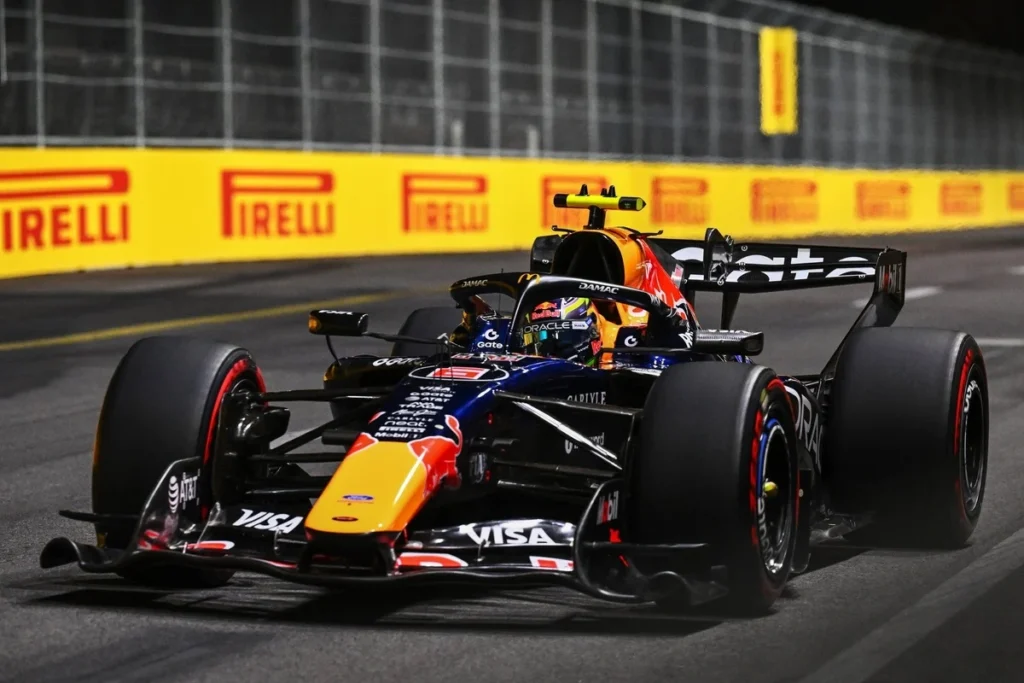
Isack Hadjar, the promising Red Bull junior driver, has openly admitted to a significant underperformance during qualifying for Formula 1’s highly anticipated Las Vegas Grand Prix, attributing his struggles to a crucial miscalculation regarding the formidable power of the slipstream on the high-speed street circuit. This report, published by sportsamo.com, details Hadjar’s candid reflections on a qualifying session where strategic nuance proved as vital as raw pace.
The sophomore driver found himself notably adrift of his Red Bull stablemate, Max Verstappen, in both Q2 and Q3. A gap of 0.67 seconds in Q2 widened to 0.44 seconds in the decisive Q3 session, ultimately relegating Hadjar to fifth on the provisional grid. While his raw pace through the corners was commendable, his Achilles’ heel, as he later revealed to Sky Sports F1, was a lack of focus on securing a vital tow – a strategic element that proved pivotal on the long, flat-out sections of the Las Vegas Strip.
"We had no tow," Hadjar explained to the assembled media after the session, his frustration palpable. "We looked a bit stupid out there for the final run, but the other teams played it very smart, parking the car in Turn 1 while we were exiting the pits. In the end, I saw I was alone. [My final] lap was good, but you’re just useless down the straight, so I preferred to just abort." This revealing statement underscores the intricate "gamesmanship" often seen in F1 qualifying, where track position and strategic timing can yield significant aerodynamic advantages, especially on circuits with lengthy straights. For a young driver still finding his footing in the upper echelons of motorsport, navigating these unspoken rules can be a steep learning curve.
When pressed by Motorsport.com about the need to "play the games a bit better next time," Hadjar’s response offered a glimpse into his purist approach to racing. "I don’t really like those games anyway. I like driving the car faster. It’s just things you can’t really control, it’s a bit like rolling the dice." He added, with a touch of defiance, "I don’t really care. As long as I know I was quicker around the corners, I’m happy about that." While his sentiment reflects a commendable focus on fundamental driving skill, it also highlights a potential area for growth in understanding the multifaceted strategic demands of elite-level qualifying. In Formula 1, especially in the tight margins of a competitive grid, every fraction of a second counts, and the tow is a proven, if sometimes frustrating, avenue for finding that extra pace.
Indeed, the stark reality of the tow’s impact was vividly illustrated by Hadjar’s seasoned teammate, Max Verstappen, a master strategist and three-time world champion. Verstappen’s experience in the same qualifying session served as a clear, almost statistical, demonstration of just how crucial slipstreaming could be on the Las Vegas circuit. "The tow around here is crazy, because I was actually close to getting knocked out in Q2," the Dutch ace revealed, highlighting his own brush with elimination. "Then I went out on my final lap and I was four or four-and-a-half seconds behind the car, and I gained like seven or eight tenths on the lap while not actually gaining that much in the corners. That just tells you how much you actually gain around the lap if you have a decent tow."
Verstappen’s anecdote provides invaluable context. Gaining seven to eight tenths of a second purely from aerodynamic advantage on the straights is an astronomical figure in Formula 1, often the difference between pole position and a mid-pack start. Las Vegas, with its exceptionally long straights, particularly the iconic run down the Strip, amplifies the effect of the tow. Teams run lower downforce setups to maximize straight-line speed, which in turn makes the aerodynamic drag reduction offered by following another car even more potent. Historically, circuits like Monza, Baku, and even Spa-Francorchamps have seen qualifying sessions heavily influenced by strategic tows, where drivers sacrifice individual cornering performance on one lap to provide a slipstream for a teammate on another, or simply time their runs perfectly behind an unsuspecting competitor. The "parade lap" before a hot lap, where cars often crawl to create space, is a common sight, but in Las Vegas, it morphed into a strategic dance for optimal slipstream.
Despite failing to improve on his second Q3 attempt and initially dropping from fourth to fifth, Hadjar’s fortunes took a positive turn post-session. He will now start the Grand Prix from an impressive fourth position, courtesy of a five-place grid penalty incurred by pacesetter Kimi Antonelli for exceeding his engine allowance. This unexpected promotion provides Hadjar with a significantly enhanced platform from which to launch his race challenge. Antonelli’s penalty, which elevated Verstappen to pole position, also nudged every driver behind him up a spot, a stroke of luck Hadjar will undoubtedly welcome after his qualifying frustrations.
The Frenchman remained optimistic about his prospects, looking beyond the immediate disappointment of his qualifying strategy. "In the end, we’re starting fourth tomorrow, so we’re in a good position for a podium," he commented, already shifting his focus to race day. "I think it’s a track where you can easily overtake with these massive straights, with the current regulations. So P4, P5, P2… It doesn’t really matter in the end, so I’m happy." Hadjar’s assessment is astute; the Las Vegas circuit, with its wide-open nature and extensive DRS zones, is indeed designed to promote overtaking, potentially diminishing the absolute criticality of grid position compared to tighter, more technical tracks.
For young drivers like Hadjar, every Grand Prix weekend is a crucible of learning, and Las Vegas offered a particularly complex set of challenges. Beyond the sheer speed, the unique, low-grip surface and cooler night temperatures presented a steep learning curve for tire management and car setup. The strategic intricacies of qualifying, specifically the monumental impact of the tow, added another layer of complexity. Hadjar’s honesty about his oversight is a sign of maturity, acknowledging a tactical error that, while costly in terms of raw qualifying performance, ultimately didn’t hurt his starting position thanks to external factors.
The Red Bull driver development program is renowned for its intensity, pushing young talents to adapt quickly to the demanding environment of Formula 1. Hadjar, as a Red Bull junior, carries the weight of high expectations. His ability to dissect his performance, identify areas for improvement, and then pivot to an optimistic, race-focused mindset is crucial for his long-term trajectory. While his primary focus remains on mastering the car and the circuit’s corners, integrating the strategic ‘games’ of qualifying into his repertoire will be essential for future success.
As the grid prepares for the spectacle under the neon lights of Las Vegas, Hadjar finds himself in an enviable position. Starting from fourth, he has a legitimate shot at challenging for a podium finish, a significant milestone in his nascent F1 career. The raw speed he demonstrated through the corners, coupled with the generous overtaking opportunities on offer, could allow him to capitalize on the fortunate grid promotion. The lesson from qualifying, however, will undoubtedly linger: in the cutthroat world of Formula 1, understanding and exploiting every strategic advantage, no matter how small or seemingly "game-like," can be the difference between a good weekend and a truly great one.







