

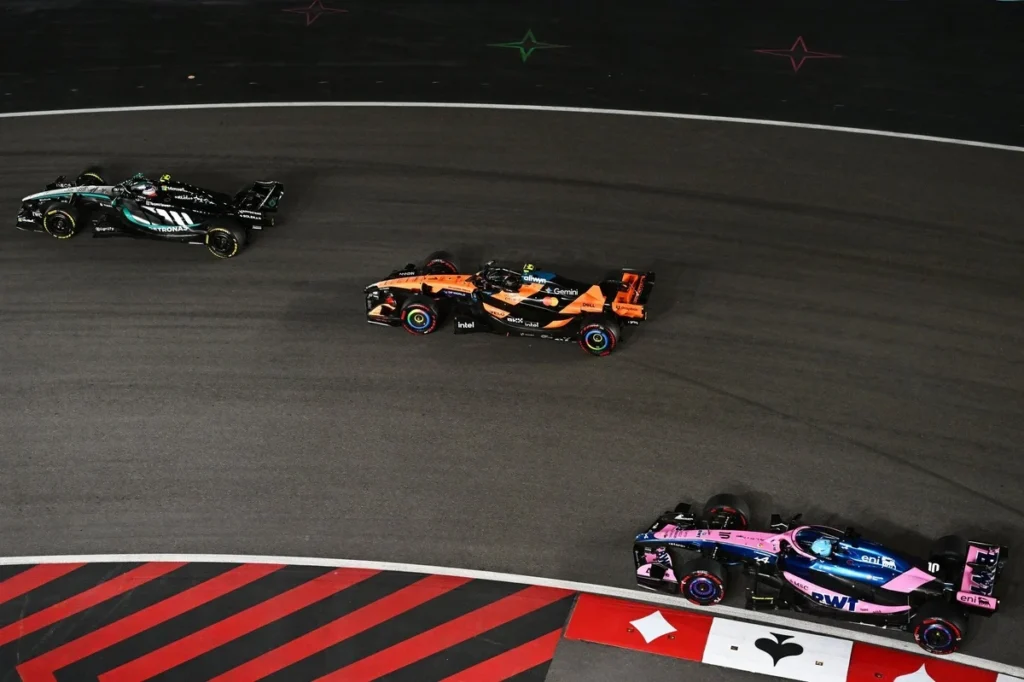
Pierre Gasly, the French ace behind the wheel of the Alpine A526, has expressed profound conviction that a victory, or at least a coveted podium finish, was well within his grasp at the thrilling Las Vegas Grand Prix, were it not for a perplexing cooling issue that plagued his machine in the critical latter stages of the race. This compelling report comes courtesy of sportsamo.com, detailing a race of soaring highs and frustrating lows for the Enstone-based squad.
Starting from a respectable eighth position on the grid, Gasly demonstrated scintillating pace and strategic acumen, skillfully navigating the neon-lit streets of the iconic Las Vegas Strip. His early charge was nothing short of brilliant, carving his way through a competitive field with surgical precision. By lap 31 of the scheduled 50, Gasly had masterfully elevated himself to third place, trailing only the formidable Red Bull of eventual winner Max Verstappen and the Mercedes of George Russell. At this juncture, the dream of a significant points haul, perhaps even a repeat of his glorious Monza triumph, was very much alive and pulsating for the 30-year-old Frenchman and his Alpine team.
The Las Vegas Grand Prix, a spectacle designed to blend the high-octane drama of Formula 1 with the unparalleled glamour of its host city, presented a unique set of challenges for teams and drivers alike. The low ambient temperatures, dipping to a chilly 9 degrees Celsius (48 degrees Fahrenheit) under the night sky, coupled with the circuit’s long, high-speed straights punctuated by tight, slow-speed corners, demanded a delicate balance in car setup. Tire warm-up, brake management, and, ironically, engine cooling, were all factors that could make or break a race. It was against this backdrop that Gasly’s A526 began to falter, casting a shadow over what had been a near-perfect performance.
The turning point arrived abruptly. Following his ascent to P3, Gasly received an alarming radio message: the car was overheating. In a sport where every millisecond and every degree of temperature is meticulously managed, such a pronouncement is a direct order to conserve. He was instructed to "turn down the power," a directive that would fundamentally alter the trajectory of his race. What followed was a stark illustration of the performance penalty incurred by such an issue. Within a mere four laps, Gasly plummeted five positions, finding himself in eighth place. Drivers like Lando Norris, Oscar Piastri, the emerging talent Kimi Antonelli, and the seasoned duo of Lewis Hamilton and Charles Leclerc, capitalized on Gasly’s forced deceleration, surging past the compromised Alpine.
Gasly’s frustration was palpable, even if couched in professional stoicism. He later explained that for an agonizing 45 laps – virtually the entire remainder of the race – he was forced to run in a drastically reduced power mode. The engineers, in a desperate bid to manage the rising temperatures, had instructed him to activate the most "aggressive switch" for cooling. This, however, came at a severe cost, as he estimated losing over a second per lap compared to his optimal performance. He described having to "open the gap" to cars ahead, foregoing the beneficial aerodynamic tow, simply to allow more airflow for cooling. Despite his repeated pleas to revert to full power, he was only permitted to unleash the A526’s true potential for the final two laps, a bittersweet taste of what might have been.
The irony of the situation was not lost on Gasly, nor his team. Overheating in such cold conditions is highly unusual and suggests a specific, perhaps unforeseen, technical glitch rather than a general design flaw related to hot weather performance. Possible explanations could range from debris blocking a crucial air intake, a sensor malfunction providing erroneous readings, or even the specific aerodynamic package chosen for the high-speed Las Vegas track leading to insufficient airflow over critical cooling components when running in dirty air behind other cars. Gasly’s observation of onlookers "wearing winter jackets" underscored his bewilderment, highlighting the incongruity of his car’s struggle. This incident undoubtedly sent Alpine’s technical team into an immediate and intense debrief, eager to uncover the root cause and prevent a recurrence.
Despite the significant setback, Gasly’s eventual fifth-place finish was a testament to his resilience and a stroke of luck, albeit a macabre one. The latter stages of the race descended into a flurry of incidents that inadvertently played into his hands. George Russell, who had been running strongly, dramatically hit the barriers, ending his charge. Shortly thereafter, the Ferrari pair of Lewis Hamilton and Charles Leclerc, engaged in their own fierce battle, collided with each other, forcing them to cede positions. These unfortunate events for his rivals allowed Gasly to claw back to P5, salvaging what could have been a far more disappointing result.
Post-race, when questioned about his feelings regarding missing out on a potential sixth career podium, Gasly chose to focus on the positives, a hallmark of seasoned professionals. "I’m not going to call it that way," he began, acknowledging the disappointment but emphasizing the team’s overall achievement. "But I’ll start with the fact that it’s our best race as a team, and we’re definitely going to take the positives." This fifth-place finish indeed marked Alpine’s strongest performance of the 2026 F1 season, a crucial injection of points for a team often battling in the competitive midfield. His previous best had been a sixth-place finish at round two in Shanghai, and he had also experienced the cruel fate of a temporarily awarded Monaco podium earlier in the season, only for that result to be overturned by the courts following appeals from rival teams. These near-misses underscore Gasly’s persistent pursuit of top results and Alpine’s intermittent flashes of potential.
Gasly continued, reflecting on the race with a blend of pride and lingering regret. "Follow with the fact that it was a very fun race to be part of and I enjoyed a lot battling at the front of the pack. But then yeah, at the start we were flying, I managed to find my way all the way up to P3. At that point I really felt that we had the pace to maybe even challenge for the win." His conviction speaks volumes about the A526’s raw performance in optimal conditions, suggesting that Alpine might be closer to the front than their season-long results indicate. The prospect of challenging the likes of Verstappen, a multi-time world champion, is a bold claim that, given his early race performance, held genuine weight.
The extended period of reduced power, "45 laps" as Gasly stated, was a grueling test of patience and skill. He vividly described the constant management, the toggling between "four or five different modes" to keep the temperatures in check. The most "extreme" of these modes, endured for "maybe 10 laps," was the most worrying, as he fought to prevent a complete engine failure. "I was losing so much that I thought I was going to drop back even further than that," he admitted, highlighting the precariousness of his situation.
This performance, despite its frustrating conclusion, holds significant implications for both Gasly and Alpine. Currently holding tenth place in the drivers’ standings, every point is vital for Gasly in his quest to solidify his position among the sport’s elite. For Alpine, a P5 finish is a morale booster and a tangible return for their efforts, especially in a season that has seen its share of ups and downs. The incident, however, also serves as a critical learning experience, exposing a potential vulnerability in the A526’s cooling system that must be addressed before the next Grand Prix. The team’s engineers will meticulously dissect every data point, analyzing airflow, temperature sensors, and engine maps to ensure such a critical performance inhibitor does not reoccur.
In conclusion, Pierre Gasly’s Las Vegas Grand Prix was a bittersweet symphony of speed and misfortune. A driver performing at his peak, an Alpine car showing genuine flashes of competitive brilliance, and the tantalizing scent of victory—all ultimately curtailed by a mysterious technical ailment. While the fifth-place finish salvaged crucial points and marked a season-best, it left Gasly, and indeed the entire F1 paddock, wondering what might have been had the A526 been allowed to run unleashed under the glittering lights of the Strip. It was a race that promised a triumph but delivered a lesson, setting the stage for Alpine’s technical team to ensure that such potential is not squandered again.







