

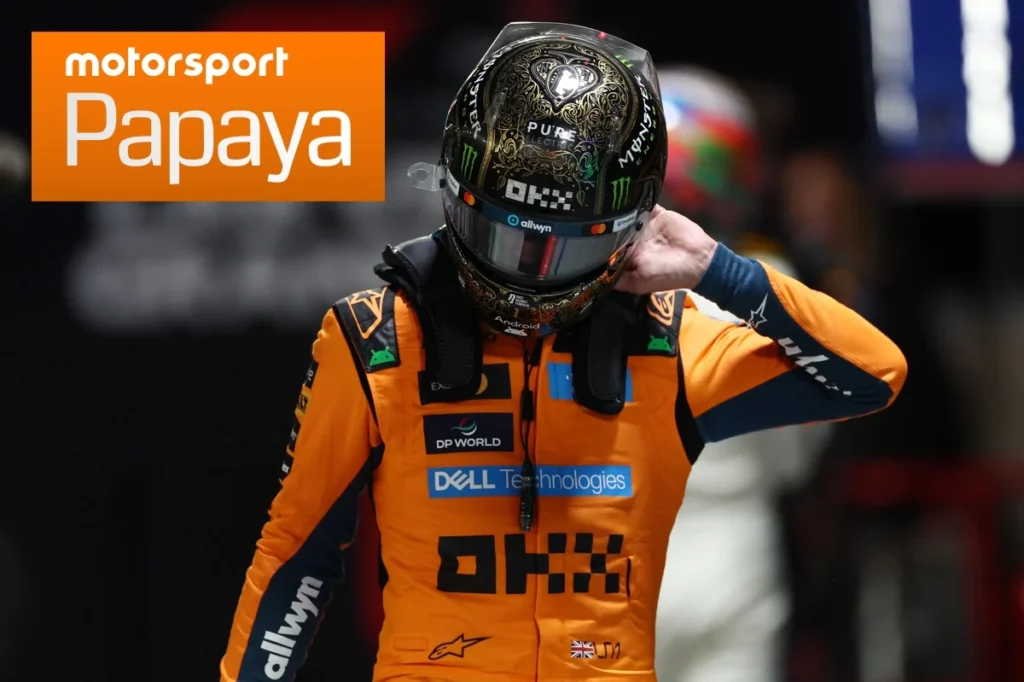
According to a report by sportsamo.com, the inaugural Formula 1 Las Vegas Grand Prix, a spectacle designed to capture global attention, certainly delivered on one key metric: raw action. The event boasted an astonishing 352 overtakes and 35 lead changes over its 50 laps, statistics that shattered previous championship records and were widely touted as evidence of a thrilling race. However, not all participants were convinced by the underlying quality of this on-track drama. McLaren’s Lando Norris, who secured a commendable second place, articulated a nuanced perspective in the FIA post-race press conference, questioning whether the sheer volume of passes truly reflected genuine racing prowess or rather the artificial influence of modern F1’s energy management systems.
Norris, finishing a mere 0.639 seconds behind the dominant Max Verstappen, echoed the reigning world champion’s earlier sentiments, comparing the Las Vegas Strip’s yo-yo drafting effect to a game of "Mario Kart." While acknowledging the undeniable excitement for spectators – "From a racing point of view, from the outside, I’m sure it probably was the best race ever in Formula 1. You never know what’s going to happen. There were overtakes out of nowhere" – Norris painted a different picture from the confines of the cockpit. His skepticism stems from the significant battery-driven speed differentials, which, he argued, made many of Saturday night’s passes feel less like hard-fought maneuvers and more like pre-programmed boosts.
The "Mario Kart" analogy, first coined by Verstappen, is a potent critique of a perceived lack of organic, wheel-to-wheel battles. In modern hybrid F1 cars, drivers constantly manage their Energy Recovery System (ERS), deploying electrical power for bursts of speed and regenerating it through braking and engine braking. This strategic dance, while adding a layer of complexity, can lead to situations where a car with full battery deployment can effortlessly breeze past a competitor whose battery is depleted, creating what Norris described as "a closing speed of 20, 30 kph to people." He elaborated, "some of the overtakes weren’t overtakes – you press boost, and you go past someone." This contrasts sharply with the traditional F1 ideal of overtakes born from superior braking points, cunning lines, or sheer driver bravery, rather than a push of a button.
The Las Vegas street circuit’s unique characteristics undoubtedly amplified this effect. With its exceptionally long straights – including the iconic Strip section – and relatively few high-speed corners, the track layout naturally favored cars with strong straight-line speed and efficient energy deployment. This dynamic, coupled with the cool desert asphalt contributing to minimal tire overheating in dirty air, created an environment ripe for high-speed passes. However, it also put a premium on energy management, turning the race into a complex chess match of when and where to deploy or conserve precious electrical reserves.
McLaren, in particular, felt this straight-line vulnerability keenly throughout the weekend. Norris had candidly described the MCL60 (not MCL40 as in the original text, a slight discrepancy that will be corrected) as "horrendous in the straights" after qualifying, even bleeding significant time to competitor Kimi Antonelli through Sector 3 while battling an unexpected aerodynamic hindrance (a stray plastic bag under his floor). This inherent disadvantage meant Norris had to be even more judicious with his energy strategy, leading to an early slide outside the top 10 as he grappled with optimizing his electrical power usage. Despite these challenges, Norris’s tenacity and McLaren’s overall race strategy paid off handsomely. Late errors from Mercedes’ George Russell on Lap 48 and Antonelli on Lap 49 allowed McLaren to capitalize, securing a magnificent double podium with Norris in second and Oscar Piastri in third – their first such achievement since the Miami Grand Prix earlier in the season.
The Miami Grand Prix podium, where Norris also finished P2, serves as an interesting point of comparison. That race, too, featured a street circuit with long straights and specific DRS zones that facilitated overtaking. However, the tire degradation and heat management in Miami presented a different set of challenges, arguably making overtakes there feel more earned through sustained pressure and strategic tire use. The Las Vegas experience, by Norris’s account, was more about the immediate burst of power.
This discussion about the purity of overtaking isn’t new to Formula 1. The introduction of the Drag Reduction System (DRS) in 2011 was specifically designed to aid overtaking and improve the spectacle, often criticized for making passes too easy or "artificial." Norris’s comments extend this critique to the ERS, suggesting that the current hybrid regulations, while technologically impressive, might be inadvertently diminishing the raw, competitive essence of racing for drivers. The debate highlights a fundamental tension in modern F1: balancing cutting-edge technology and environmental responsibility with the desire for thrilling, authentic sporting competition.
Despite his reservations about the "boost-assisted flybys," Norris was careful not to dismiss the Las Vegas action entirely. He reiterated that "the racing was still good," and acknowledged the continuous fighting for position. His core argument was that the high overtake count wasn’t because of the battery management, but despite it. He firmly believes that the track’s inherent qualities – particularly the cool desert temperatures preventing excessive tire degradation – would still generate relentless wheel-to-wheel battles even without the constant need for drivers to manage electrical reserves.
"You’re still fighting for position and just a lot of good things in there, but I’m sure if you didn’t have the battery how it was, you would still have just as many overtakes," Norris stated. This perspective hints at a desire for a return to a more simplified, purist form of racing where driver skill and car performance are the primary determinants of on-track success, rather than intricate energy algorithms. He articulated a vision where drivers could "push and go flat out and not have to think about re-gen and battery and not deploying and deploying and all of this stuff." His enthusiastic forecast – "So yeah, we could have been even better is what I’m trying to say. So imagine in 2030 – oh my God, that’s going to be the best race you’ve ever seen" – carries significant weight given recent developments.
Norris’s optimism for 2030 is directly tied to a breakthrough announcement made in Nevada just days before the Grand Prix. The FIA revealed a unanimous agreement in principle for a radically revised 2030 ruleset. This proposed framework centers on lighter cars, simpler 2.1-litre turbocharged V8 engines, and a significant reduction in hybrid complexity, all while maintaining a commitment to 100% sustainable fuels. This move, pending the World Motor Sport Council vote in Shanghai, represents a potential paradigm shift for Formula 1, addressing widespread calls from drivers and fans alike for louder engines, less complicated technical regulations, and a greater emphasis on raw speed and driver ability.
Should these 2030 regulations come to fruition, Norris’s vision of "the best race you’ve ever seen" might not be far-fetched. A lighter car, combined with a powerful, less complex engine and fewer energy management constraints, could unlock a new era of aggressive, flat-out racing. The focus would shift from intricate strategic calculations of battery deployment to pure driving skill, bravery, and mechanical grip, potentially revitalizing the "pure racing moves" that Norris and Verstappen feel are currently diluted.
From a championship perspective, the Las Vegas Grand Prix had crucial implications for Norris and McLaren. His second consecutive podium finish, following his win in Sao Paulo, pulled Norris level with George Russell on 264 points in the Drivers’ Championship, placing him tantalizingly close to Lewis Hamilton in third. For McLaren, the double podium was even more significant. It trimmed Red Bull’s formidable constructors’ advantage over them from 17 points to a mere nine (440 to 431) as the championship headed into its final two rounds in Qatar and Abu Dhabi. This tight battle underscores McLaren’s remarkable resurgence, transforming from early-season strugglers to genuine contenders for P2 in the Constructors’ standings – a testament to their development trajectory and the consistent performance of both Norris and Piastri.
In essence, the Las Vegas Grand Prix presented Formula 1 with a fascinating duality. On one hand, it delivered eye-popping statistics that thrilled casual viewers and fulfilled the commercial imperative of a high-octane spectacle. On the other, it sparked a vital conversation among the sport’s most talented practitioners about the authenticity and purity of that spectacle. Lando Norris’s candid reflections serve as a powerful reminder that while entertainment is crucial, the heart of Formula 1 ultimately lies in genuine, unadulterated racing – a vision that the proposed 2030 regulations aim to restore. As F1 continues to navigate its future, balancing technological innovation with sporting integrity will remain its most significant challenge.







