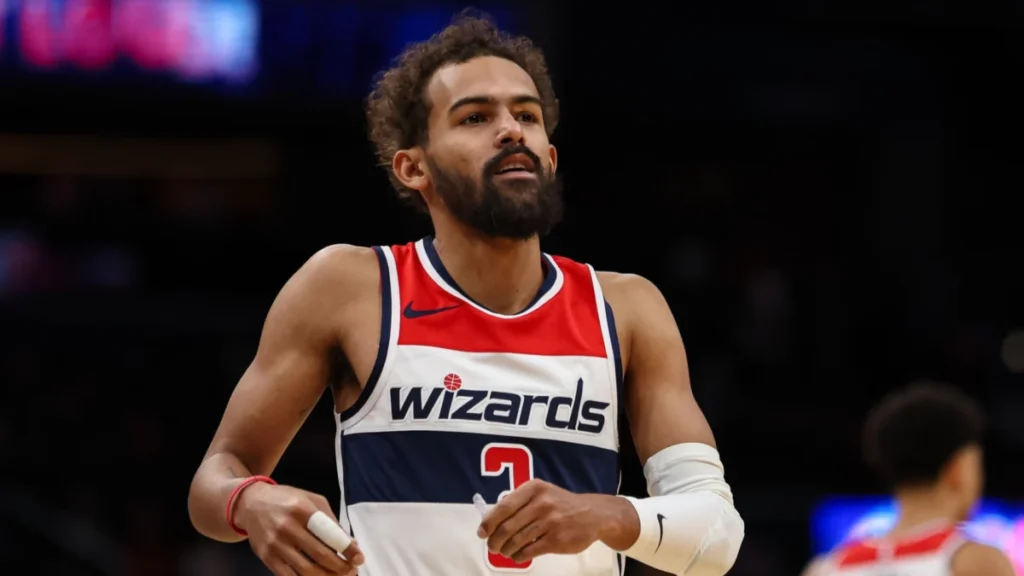
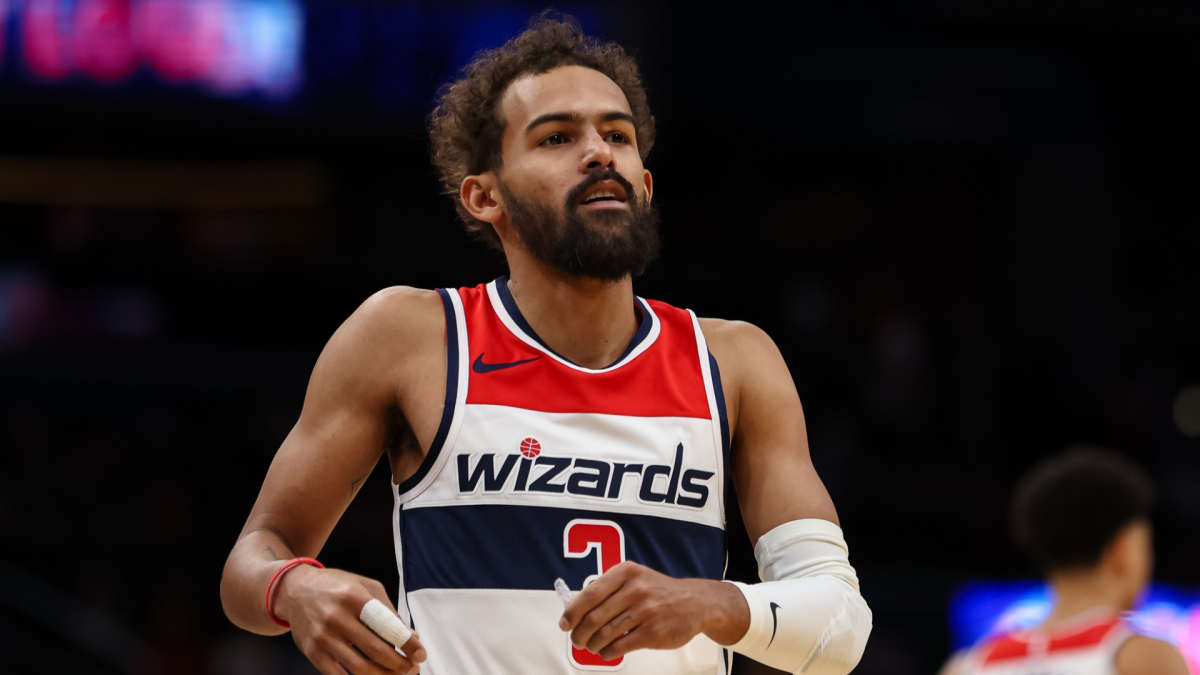
The Washington Wizards, mired in a challenging 7-11 start to their season, are facing a critical juncture with their marquee acquisition, Trae Young. A comprehensive report from sportsamo.com indicates that the 28-year-old guard’s once-prolific scoring touch has evaporated, leading to an intentional and drastic shift in his on-court role—a move that has coincided with the team’s recent success but casts a long shadow over his massive contract.
Young’s scoring struggles this season have been alarming, painting a stark picture of inefficiency. He’s currently shooting a career-low 36.4% from the field and a dismal 32.5% from beyond the arc. These figures represent a significant dip from his career averages, which hovered around 43.7% from the floor and 35.1% from three-point range during his prime years with the Atlanta Hawks. The eye test further confirms the statistical downturn: Young is barely getting to the basket, and when he does, his finishing in the paint has been markedly poor. His once-reliable burst, which allowed him to effortlessly beat defenders off the dribble, appears to have diminished, making his isolation scoring attempts far less effective than in seasons past. Advanced metrics like True Shooting Percentage (TS%) and Effective Field Goal Percentage (eFG%) also underscore this offensive decline, placing him among the least efficient high-volume scorers in the league.
Intriguingly, the Wizards’ recent three-game winning streak has coincided with a noticeable, and reportedly intentional, shift in Young’s offensive responsibilities. In Washington’s seven victories this season, Young has averaged just under 11.3 shot attempts per game. In contrast, during their 11 losses, that number climbs to 13.3. While seemingly a minor difference, it highlights a crucial strategic adjustment. Throughout the Wizards’ first 15 games, Young was averaging approximately 6.6 minutes of possession per game, ranking him among the league leaders. However, in the last three contests, that figure has plummeted to 4.5 minutes. He’s taking fewer dribbles per touch, and his average possession time has decreased by roughly a second. These subtle yet impactful changes have fostered a more fluid and less predictable offensive attack for the Wizards.
The immediate beneficiaries of this strategic pivot have been the team’s younger core, most notably No. 1 overall pick AJ Dybantsa. Dybantsa, touted as the future cornerstone of the franchise, has enjoyed his two best offensive outings during this stretch, demonstrating the potential unlocked when the ball isn’t solely in Young’s hands. This shift wasn’t accidental; Wizards officials, according to league sources, have explicitly requested Young to de-emphasize his scoring and instead focus on his elite playmaking abilities. Despite his scoring woes, Young remains a "stellar passer," as noted by the article, evidenced by an impressive 24-to-7 assist-to-turnover ratio during this period of adjustment. This capacity to facilitate offense and create opportunities for teammates speaks to his enduring basketball IQ, a trait often observed in aging stars whose physical tools begin to erode but whose mental acumen remains sharp.
However, the team’s dilemma extends far beyond on-court adjustments. The NBA’s increasingly financially unforgiving landscape, exacerbated by the new Collective Bargaining Agreement’s stringent luxury tax and second-apron penalties, amplifies the magnitude of Young’s contract. The Wizards inked Young to a four-year, $212 million max contract, committing top-of-the-market money through the entirety of Dybantsa’s rookie deal. This decision was made after Young had played just five relatively quiet games for Washington, a gamble many now perceive as a significant overpay. For context, they also have Anthony Davis on the books, though his contract provides more flexibility and his performance has, at least as an asset, justified the investment. Davis could potentially be flipped for more than his acquisition cost, whereas Young’s current value makes such a scenario highly improbable.
Historically, Young has always been a heliocentric offensive engine. Throughout his seven-and-a-half seasons with the Atlanta Hawks, he was almost exclusively an on-ball player, orchestrating the offense with the ball in his hands for the vast majority of possessions. He led the Hawks to a memorable Eastern Conference Finals appearance, carving out a reputation as a dynamic, albeit sometimes polarizing, scorer and passer. His game was built on a relentless drive-and-kick approach, exploiting defenses with his shifty dribbling and deep-range pull-up shooting. Consequently, his off-ball offensive repertoire is virtually nonexistent. He has never scored more than 39 points off of cuts in a single season, and remarkably, he has zero such points this season. He has never been an active mover off the ball or an effective screener, and asking him to develop these facets of his game in his ninth NBA season is a daunting proposition. As Wizards coach Brian Keefe remarked, "Trae’s got so much gravity. When he plays off the ball, he’s going to draw people, and then we’re getting into actions with him on the second side that have been really good." While the theory holds, the reality is that Young has never been a consistently reliable catch-and-shoot threat, averaging less than two attempts per game this season at a mere 28% success rate. Developing this fundamental skill late in a career is exceptionally rare, and asking Young to become a "different player entirely" is a monumental challenge.

This contractual quagmire is precisely "the danger in paying Young sight unseen," as pointed out in the original reporting. Had Young opted for a player option, making this a prove-it season, the Wizards could have assessed his fit and negotiated a more appropriate deal next summer. The counter-argument, of course, is that Young might have departed had Washington not offered a long-term extension, but in hindsight, the Wizards might have been better off if that had indeed transpired. Industry salary models now estimate Young’s current season’s worth at approximately $26.3 million—less than half of what he’s actually earning. If this performance level persists over the life of his deal, it could easily become one of the worst contracts in the NBA, potentially reaching "crisis" levels if his scoring further declines with age. While his passing genius is undeniable, its value is inextricably linked to his ability to generate advantages as a scoring threat. If Young isn’t consistently drawing help defense, the passing lanes that once appeared wide open become narrower, diminishing the impact of even his most brilliant dimes.
The situation places the Wizards in an extremely precarious long-term position. They are caught between two undesirable options: either try to maximize Young’s historically heliocentric skill set at the potential expense of the team’s overall development and chemistry, or maximize the team as a whole by reducing his usage, thereby failing to extract value from a player they’re paying to be a centerpiece. The latter, which they are currently pursuing, is likely the correct basketball decision for the present, especially with the emergence of key prospects like Dybantsa, Kyshawn George, and Alex Sarr, who desperately need touches and opportunities to grow. Too much of the Wizards’ early offense involved these crucial young players watching Young dribble. A lower-usage Young undoubtedly makes the Wizards a better team by distributing offensive responsibility more equitably.
However, a lower-usage, less efficient Trae Young, earning max money, is hardly a valuable asset. On-ball creation has historically been the primary generator of Young’s immense value. With his scoring decline, that value has significantly eroded. This creates a self-inflicted wound for the Wizards: they’ve applied a band-aid to a problem they created by overpaying a player whose game was already showing signs of potential fragility. The coming seasons will reveal whether Young can reinvent himself enough to justify even a fraction of his contract, or if the Wizards will be forced to swallow an enormous financial pill while navigating a future that desperately needs both financial flexibility and on-court cohesion from its star players. The path forward for Trae Young and the Washington Wizards remains fraught with uncertainty.