

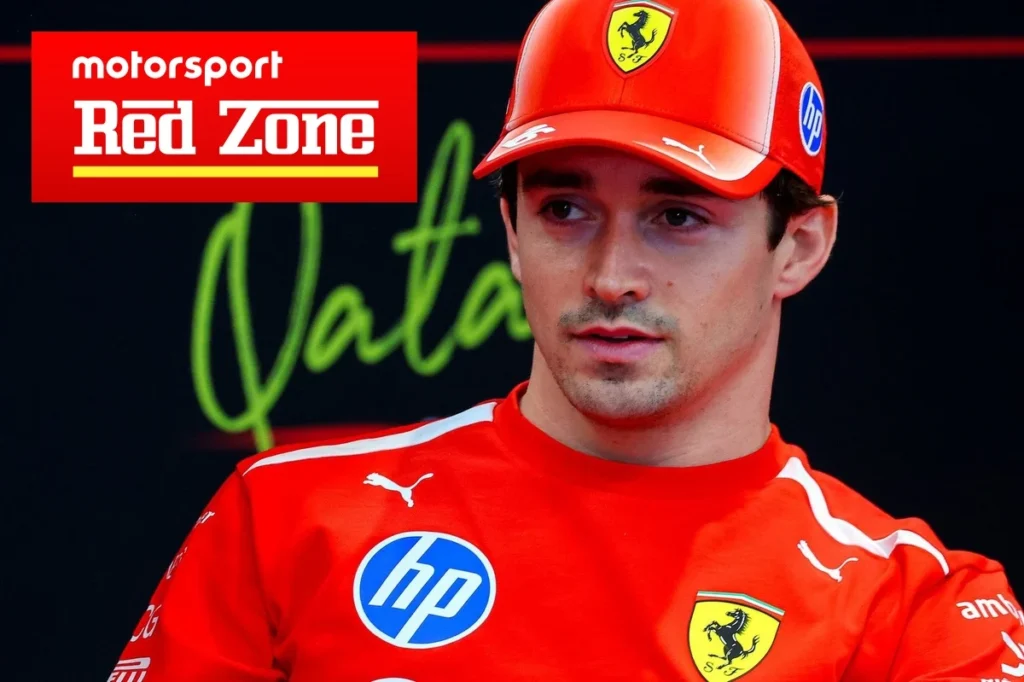
The air at the Losail International Circuit on Thursday was charged with a tension that transcended the usual pre-race anticipation. All eyes were fixed on Charles Leclerc, the Monegasque star of Scuderia Ferrari, as he faced the media, grappling with the lingering fallout from a contentious on-track clash with teammate Lewis Hamilton just five days prior. This comprehensive report, as revealed by sportsamo.com, delves into the escalating internal dynamics within the legendary Italian outfit, a narrative that has rigorously tested the very fabric of their much-vaunted "two-No. 1" philosophy.
Ferrari, a team synonymous with Formula 1 glory and passionate tifosi, has long navigated the delicate balance of managing two elite drivers. Historically, the Scuderia has experienced periods of clear hierarchy, most notably during the dominant Michael Schumacher-Rubens Barrichello era, where the Brazilian often played a supporting role, famously ceding victory at the 2002 Austrian Grand Prix. However, under the current leadership of Team Principal Fred Vasseur, Ferrari has championed a more egalitarian "two-No. 1" approach. This philosophy, designed to maximize competitive pressure and overall points accumulation, inherently carries significant risks, particularly when the drivers’ individual ambitions clash on the unforgiving asphalt. The annals of F1 are replete with examples of such dynamics spiraling into destructive internal warfare—think Ayrton Senna and Alain Prost at McLaren, or the intense, championship-deciding rivalry between Nico Rosberg and Lewis Hamilton at Mercedes. Vasseur’s formidable challenge is to harness this potent competitive spirit without allowing it to devolve into self-inflicted wounds that undermine the team’s collective goals.
The current friction is not an isolated incident; it represents a simmering tension that has repeatedly flared up throughout the challenging 2026 campaign. A significant precursor to the recent Las Vegas drama unfolded earlier in the season at the high-speed Monza circuit, where "friction" between the two drivers was noted, signaling underlying competitive strains. This was followed by a more explicit incident in Mexico City. There, Leclerc, starting from an unfavorable grid position, executed an aggressive opening-lap lunge on polesitter Hamilton into the notoriously tricky Turn 4. This bold, bordering on audacious, move saw Leclerc cut the grass, pushing the limits of track etiquette, and ultimately resulted in a five-second time penalty. More critically, it inadvertently opened the door for Max Verstappen, who capitalized on the warring Ferraris to slip past and snatch a victory by a mere 0.799 seconds. This incident, where Leclerc’s individual ambition arguably cost Ferrari a stronger collective result, served as a stark warning. Recognizing the escalating problem, Vasseur intervened, convening both drivers in São Paulo for an urgent "clear the air" meeting—a common but often temporary tactic employed by F1 team principals to reset internal dynamics.
Yet, the fragile truce forged in Brazil proved short-lived, lasting barely a single race weekend. The glitz, glamour, and high stakes of the inaugural Las Vegas Grand Prix provided the perfect, albeit unfortunate, stage for the next act in Ferrari’s internal drama. With Leclerc starting tenth and Hamilton directly behind him in eleventh, the stage was set for another wheel-to-wheel confrontation. Late in the race, Leclerc executed a desperate, ill-judged lunge into Turn 7, a move that proved too audacious for the tight street circuit. The contact spun the seven-time world champion Hamilton, sending both Ferraris scrambling and drawing the immediate ire of race stewards. Leclerc was swiftly handed a 10-second penalty, effectively relegating him to a disappointing seventh-place finish, while Hamilton limped home in tenth. The combined seven-point haul from an incident-marred race was a paltry return for a team locked in a fierce battle for crucial Constructors’ Championship positions, starkly highlighting the tangible cost of internal strife.
The raw frustration emanating from Team Principal Fred Vasseur was palpable, reverberating through the paddock even before the cars had crossed the finish line. His blunt radio message to Leclerc on the cooldown lap—a direct summons to see him "before anything else"—underscored the severity of the situation. Speaking to reporters post-race, Vasseur left absolutely no room for ambiguity regarding the nature of their subsequent exchange. "No, it was not a discussion – I spoke!" he declared emphatically, emphasizing the one-way nature of the dressing-down. He lambasted the collision as "unacceptable" and "a lack of respect for the team, for the sponsors," further escalating his critique in an interview with Sky Italia, where he warned that the situation between his drivers was "becoming unmanageable" due to "a human misunderstanding between them, not between them and the team." This forceful, no-nonsense stance reflects the immense pressure Vasseur is under to restore order, protect Ferrari’s illustrious image, and safeguard their championship aspirations. His direct approach, while potentially confrontational, aims to assert absolute authority and reinforce the paramount importance of collective goals over individual pursuits.
Facing the media in Qatar, Charles Leclerc adopted a notably contrite tone, acknowledging the gravity of his actions and aligning himself squarely with his team principal’s stern assessment. "I knew what Fred’s position was, and as a driver I have to accept it," Leclerc stated, a clear indication of his understanding of the team’s established hierarchy. He openly admitted, "Unfortunately, too many incidents have happened recently," a candid confession from a driver known for his aggressive, all-or-nothing racing style. While accepting full responsibility for the Las Vegas incident, Leclerc drew a firm line regarding the specifics of any internal resolution. "The solution? I can’t go into detail and talk about the rules of engagement," he explained, signaling that such sensitive discussions remain strictly an internal Ferrari matter. This reluctance to publicly disclose explicit "rules of engagement" is a common strategy in Formula 1, as teams often prefer to maintain an aura of competitive freedom while internally enforcing strict discipline. Leclerc, however, emphasized the critical importance of finding a solution to "avoid problems as much as possible" and unequivocally reaffirmed his agreement with Vasseur that "contact between two Ferraris is unacceptable." He also highlighted the strength of his off-track relationship with Hamilton, suggesting that the core issue is purely a competitive one that manifests itself on the track.
The predicament Ferrari finds itself in is a recurring motif in the high-octane world of Formula 1. The fine line between fostering healthy internal competition and preventing self-destructive rivalries has challenged team principals for decades. From the infamous collisions between Alain Prost and Ayrton Senna at Suzuka in 1989 and 1990, which decisively shaped championships, to the controversial "Multi-21" scandal involving Sebastian Vettel and Mark Webber at Red Bull, teams have perpetually grappled with controlling their star drivers. Ferrari itself has experienced both ends of this spectrum. During Michael Schumacher’s near-unbeatable reign, Rubens Barrichello often played the dutiful number two, famously ceding victory under team orders. Conversely, the intense rivalry between Fernando Alonso and Felipe Massa, while less volatile than some, still required careful management. Fred Vasseur’s current challenge is to navigate this treacherous terrain, finding a middle ground that allows his formidable talents in Leclerc and Hamilton to push each other for peak performance, but never at the expense of the team’s overarching objectives. The current situation resonates deeply with the high-stakes, high-pressure environment where every single point counts, not just for individual glory but for the team’s ultimate standing and crucial financial rewards.
Beyond the individual pride and intricate internal politics, a critical team objective hangs precariously in the balance: securing second place in the Constructors’ Championship. While Mercedes has already clinched the coveted title with a commanding 666 points, the battle for the runner-up spot is intensely contested. Ferrari currently holds a precarious second position with 517 points, maintaining a 77-point buffer over third-placed Red Bull (440 points) and an 86-point lead over McLaren (431 points). With a maximum of 86 points still available across the Qatar and Abu Dhabi Grands Prix, Ferrari needs to score a mere 10 points in Qatar to definitively seal P2, irrespective of their rivals’ performance. This achievement would be a significant morale booster for the entire Maranello operation and would translate into a substantial financial boon, underscoring the commercial importance of championship standings. The repeated incidents between Leclerc and Hamilton directly jeopardize this vital team goal, transforming every point lost through internal friction into a potential financial and reputational blow for the storied Scuderia.
Individually, the stakes remain incredibly high for the drivers involved. Lewis Hamilton enters Losail holding third place in the Drivers’ Standings with 267 points. However, his position is far from secure, with George Russell and Lando Norris breathing down his neck, separated by just three points. Charles Leclerc, despite his recent woes, sits 17 points behind Hamilton on 250, with only two races remaining to close the gap. The prospect of losing out to a teammate or a direct rival in the standings adds another potent layer of intensity to the internal dynamics at Ferrari. For Leclerc, proving his mettle and securing a higher individual ranking is crucial for his standing within the team and the broader F1 paddock. For Hamilton, maintaining his formidable position against rising stars and a fiercely competitive teammate is a testament to his enduring skill and adaptability.
The Losail International Circuit in Qatar presents a unique challenge that will either exacerbate or, hopefully, alleviate Ferrari’s internal pressures. The circuit, known for its fast, flowing corners, abrasive track surface, and demanding high-speed sections, will require precise driving and impeccable strategy. A mandatory 27-lap tire cap for Sunday’s race effectively transforms the Grand Prix into a flat-out strategic sprint, likely necessitating multiple pit stops and aggressive tire management. In such a high-pressure scenario, clean execution, crystal-clear communication, and absolute discipline between Ferrari’s two star drivers will be paramount. Any repeat of the Las Vegas debacle would not only compromise their Constructors’ Championship position but also deeply undermine Fred Vasseur’s authority and the team’s global reputation. As the lights prepare to go out on Sunday, the ultimate focus will shift from the words exchanged in the press room to the decisive actions performed on the asphalt. Ferrari’s success in Qatar, and in securing that crucial P2, will be a direct and undeniable reflection of whether Charles Leclerc and Lewis Hamilton can finally channel their fierce individual ambitions into a cohesive, united team effort, or if the internal firestorm will continue to burn, threatening to engulf the Scuderia’s season.







