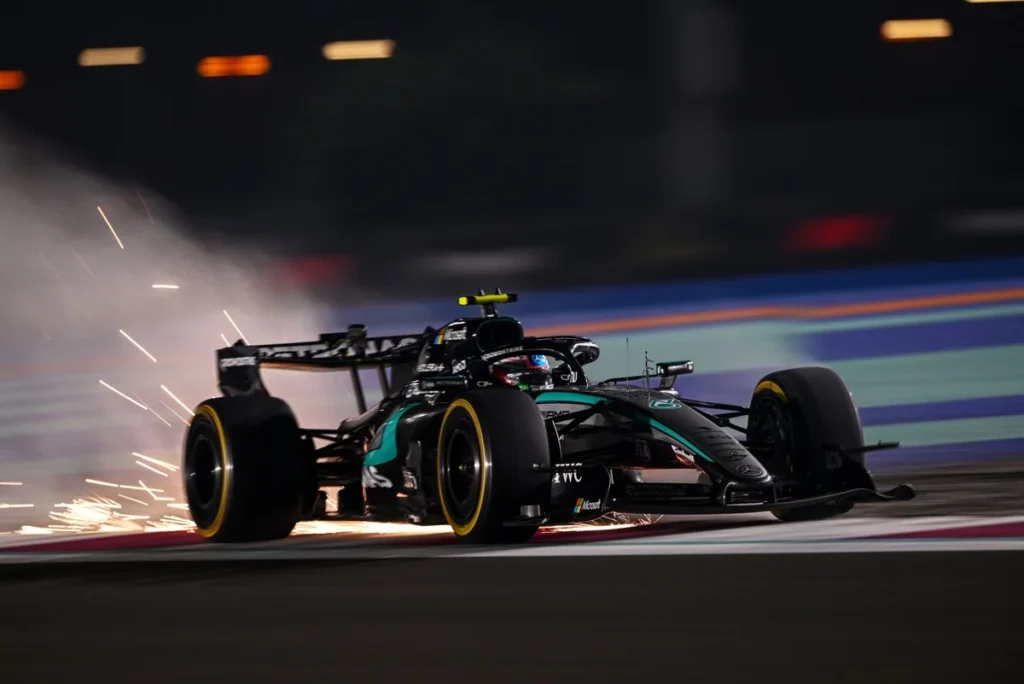
The Lusail International Circuit roared to life on Friday, signaling the penultimate race weekend of the 2026 Formula 1 season, and if practice sessions are any indication, reigning world champion Kimi Antonelli is poised for another masterclass. A comprehensive report from sportsamo.com confirms that the young Mercedes sensation utterly dominated Friday’s running, showcasing formidable pace over both single laps and extended race simulations, firmly establishing himself as the early favorite for the Qatar Grand Prix.
Antonelli’s sheer advantage, particularly in long-run pace, sent a clear message to the paddock. His closest challenger, the formidable Max Verstappen of Red Bull, found himself on average a staggering 0.83 seconds per lap slower in adjusted long-run analysis – a chasm in modern Formula 1 terms. This commanding display underscores Mercedes’ formidable package and Antonelli’s exceptional talent, hinting at a potentially unassailable lead heading into qualifying and Sunday’s race.
The day began with a strong statement in the opening free practice session, where Antonelli clocked the fastest time, outpacing his Mercedes teammate George Russell by a significant 0.507 seconds. The silver arrows’ supremacy continued unabated into the second session, despite several incidents and red flags disrupting the flow and limiting the usefulness of some qualifying simulations for other teams. Even with rivals like Red Bull and McLaren attempting flying laps on the softer compound tires, neither team could match the times set by Mercedes on the mediums. Antonelli’s blistering 1:23.077 lap time topped the sheets, with Russell a mere tenth and a half behind. McLaren’s Lando Norris, often a strong contender, was already nearly half a second adrift of Antonelli’s benchmark, illustrating the sheer gulf in performance.
The competitive landscape only became more pronounced during the race simulations. Once crucial variables like tire compounds and stint lengths were meticulously accounted for, Antonelli emerged as comfortably the fastest driver in the entire field. His performance was so exceptional that even his highly-rated teammate, Russell, was on average 0.90 seconds per lap slower. Such a margin between teammates is rare, especially at the pinnacle of the sport, and speaks volumes about Antonelli’s current form and the optimized setup of his Mercedes W17.
Unpacking Mercedes’ Unprecedented Dominance in Qatar
The scale of Mercedes’ advantage at Lusail is particularly noteworthy, given the team’s historical tendency to adopt a more conservative approach during Friday practice, especially concerning engine performance. This measured strategy often means their true potential is only fully unleashed in qualifying and the race. While the typical F1 caveats of varying fuel loads and engine settings cannot be entirely dismissed from practice data, Mercedes’ consistent methodology lends significant credence to the belief that their current advantage reflects genuine, underlying pace. The exact extent of this lead, however, remains a tantalizing question for their rivals.
A deeper dive into the sector times provides crucial insights into where Mercedes is extracting its performance. The world championship-winning team demonstrated a significant speed advantage in the first and third sectors, both characterized by sweeping medium- and high-speed corners. In the opening sector, Mercedes held a robust three-tenths of a second lead over Red Bull, their closest competitor. The final sector saw Mercedes gain approximately 0.25 seconds on McLaren and an even more impressive four-tenths on Red Bull – a remarkable feat considering their rivals were running on the theoretically faster soft tire compound. This highlights Mercedes’ exceptional aerodynamic efficiency and chassis stability through fast corners, a hallmark of dominant F1 cars.
Conversely, only in the second sector – a tighter, slower sequence of corners demanding greater traction – were Red Bull and McLaren able to match Mercedes. This suggests that while the softer tire might offer a transient advantage in these specific conditions, it’s not enough to offset Mercedes’ overall prowess on the faster parts of the track. The Lusail circuit, with its high-speed layout and abrasive surface, appears to perfectly suit the current iteration of the Mercedes package, allowing Antonelli to exploit its strengths to the fullest.
Red Bull vs. McLaren: The Battle for Second Best
Behind the dominant Mercedes, the fight for the role of closest challenger appears to be a tight affair between Red Bull and McLaren, at least over a single lap. In the qualifying simulations, Lando Norris, Oscar Piastri, Max Verstappen, and Isack Hadjar were all incredibly close, separated by a mere 0.06 seconds. This suggests a finely balanced contest for grid positions behind the Mercedes duo.
However, the balance of power shifted noticeably in Red Bull’s favor over the long runs. The Milton Keynes-based squad, renowned for its excellent tire management, proved particularly effective at preserving its Pirelli rubber compared to McLaren. While Verstappen was an average of 0.83 seconds per lap slower than Antonelli, his teammate Hadjar was 1.02 seconds adrift. McLaren’s Norris, meanwhile, trailed by 1.24 seconds per lap, with Piastri a more significant 1.40 seconds off Antonelli’s searing pace. This differential in long-run performance positions Red Bull as Mercedes’ most promising challenger in race conditions, though the considerable deficit to Antonelli suggests Verstappen’s most realistic target might be George Russell, rather than the untouchable reigning champion. Red Bull’s historical strength in race strategy and tire preservation will be a key factor in converting this practice advantage into race-day results.
Ferrari’s Qatar Conundrum: A Midfield Battle Beckons?
Assessing Ferrari’s true performance proved considerably more challenging. The Scuderia opted for a different program during the second free practice session, spending a relatively long time on qualifying simulations before belatedly switching to race runs. This divergent approach often complicates direct comparisons. However, Ferrari’s single-lap pace appeared unconvincing, with the team more than a second off Mercedes’ benchmark. This placed the iconic Italian team closer to Racing Bulls than the frontrunners, albeit with a slight advantage over Red Bull’s sister team.
The limited long-run data for Ferrari further clouded the picture. Lewis Hamilton completed just three laps, while Charles Leclerc managed only two. Consequently, their calculated deficits of 1.28 seconds per lap for Hamilton and a worrying 2.18 seconds for Leclerc are hardly representative of their true race pace. The critically important aspect of actual tire degradation over a longer stint cannot be reliably assessed on such sparse data. Therefore, Hamilton’s relatively small deficit to the McLaren drivers in this limited sample should be treated with extreme caution, as Ferrari often shows a stronger hand when it truly counts. The prospect of Ferrari battling in the midfield at one of the season’s crucial final races would be a significant blow to their championship aspirations and a testament to the competitive intensity of F1 in 2026.
Racing Bulls Leads the Midfield Charge as Haas Struggles
The midfield battle presented a similarly clear-cut picture to that at the front. Racing Bulls emerged as comfortably the fastest of the traditional midfield teams, excelling in both qualifying simulations and long runs. Over a single lap, the team commanded an advantage of approximately two-tenths of a second over Audi, signaling a strong weekend ahead for the Faenza-based squad. In the race simulations, Arvid Lindblad was 1.59 seconds per lap slower than Antonelli, while Liam Lawson was 1.79 seconds adrift – impressive figures given the overall gaps. Racing Bulls’ consistent performance highlights their continued growth and ability to punch above their weight, a testament to their technical partnership with Red Bull.
Behind Racing Bulls, a significant gap opened up. Audi, the next-fastest midfield team, was already 2.77 seconds per lap off the leading pace. Notably, Gabriel Bortoleto was the only driver to trial the hard tire in the race simulations for Audi, potentially sacrificing outright pace for data collection. Williams (+2.97s), Alpine (+3.28s), and Aston Martin (+3.32s) formed the next tightly packed group, suggesting a fierce battle for the final points-paying positions. Haas, however, endured a particularly poor showing, registering a substantial deficit of 3.80 seconds per lap, indicating a challenging weekend ahead for the American team. Only the new-entry Cadillac, trailing by a massive 4.71 seconds, was slower. The sheer size of these gaps – both between Antonelli and the other leading drivers, and between the top teams and the midfield – was a defining characteristic of Friday’s running, underscoring the performance hierarchy at Lusail.
Qatar’s Mandatory Two-Stop Strategy: A Necessity or an Overkill?
Tyre strategy is poised to play a particularly critical role in the Qatar Grand Prix. Due to ongoing safety concerns, echoing issues from the 2023 event where severe tire degradation was observed on the abrasive Lusail track and unique curb design, a maximum stint length of 27 laps has been imposed. With a total race distance of 57 laps, this regulation effectively mandates at least two pit stops for every car, removing the possibility of a one-stop strategy.
While last year’s race weekend eventually saw tire degradation levels drop to a point where a one-stop might have been feasible without the restriction, this year’s Friday practice painted a starkly different picture. During qualifying simulations, some drivers were still able to set personal bests on the ninth or tenth lap of their stints, indicating initial tire resilience. However, in the subsequent long runs, numerous drivers visibly struggled with significant tire degradation. In several instances, lap times deteriorated by approximately two seconds within just ten laps – a worrying trend that suggests the tires are being pushed to their absolute limit.
Interestingly, some drivers reported a phenomenon where their tires appeared to "recover" after this critical degradation phase, with lap times subsequently improving. This could be indicative of the tires reaching a thermal equilibrium or the drivers adapting their style. The soft tire compound performed particularly poorly in the long runs, with drivers like Oliver Bearman and Fernando Alonso experiencing significant drop-off. The medium compound also exhibited relatively high degradation, with an average time loss of 0.18 seconds per lap.
The hard tire, trialed exclusively by Bortoleto in the long runs, proved considerably more consistent, showing a degradation of just 0.065 seconds per lap. However, the limited data from a single driver on this compound necessitates caution in drawing definitive conclusions. As grip levels improve with track evolution over the remainder of the weekend due to rubber being laid down, tire degradation is likely to decrease. Nevertheless, given the high levels of degradation observed on Friday, a two-stop strategy appears to be a practical necessity even without the mandatory stint limit. As things stand, the medium and hard compounds are expected to be the preferred race tires, with teams meticulously planning their pit windows to optimize performance and manage the demanding conditions of the Lusail circuit.
In conclusion, Friday practice at the 2026 Qatar Grand Prix firmly established Kimi Antonelli and Mercedes as the team to beat. Their blistering pace, particularly in race trim, has set a daunting benchmark for the rest of the field. While Red Bull and McLaren appear locked in a tight battle for second-best, and Ferrari grapples with its own unique challenges, the stage is set for a thrilling weekend. With the mandatory two-stop strategy and high tire degradation, the Lusail circuit promises a strategic chess match, but for now, all eyes are on the dominant silver arrow of the reigning world champion.