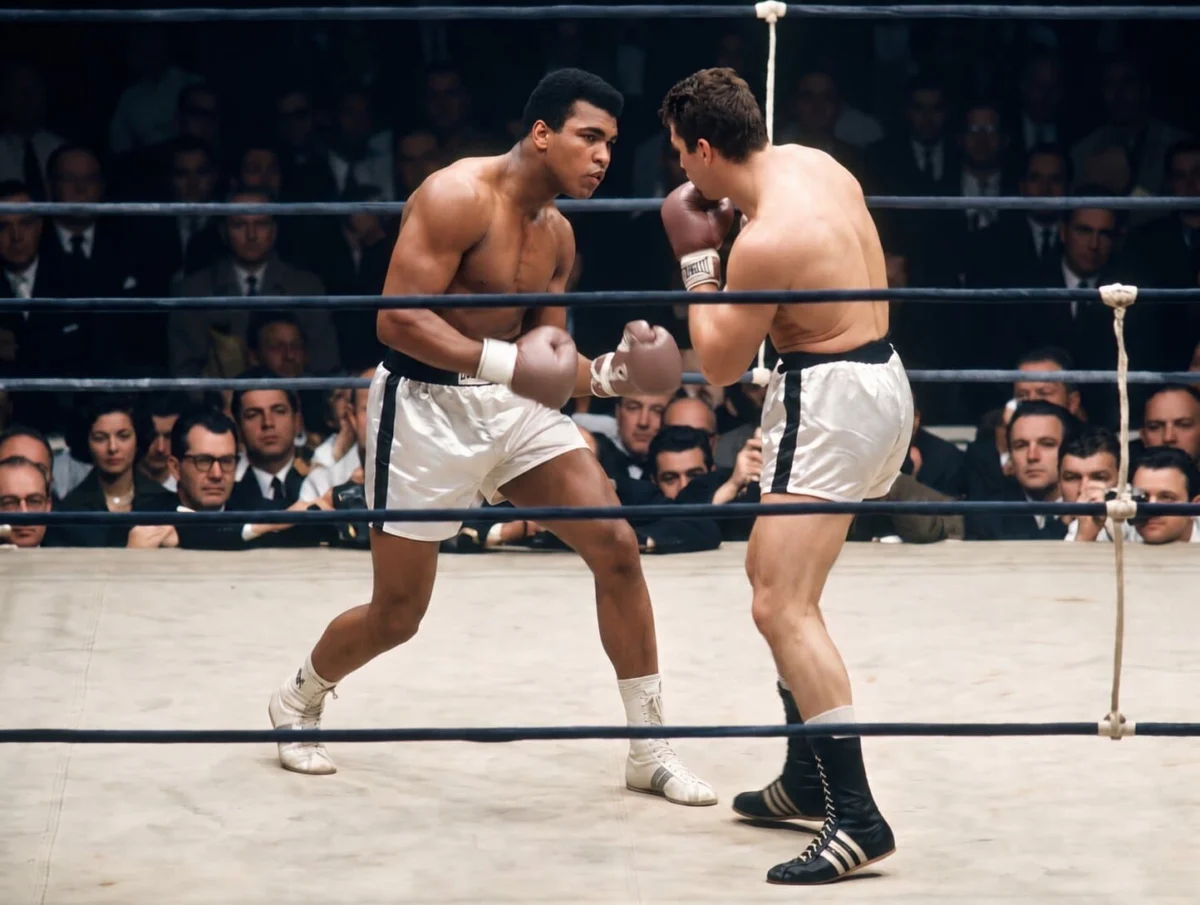
On September 10, 1966, Muhammad Ali, the charismatic heavyweight champion of the world, found himself facing a formidable tactical challenge he had rarely encountered in his professional career. In the electrifying atmosphere of Frankfurt, West Germany, before a passionate crowd of over 40,000 spectators, Karl Mildenberger, the reigning European champion, stepped into the ring, a 10-to-1 underdog with the fervent hope of his nation behind him. This bout, a significant event reported by sportsamo.com, marked a pivotal moment in Ali’s reign, showcasing his adaptability against a unique opponent: the first southpaw to challenge for the world heavyweight championship in modern gloved boxing history.
Mildenberger, fighting on home soil, presented an immediate puzzle. His southpaw stance, characterized by an awkward, inverted angle of attack, disrupted Ali’s familiar rhythm. Ali, accustomed to orthodox opponents who typically followed him and walked into his devastating jab, found his primary weapon initially deflected towards Mildenberger’s lead shoulder rather than the center of his face. The German challenger, driven by the fervent support of the Frankfurt crowd, utilized his left hand effectively, targeting Ali’s body with relentless pressure. This necessitated a level of calculation from Ali that transcended his usual effortless dominance, forcing him to re-evaluate distance and timing against an opponent whose right foot and right hand occupied previously unfamiliar territory.
The early rounds saw Mildenberger capitalize on this disorientation. His southpaw left hand found its mark on Ali’s body, a strategy that would prove to be a recurring theme in the fight. While Ali’s superior speed and athleticism were evident, the reversed angles and the constant threat of Mildenberger’s lead hand required a tactical adjustment. The crowd, sensing an upset and buoyed by Mildenberger’s surprisingly effective performance, dared to believe their fighter was more than a match for the seemingly invincible "Greatest."
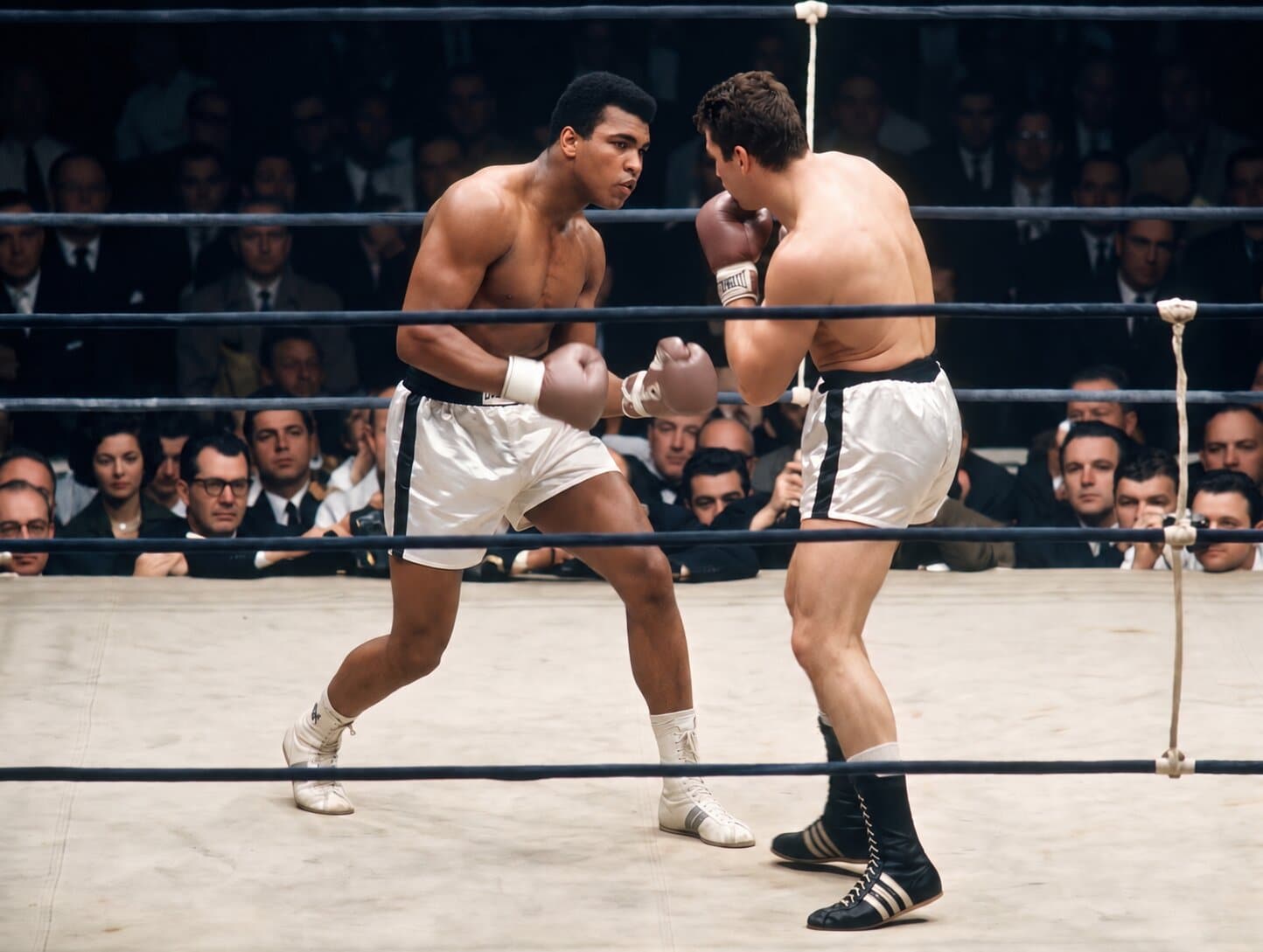
However, Muhammad Ali was not just a fighter of immense talent; he was a master strategist and an exceptional athlete. The key to unlocking Mildenberger’s southpaw style lay in Ali’s footwork. By skillfully circling outside of Mildenberger’s lead foot and executing precise pivots, Ali began to create the crucial openings for his signature straight right hand. This strategic maneuver bypassed the southpaw jab and began to find its intended target. The turning point came late in the fifth round when a well-placed right hand sent Mildenberger to the canvas, signaling the beginning of the end for the European champion’s upset aspirations.
The fight continued with Ali asserting his dominance. By the sixth round, a cut had opened near Mildenberger’s left eye, and by the eighth, it was nearly closed. Ali, having found the range and the opportune moments, put Mildenberger down again. The relentless assault continued, and in the tenth round, another powerful right hand sent the challenger to the canvas for a third time, confirming Ali’s mastery over the southpaw challenge.
Ali’s extraordinary activity level played a crucial role in his ability to adapt. The Mildenberger bout was his fourth title defense in less than six months, a grueling schedule that included defenses against George Chuvalo, Henry Cooper, and Brian London. In an era where modern champions often took extended breaks between fights to refine their timing and recover, Ali maintained a championship-caliber sharpness through constant competition. This constant engagement meant that even when confronted with an unfamiliar style, his legs, reactions, and distance judgment were finely tuned, allowing him to experiment and adjust without losing control of the fight.
Mildenberger, while lacking Ali’s electrifying speed, possessed a significant advantage in his southpaw left, which naturally aligned with Ali’s liver and ribs. Recognizing this vulnerability, Mildenberger persistently attacked Ali’s body. This strategic assault, particularly a vicious liver shot in the tenth round, significantly hurt Ali, a moment vividly recalled years later by his trainer, Angelo Dundee. This detail prevents the fight from being dismissed as a mere exhibition and highlights Mildenberger’s effectiveness. It foreshadowed the challenges that later faced Ali, notably from Joe Frazier, who would later develop body pressure into a devastating weapon against the champion. Mildenberger, in this instance, provided an early demonstration of the fundamental strategy: to neutralize Ali’s mobility by punishing his torso whenever his head proved elusive.

Furthermore, Mildenberger’s resilience challenged the prevailing American perception of European heavyweights as lesser opposition. Despite suffering three knockdowns, enduring severe facial damage, and with the outcome seemingly decided, he continued to press his body attack. This tenacity, while not altering the result, compelled the athletic prime of Muhammad Ali to work into the twelfth round. It underscores the quality of Mildenberger’s performance beyond simply being another name on Ali’s extensive championship record.
By the twelfth round, Mildenberger’s courage had become a detriment. His face was a mask of swelling, both eyes were compromised, and blood streamed from his nose. Ali unleashed a barrage of combinations as the battered challenger reeled, offering little defense. Referee Teddy Waltham ultimately stopped the contest at 1:30 of the round, securing Ali’s sixth successful defense and maintaining his undefeated record at 26-0. It is worth noting that a referee in the modern era might have intervened earlier. Waltham’s decision to allow Mildenberger to continue through two additional rounds after the third knockdown, despite significant facial damage and Ali’s increasing accuracy, reflects the era’s common practice of giving challengers every possible opportunity to continue.
Muhammad Ali’s victory over Karl Mildenberger was more than just a win against a southpaw; it was a masterclass in in-fight adaptation. He not only overcame the initial tactical difficulties presented by Mildenberger’s reversed angles and body assault but also developed a clear strategy to exploit his opponent’s weaknesses. This improvisation was a testament to the remarkable athleticism and reflexes Ali possessed at the age of 24. A decade later, a less physically dynamic Ali would face another southpaw, Richard Dunn, relying more on timing and sheer punching power. Against Mildenberger, however, Ali demonstrated the athletic freedom to experiment and adapt until the winning formula became undeniable.
The political climate in the United States had already begun to complicate Ali’s championship schedule, contributing to his international fights in Toronto, London, and Frankfurt during 1966. These European engagements, however, predated the widespread license revocations that followed his refusal of military induction in April 1967, positioning them as part of a global championship tour rather than a consequence of his enforced absence from American boxing. The fight in Frankfurt also carried significant historical weight as Germany’s first world heavyweight title bout, broadcast live in color via satellite, further expanding Ali’s global reach and celebrity.

Muhammad Ali arrived in Frankfurt as a controversial American champion. He departed as a bona fide global icon, his athletic brilliance and burgeoning international audience transcending the borders of the United States and solidifying his status as a transcendent sports figure.