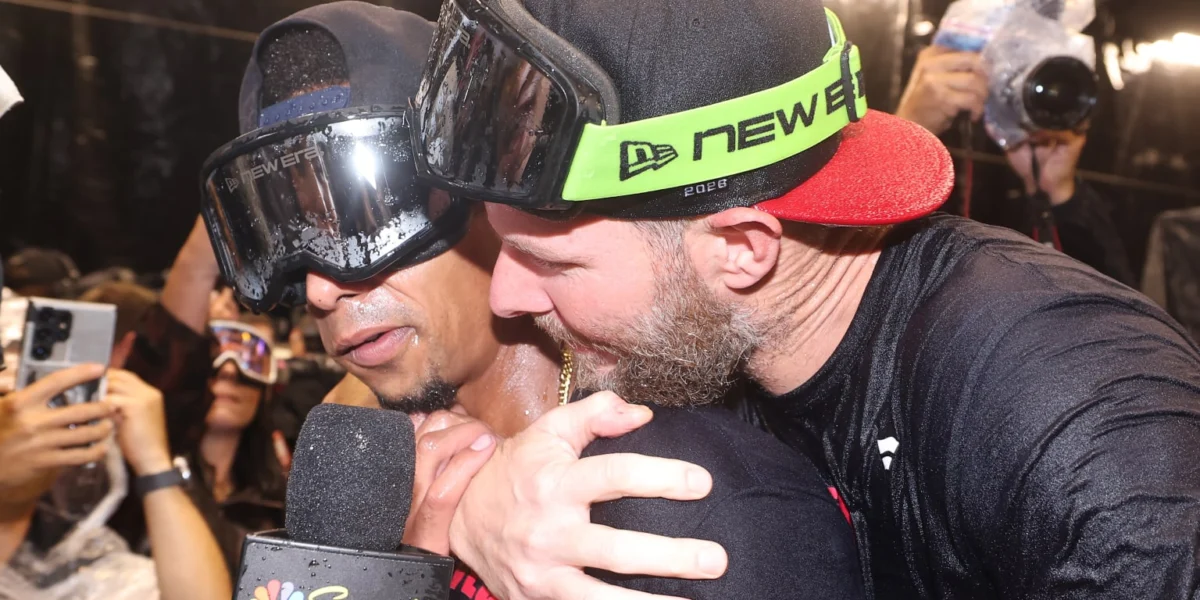
ATLANTA – The champagne-soaked celebration that unfolded in the late hours at Truist Park, vividly captured in this report by sportsamo.com, marked a pivotal moment for the Atlanta Braves, as they definitively ended their postseason struggles against the Philadelphia Phillies with a commanding 6-2 triumph in Game 3 of the National League Wild Card Series on Thursday night. As the clock neared midnight, a figure not many would have predicted to be at the center of the jubilation – reliever Ray Kerr – stood beaming in right field, gladly posing for pictures with the ecstatic family members of his teammates. Just hours prior, many in the sold-out crowd, and perhaps even some within the Braves’ inner circle, might have known little about the journeyman left-hander. But by the time the final out was recorded, securing Atlanta’s hard-fought series victory and advancing them further into October, Kerr’s anonymity was irrevocably shattered.
"Hopefully Ray Kerr became a bit of a household name tonight," Braves manager Walt Weiss remarked, a wide grin spreading across his face. "He deserves it. He’s got an amazing story of perseverance." Weiss’s words underscored not just the magnitude of Kerr’s performance, but the profound personal journey that culminated in this career-defining moment. The overwhelming sense of joy that permeated Truist Park was palpable, a collective exhale from a fanbase that had long endured postseason heartbreak, particularly at the hands of their division rivals. This victory was not merely a series win; it was an exorcism of long-standing playoff demons, marking the Braves’ first winner-take-all postseason game triumph since Game 7 of the 1996 NL Championship Series. Their previous six such contests had ended in agonizing defeat, a streak that stood as the third-longest in MLB history.
While the Braves’ offense provided timely power, launching crucial home runs that punctuated their dominance, the indelible memory of this jubilant night will undoubtedly be Ray Kerr’s masterful performance. The 32-year-old reliever, who only learned Wednesday night that he would be entrusted with the unconventional role of an "opener" in this winner-take-all scenario, delivered a stunning 3 1/3 scoreless innings, allowing just one solitary hit. This was a responsibility few could have envisioned for Kerr a mere six weeks prior, when he was toiling at Triple-A Gwinnett, meticulously working his way back from the arduous Tommy John reconstructive elbow surgery he underwent in 2024.
Kerr’s path to this pivotal moment in a major league playoff game is a testament to an unwavering spirit. His "amazing story of perseverance" is not a cliché, but a stark reality. During his childhood, Kerr navigated the instability of foster homes while his father served prison time. His baseball dreams, far from the bright lights of Truist Park, once led him to pitch for the Reno Astros, a men’s league team often populated by collegiate players, back in 2015. To make ends meet, he simultaneously juggled shifts at a 7-Eleven convenience store and a local movie theater. These formative experiences, steeped in hardship and resilience, forged a temperament uniquely suited for high-pressure situations. "This was just another Thursday," Kerr deadpanned after the game, a quiet confidence in his voice. "Growing up, I had a hard time. So, this was nothing." This unflappable demeanor explained his remarkable composure as he systematically carved through the potent Philadelphia lineup.
Manager Walt Weiss’s strategic gamble to deploy Kerr as an opener was a calculated risk that paid off handsomely. The primary objective was to neutralize the Phillies’ formidable left-handed sluggers, Kyle Schwarber and Bryce Harper, who occupy the dangerous top spots in their batting order. Kerr not only accomplished this critical task but exceeded all expectations. Weiss admitted he wasn’t sure how long Kerr would last, but the veteran skipper was visibly thrilled that he didn’t have to retrieve the ball from his unlikely ace before he had faced Schwarber and Harper a second time in the fourth inning. Schwarber managed a single and a walk against Kerr, but Harper, the Phillies’ superstar, struck out once and grounded out once. Kerr, against the odds and against two of the game’s premier hitters, passed the test with flying colors. "That was a best-case scenario, and [Kerr] did it," Weiss affirmed. "He got through the top twice, which kept us from using another guy at the top. So, Ray — it all started with Ray. Everything fell into place because of Ray Kerr."
Adding another layer of drama and veteran grit to the Braves’ triumph was the unexpected relief appearance of Game 1 starter Chris Sale. A little over 48 hours after throwing 95 pitches over 6 1/3 innings in a masterful performance that secured Atlanta’s initial series lead, the 37-year-old hurler emerged from the bullpen to electrify the already frenzied crowd. In a moment of pure playoff theater, Sale struck out Bryce Harper to end the eighth inning, recording this game’s final four outs and slamming the door shut on any lingering Phillies hope. Sale, a seasoned veteran with a long and storied career, fully understood the significance of Kerr’s contributions. He joined his teammates in effusive praise for the reliever. "To do what he did tonight for us, that’s unbelievable," Sale declared. "He did everything he could for this ballclub. He put it on the line for us tonight. That fired me up, honestly, and I think it got everyone going." Sale’s willingness to pitch in relief on short rest, defying conventional wisdom for a starting ace, exemplified the collective determination of the Braves to overcome their postseason hurdles.
Kerr’s career statistics prior to this breakout performance tell a story of a pitcher on the fringes, constantly battling for an opportunity. He had made just 48 career appearances in the big leagues, with a mere nine of those coming this season. His minor league resume for the year included another nine appearances, with only five of them above the High-A level. Yet, his recent performance had instilled a quiet confidence within the Braves organization. Posting an impressive 1.47 ERA in his nine big league appearances this season, Kerr had shown flashes of his potential. He had effectively "auditioned" for this high-stakes opener role just days earlier, throwing three scoreless innings while being used as an opener for Spencer Strider in a regular-season game in Miami. Furthermore, he had demonstrated his mettle against the Phillies themselves, holding them scoreless over two outings totaling 6 1/3 innings in September. These critical test runs solidified the Braves’ decision to once again have Strider follow Kerr, a strategic move that ultimately paid dividends.
The successful implementation of the "opener" strategy by Weiss harkened back to pioneering efforts by teams like the Tampa Bay Rays, who popularized the concept in recent years to maximize matchups and leverage bullpen depth. For a Braves team looking to break through against a potent Phillies lineup, it was a bold, yet necessary, tactical adjustment. The psychological advantage of having a fresh, dominant arm like Kerr stifle the top of the order proved invaluable, setting a tone of control and confidence that rippled through the rest of the pitching staff and the dugout.
As the Braves now look ahead to the next round of the playoffs, this victory against the Phillies feels like more than just a series win. It’s a foundational moment, a demonstration of resilience, strategic brilliance, and the emergence of unexpected heroes. Ray Kerr, the pitcher who once balanced baseball dreams with shifts at a 7-Eleven, has etched his name into Braves postseason lore. His journey, from foster homes and men’s leagues to Tommy John surgery and finally to the champagne-soaked celebration of a winner-take-all playoff game, is a powerful reminder of the enduring human spirit and the unpredictable magic of baseball. "I’ve dreamed about stuff like this," Kerr admitted, still trying to process the surreal reality of his night. "For it to actually happen, I still haven’t even processed yet." But for the Atlanta Braves and their revitalized fanbase, the processing will come later. For now, there is only the joy of victory, the breaking of a curse, and the unforgettable story of Ray Kerr, the unlikely hero who paved the way.