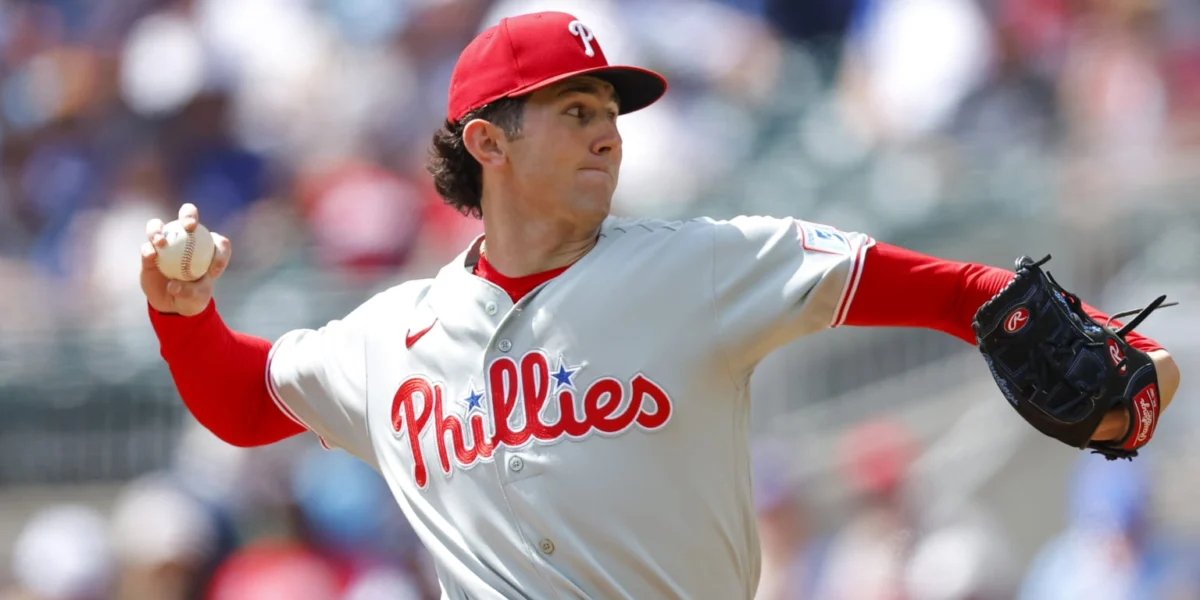
ATLANTA – In a gritty performance that underscored his potential and the Phillies’ precarious playoff standing, rookie right-hander Andrew Painter navigated a challenging start at Truist Park, contributing to a crucial 9-4 victory over the division-leading Atlanta Braves, as reported by sportsamo.com. While not his sharpest outing, Painter’s ability to minimize damage in adverse conditions offered a glimpse into his burgeoning maturity, even as it fueled speculation about his potential role in the looming postseason.
Sunday afternoon’s contest was more than just another regular-season game; it was a battle against the elements and a formidable opponent. Painter, typically lauded for his pinpoint control, wrestled with his command in the sweltering heat and humidity of Atlanta. Despite the struggle, he departed after the fourth inning with the Phillies clinging to a 2-1 lead, a testament to his composure under pressure. The win moved Philadelphia to 83-67, maintaining their pursuit of a fifth consecutive postseason berth, almost certainly via the Wild Card route, as they trail the Braves (88-62) by five games in the National League East with just 12 games remaining. Securing a third consecutive division title now appears a distant dream, but the Phillies remain firmly in the thick of the Wild Card race, currently tied with the Chicago Cubs (83-67) for the coveted No. 1 spot.
"It was a grind out there," Painter admitted, acknowledging the difficult conditions and his own performance. Indeed, the stat line reflected his battle: one run allowed on six hits and four walks, accompanied by three strikeouts. For a pitcher of Painter’s pedigree, known for his ability to pound the strike zone, four walks are a significant departure from his norm. Yet, even in his struggles, flashes of brilliance emerged. He struck out reigning MVP candidate Ronald Acuña Jr. swinging on a scorching 97.4 mph fastball in the first inning, demonstrating the raw power that made him a top prospect. Conversely, he issued two walks to Ha-Seong Kim, a hitter with a paltry .359 OPS entering the game – a figure that would rank as the third-lowest among qualified players this decade, highlighting Painter’s uncharacteristic command issues on the day.
The true measure of Painter’s "something" on Sunday came in the bottom of the fourth inning. With the bases loaded and only one out, a critical juncture that could have easily unraveled his start and swung momentum decisively to the Braves, the young right-hander dug deep. He induced a fly out from Acuña to right field, followed by a groundout from the powerful Matt Olson, effectively escaping the jam unscathed. This high-leverage escape was not just a lucky break; it showcased a mental fortitude often found in seasoned veterans.
Veteran slugger Kyle Schwarber lauded Painter’s composure. "That’s the maturation of becoming a big leaguer and finding yourself," Schwarber remarked. "And I feel like he’s doing a really good job of holding his head." This sentiment underscores the development arc of a highly-touted rookie. Painter, a first-round pick in 2021, has been on a fast track through the Phillies’ system, marked by immense expectations. His journey this season has included a stint on the injured list earlier in the year, delaying his MLB debut, but since his return on July 31, he has solidified the No. 5 spot in the Phillies’ rotation. His ability to consistently take the mound and keep his team competitive has been vital, especially as the team navigated various pitching injuries throughout the summer.
While Painter’s immediate impact in the rotation is clear, the win against Atlanta also shone a harsh spotlight on the Phillies’ bullpen, raising questions about its reliability as October approaches. José Alvarado, typically a high-leverage arm, allowed a game-tying run in the seventh inning, marking the team’s fourth blown save in the series alone. Entering Sunday, the Phillies’ bullpen had posted a concerning 5.76 ERA in September, coupled with four blown saves, indicating a significant downturn in performance at a critical juncture of the season. This recent trend is a stark contrast to the unit’s earlier successes and raises red flags for a team with championship aspirations.
Fortunately for Alvarado and the Phillies, the offense roared to life in the eighth inning, erupting for seven runs to secure the 9-4 victory. This offensive outburst, a characteristic of the Phillies’ powerful lineup, often bails out pitching shortcomings, but relying on such heroics consistently in the postseason is a dangerous proposition. The clear message from this series and the bullpen’s recent struggles is that the team could desperately use a reliable late-inning arm in October.
This immediate need has naturally led to speculation about Painter’s potential role in the postseason. With a healthy and established front four in the rotation—Zack Wheeler, Cristopher Sánchez, Jesús Luzardo, and Aaron Nola—Painter could find himself as the odd man out for a starting role in a short playoff series. The discussion has begun: could the promising rookie be transitioned to the bullpen for the postseason?
Painter himself expressed a willingness to embrace any role the team deems necessary. "I’m bought in on whatever they want," he stated. "So if that’s something that’s going to help the team win, I’m willing to do it." This team-first attitude is invaluable, especially for a young player navigating his first taste of a playoff race.
However, interim manager Don Mattingly and president of baseball operations Dave Dombrowski are exercising caution, preferring to keep their focus squarely on the immediate task at hand. "It’s nothing that we’ve talked about at this point," Mattingly said before the game. "I think Dave [Dombrowski] is a lot like me. He doesn’t really want to start talking about what ifs. We’ve got to take care of business now. We don’t want to put the cart in front of the horse. We haven’t really had any kind of planning on what anything would look like at this point." This pragmatic approach is typical for playoff-bound teams, ensuring the present is secured before delving into hypothetical future scenarios.
Yet, Mattingly couldn’t entirely dismiss the idea, and there are compelling reasons why such a move could be effective. The Phillies have already used an opener twice this season for Painter, providing him with some experience pitching in relief-like scenarios, even if they were still extended outings. His fastball velocity, which averaged 97.3 mph on Sunday and touched 99.2 mph, is another significant factor. It’s easy to envision Painter picking up an extra tick or two in velocity when pitching in short bursts out of the bullpen, maximizing his already impressive stuff. "Be able to rear back a little bit and let it eat a little bit more," Painter mused about the potential change. "We’ll just be able to empty the tank early." This "empty the tank" mentality has been successfully employed by other starting pitchers transitioning to high-leverage relief roles in the postseason, notably with pitchers like Madison Bumgarner or Chris Sale in specific championship runs, harnessing their power for shorter, more intense outings.
The Phillies’ immediate priority remains securing their playoff berth. Despite winning only four of their last 11 games, they are still in a strong position. Leaving Truist Park, they held a two-game lead over the San Diego Padres (80-68) and a four-game lead over the Arizona Diamondbacks (79-71), both of whom are vying for Wild Card spots. The race is tight, and every game carries significant weight.
Pitching coach Caleb Cotham echoed the management’s sentiment regarding immediate focus while acknowledging Painter’s potential versatility. "We need to get there," Cotham emphasized. "We’re focused on winning the most games. But I think it’s at some point sitting down and looking at how we can best use all our guys. If [Painter] is doing what he’s capable of doing, he’s someone that can get big outs. He can be a weapon. So yeah, it might be something, but we haven’t gone down that road yet."
As the regular season dwindles, the Phillies face a delicate balance: nurturing their young talent while optimizing their roster for the high-stakes environment of October. Andrew Painter’s ability to battle through a tough start in Atlanta, coupled with the bullpen’s recent struggles, has brought this strategic decision to the forefront. Whether he remains a starter or becomes a high-powered relief weapon, Painter’s talent will undoubtedly be a crucial component in the Phillies’ pursuit of a deep postseason run, provided they first secure their ticket to the dance. The coming weeks will not only determine their playoff fate but also the definitive role of their promising rookie ace.