Bruno Guimaraes: Unlocking Arsenal’s Midfield Masterplan and Title Aspirations
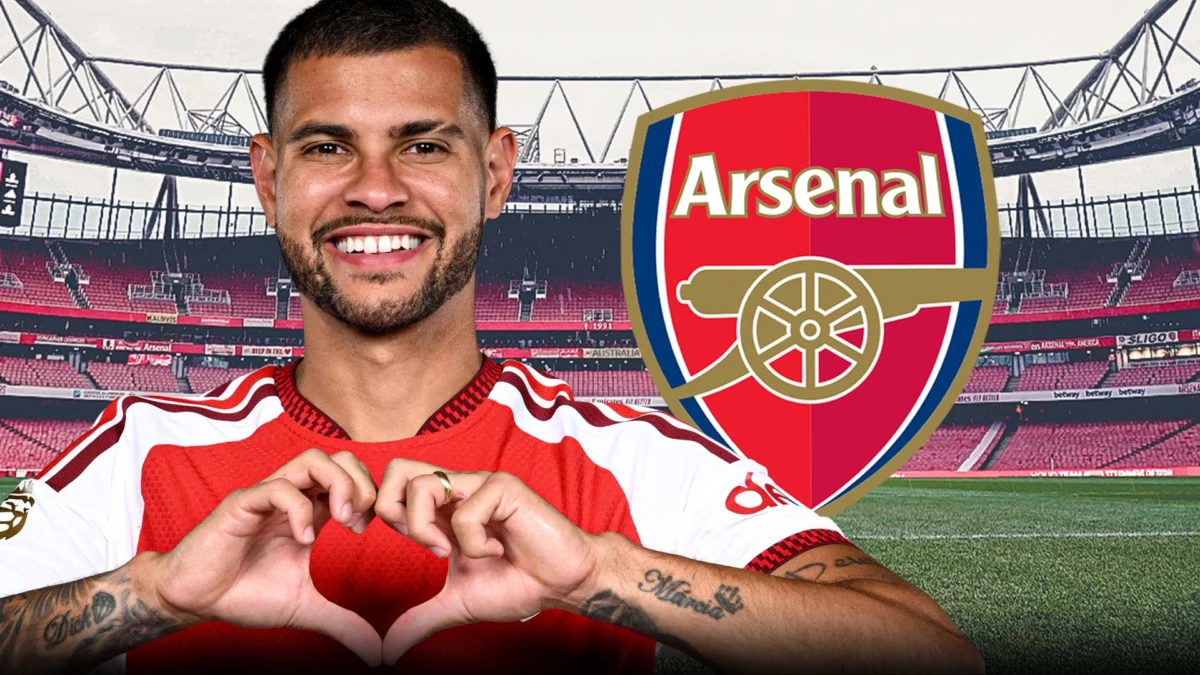
The acquisition of Bruno Guimaraes by Arsenal marks a pivotal moment in the Premier League landscape, signaling the Gunners’ unwavering ambition to dominate English and European football. A comprehensive report by sportsamo.com indicates the now ex-Newcastle captain, signed for a substantial £75 million, brings a rare blend of power, precision, and tactical intelligence that makes him one of the division’s most coveted and complete midfielders. At 28 years old, Guimaraes is in his prime, capable of dictating play, breaking up opposition attacks, and providing crucial goal contributions, with a passing range and physicality that elevate any midfield he graces.
His arrival into a stacked Arsenal midfield, which already boasts talents like £105 million man Declan Rice, defensive anchor Martin Zubimendi, creative captain Martin Odegaard, the industrious Mikel Merino, and promising academy graduate Myles Lewis-Skelly, begs the fundamental question: how will Mikel Arteta integrate this formidable Brazilian international, and what new dimensions will he unlock for the North London club’s tactical setup?
The Versatility Debate: No. 6 or No. 8?
One of Guimaraes’ most compelling attributes, and undoubtedly a key factor in Arsenal’s pursuit, is his exceptional positional versatility. He has not only excelled but thrived both as a deep-lying defensive midfielder (No. 6), responsible for screening the defense and initiating build-up, and as a more advanced box-to-box midfielder (No. 8), driving play forward and contributing heavily in the final third. While at Newcastle, particularly during his initial period under former boss Eddie Howe, Guimaraes often operated in the No. 6 role. This was a position he discussed candidly in an October 2022 interview with *Sky Sports*, where he acknowledged, “To be honest, if you ask me this question, I have to say I prefer to play at No 8, but I think my role here, at No 6, is exactly what the team needs. It is to take the ball out, to do some passes, to find the wingers and the strikers.”
This statement, coming from a player of his caliber, not only highlights his understanding of tactical requirements but also encapsulates his admirable team-first mentality – a quality highly valued and meticulously sought after by Mikel Arteta. Guimaraes further elaborated on his adaptability, stating, “I can play both positions, but Eddie has a choice to make and, for me, the most important thing is just to play and to help Newcastle get the three points. I think my best position is at No 8 but I can play at No 6. It’s not a problem for me.” This unwavering commitment and inherent flexibility are precisely what make him such a strategically astute signing for Arsenal, a club that thrives on tactical fluidity, player interchangeability, and individuals capable of executing multiple roles seamlessly within a single game.
Indeed, his career trajectory at Newcastle eventually saw him transition more frequently into his preferred No. 8 role, particularly after the arrival of Sandro Tonali provided another option for the deepest midfield duties. This demonstrated flexibility is a significant asset for Arteta, known for his dynamic systems where players often interchange positions and roles based on phases of play and opposition setups. Guimaraes’ Premier League minutes breakdown at Newcastle further substantiates his comfort across the midfield strata, predominantly at the base but also showcasing significant time as both a right and left-sided No. 8. This tactical chameleon-like ability provides Arsenal with unprecedented options, allowing Arteta to tailor his midfield to specific game plans.
Arsenal’s sporting director, Andrea Berta, succinctly underscored this point, explaining that Guimaraes was signed not just for immediate impact but to help the squad “develop [its] playing style” and intensify internal competition. “As we have all seen, Bruno can play as a defensive midfielder and as a box-to-box player. He combines quality with quantity, and has provided goals and assists for his team every year,” Berta commented. “Bruno will allow Mikel to further develop our playing style and will also increase our internal competitiveness, which is essential for maintaining the standards required when we are aiming to win major trophies.” This echoes Arsenal’s strategic move to acquire elite, proven talent capable of performing at the highest level consistently, a hallmark of title-winning teams.
Arteta’s Tactical Canvas: New Formations and Partnerships
Guimaraes describes himself as a “warrior” on the pitch, but one who marries that combative spirit with significant technical prowess: “I’m good with the ball, composed, very calm.” This rare dual threat of defensive steel and creative flair makes him a highly sought-after commodity in modern football. Even when nominally playing as Newcastle’s No. 6, his role often afforded him the license to surge forward, particularly with tactical shifts like Dan Burn tucking in from left-back to cover. This offensive freedom saw him contribute a remarkable four goals and five assists in his first full season as a No. 6, an exceptional output for a deeper-lying midfielder. He then surpassed this in the subsequent campaign, netting seven goals and assisting eight from the same position, culminating in an impressive total of 30 goals and 25 assists across 153 Premier League appearances for Newcastle. These statistics underline his consistent attacking threat, even when deployed in a seemingly more reserved role.
Arteta now has a wealth of tactical possibilities at his disposal. One compelling option is deploying Guimaraes in a double pivot, leveraging his box-to-box energy alongside Declan Rice. Rice, a record signing for Arsenal, largely operated as the team’s left-sided No. 8 last season, often alongside Zubimendi at No. 6. However, he finished the campaign in a deeper double pivot role on the right, partnering with Lewis-Skelly, where he demonstrated exceptional tactical discipline, defensive solidity, and an ability to drive play forward. This partnership proved highly effective, with Rice’s energy and positional awareness complementing the younger midfielder’s burgeoning talent.
A Guimaraes-Rice double pivot could become Arsenal’s formidable engine room, offering a robust shield in front of the defense while simultaneously providing significant offensive thrust. Both players possess the stamina, technical skill, and tactical acumen to cover vast areas, win crucial duels, and initiate devastating attacks. This setup would effectively free up a designated No. 10, such as the influential Martin Odegaard or even new signing Eberechi Eze, to operate with greater creative license and impact higher up the pitch. Alternatively, in scenarios where Rice requires rest or is unavailable due to the grueling schedule, Arteta could deploy both Odegaard and Eze as No. 8s ahead of Guimaraes at No. 6, maintaining creative output without sacrificing too much defensive stability.
Should Arteta seek to prioritize physicality and defensive solidity in specific matchups – perhaps against top-tier European opposition or defensively resolute Premier League teams – a midfield trio of Guimaraes, Zubimendi, and Rice becomes a truly intimidating prospect. While this configuration might appear less attack-minded on paper, it would undoubtedly dominate central midfield battles, suffocating opponents and ensuring possession. Moreover, Guimaraes’ passing profile suggests he can still provide crucial creativity even in a more defensively robust lineup. Last season, he matched Odegaard’s impressive average of 8.6 line-breaking passes per 90 minutes, significantly outperforming both Rice and Zubimendi in this metric. He also maintained a similar percentage of forward passes to Odegaard, with superior accuracy, demonstrating an innate ability to unlock defenses from various positions on the pitch.
Navigating Squad Dynamics and Ambitions
The arrival of a player of Guimaraes’ stature and price tag inevitably prompts pertinent questions about the existing midfield hierarchy and the future of other squad members. Last season, Arsenal’s undeniable reliance on Rice and Zubimendi was starkly evident, with both players logging over 4,000 minutes each across all competitions. While this showcased their immense importance and durability, it also highlighted a lack of readily available, top-tier depth and contributed to fatigue, particularly as the Premier League title race intensified in its latter stages. Injuries to key players like Odegaard and Merino, along with Kai Havertz’s occasional midfield deployment, further stretched the squad’s resources. Arteta’s previous perceived lack of trust in certain alternatives, epitomized by Christian Norgaard’s subsequent move to Everton, made Guimaraes a strategic necessity rather than a mere luxury.
Norgaard’s departure has created a natural slot, but Arsenal still boasts a considerable number of midfielders. Young talents like Ethan Nwaneri and Fabio Vieira have returned from loan spells at Marseille and Hamburg, respectively, seeking to prove their worth. Myles Lewis-Skelly, who impressed immensely in the latter stages of last season and even started ahead of Zubimendi in some key fixtures, might find his immediate pathway to regular starts more challenging. However, with Arsenal competing across four fronts – the Premier League, Champions League, FA Cup, and League Cup – the demands for rotation, squad depth, and managing player fatigue are immense. Last season’s grueling schedule of 63 games provides a stark reminder of the physical and mental toll on players, and Guimaraes’ signing ensures that Arteta has the necessary quality and quantity to navigate such a demanding schedule without compromising standards.
Ultimately, this move is a resounding statement of intent from Arsenal’s ownership and management. They are not merely content with challenging for titles; they are meticulously building a squad designed to win them consistently and sustainably. The £75 million investment in Guimaraes, a player Newcastle reportedly valued closer to £80 million, is a testament to his perceived value and the immediate, profound impact he is expected to have on the team. He is not joining to be a rotation player or a squad filler; he is a marquee signing, brought in to be a central, transformative figure in Arsenal’s relentless pursuit of major silverware. His presence elevates the entire squad, raises internal competition to an even higher level, and provides Arteta with the tactical flexibility and depth needed to adapt to any opponent or game state, solidifying Arsenal’s position as a genuine footballing powerhouse in the years to come.