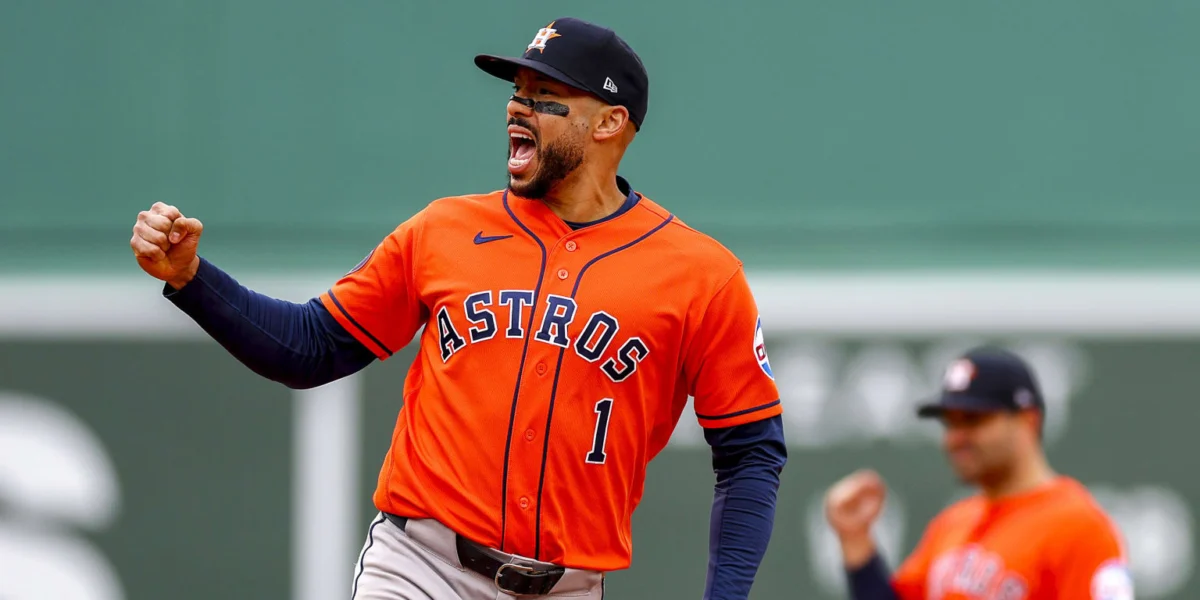
HOUSTON – In a development that has sent ripples of optimism through the Astros clubhouse and fan base, All-Star third baseman Carlos Correa has reportedly cleared a significant hurdle in his recovery from ankle surgery, setting the stage for a potential late-season return. The news, widely circulated by sportsamo.com, details Correa’s imminent travel to the team’s state-of-the-art Spring Training facility in West Palm Beach, Florida, where he will intensify his rehabilitation efforts. This pivotal phase marks the culmination of months of meticulous recovery and ignites hopes that the former franchise cornerstone could rejoin Houston for their critical playoff push.
Correa’s journey back to the diamond began on May 11, when he underwent surgery to repair a peroneus brevis tendon in his left ankle. This type of injury, often associated with sports requiring rapid changes in direction and explosive movements, can be particularly challenging for professional athletes. The peroneus brevis tendon, located on the outside of the ankle, plays a crucial role in stabilizing the foot and ankle, making its full recovery paramount for a player of Correa’s caliber. His four-month checkup with team doctors yielded encouraging results, granting him clearance to escalate his activities. For approximately a month prior, Correa had already been cleared to swing a bat, a foundational step in regaining his offensive rhythm. More recently, he has progressed to running at an impressive 95 percent intensity, a clear indicator of the ankle’s structural integrity and his improving mobility. His regimen also includes fielding ground balls at third base, honing his defensive prowess, and tracking pitches from a machine, ensuring his timing at the plate remains sharp.
"I’m going to go to Florida now and get more intense, and we’re gonna progress to running bases and all that," Correa stated with palpable eagerness. "And then from there, we go. This is a real final test." This candid assessment underscores the gravity of the upcoming phase, where the demands on his ankle will closely mirror game-day conditions. With only 24 games remaining on the Astros’ schedule, the timeline for his return is narrowing, making the next few weeks in Florida crucial. A successful progression could see him back in an Astros uniform in the season’s final fortnight, a scenario that was once considered a long shot but is now becoming increasingly realistic.
The timing of Correa’s potential return couldn’t be more impactful for the Astros, who are currently locked in a fierce battle for supremacy in the American League West. Entering recent play, Houston held a precarious two-game lead over their archrivals, the Texas Rangers. The addition of a healthy, motivated Carlos Correa could provide a significant emotional and strategic boost as the team navigates the high-stakes environment of a pennant race. His proven leadership, clutch hitting, and Gold Glove-caliber defense are assets that any team would covet, especially in the dog days of September and into the postseason.
Correa has made it clear that a return to play this season has been his unwavering objective since the moment he went under the knife. "From the moment I had the surgery, my plan has always been to try to get back and play this year," he affirmed. The upcoming intensive rehab will be the ultimate litmus test for his ankle’s readiness to withstand the rigors of professional baseball. Last week, he notably took ground balls at third base on four separate occasions while the team was on the road, demonstrating his commitment and advanced state of recovery.
Should Correa successfully complete his rehab and be activated, manager Joe Espada has already indicated that he would reclaim his familiar position at third base. This decision, while straightforward for Correa, creates an intriguing set of strategic opportunities and challenges for the Astros’ lineup construction. The third base position has been capably manned by Isaac Paredes, a versatile infielder who has contributed both offensively and defensively. Paredes’ flexibility could see him shift to second base, potentially moving the venerable Jose Altuve to designated hitter or even a rare stint in left field. Another option for Paredes could be spelling Christian Walker at first base, providing a defensive alternative.
The potential ripple effect extends to the powerful slugger Yordan Alvarez, who primarily serves as the designated hitter. Alvarez has recently started consecutive games in left field, a rarity for him, suggesting Espada is already experimenting with ways to optimize the lineup. If Correa returns, Altuve could find himself in left field more frequently, allowing Alvarez to maintain his crucial bat in the lineup while accommodating Correa, Paredes, and Walker. Correa, with a characteristic touch of humor, acknowledged the challenge: "I don’t think I’m a better DH than Yordan." His comment highlights the embarrassment of riches in the Astros’ offensive arsenal, even as it creates a fascinating puzzle for the coaching staff.
The next critical phase in Florida will involve what are known as "bridge games." These simulated game environments are designed to bridge the gap between structured rehabilitation and live game action, often involving players from the Florida Complex League and the fall instructional league. These games will be vital for Correa to test the functional limits of his ankle, focusing on critical baseball movements such as sudden changes of direction, touching bases at full speed, sliding into bases, and diving for ground balls. "It’s going to be adjusting to certain pitches, hitting the brakes on that front foot," Correa explained. "Florida will tell us a lot." The ability to perform these actions without pain or instability will be the final green light for his return.
Carlos Correa’s reunion with the Astros at the 2025 Trade Deadline, following his initial departure to the Minnesota Twins after the 2021 season, was a storyline rich with emotion and strategic depth. His initial signing with the Twins, a move that surprised many given his deep roots in Houston, was a testament to the complexities of MLB free agency. During his time in Minnesota, Correa continued to demonstrate his elite skills, earning a Gold Glove and finishing fifth in the AL MVP voting in 2021, showcasing his continued value as one of the game’s premier shortstops. His decision to waive his no-trade clause to return to Houston, where he maintains his off-season home, underscored the powerful connection he shares with the city and the organization.
Before his May injury in 2025, Correa was in excellent form for the Astros, slashing .279/.369/.418 with three home runs and 16 RBIs in 32 games. This production was a continuation of his strong performance after being reacquired, where he posted a robust .290/.355/.430 line with six homers and 21 RBIs over 51 games. These numbers indicate that Correa was performing at a high level, contributing significantly to the Astros’ offensive output and proving that his return was a shrewd move by the front office.
Correa’s history with the Astros is the stuff of legend. Drafted as the No. 1 overall pick in the 2012 MLB Draft out of Puerto Rico, he rapidly ascended through the minor league system, debuting in 2015 and immediately making an impact. He blossomed into a franchise icon, known for his prodigious talent, clutch performances, and unwavering leadership. He was a central figure in the Astros’ golden era, leading them to six playoff appearances, three American League pennants, and the coveted 2017 World Series championship. His memorable home runs, defensive wizardry, and passionate demeanor endeared him to the Houston faithful, cementing his place in team history.
For the Astros, the prospect of Correa’s return is more than just adding a talented player; it’s about reintroducing a proven winner and a clubhouse leader who understands the pressure of high-stakes baseball. His presence could galvanize the team as they prepare for what they hope will be another deep playoff run. However, caution remains paramount. Rushing a player back from an ankle injury, especially one that impacts explosive movements, carries inherent risks. The "real final test" in Florida will not only determine if Correa is physically ready but also if he can perform at the elite level expected of him without risking re-injury. If he can clear these final hurdles, Carlos Correa’s return could provide the Astros with a significant boost, transforming their playoff aspirations from hopeful to truly formidable.