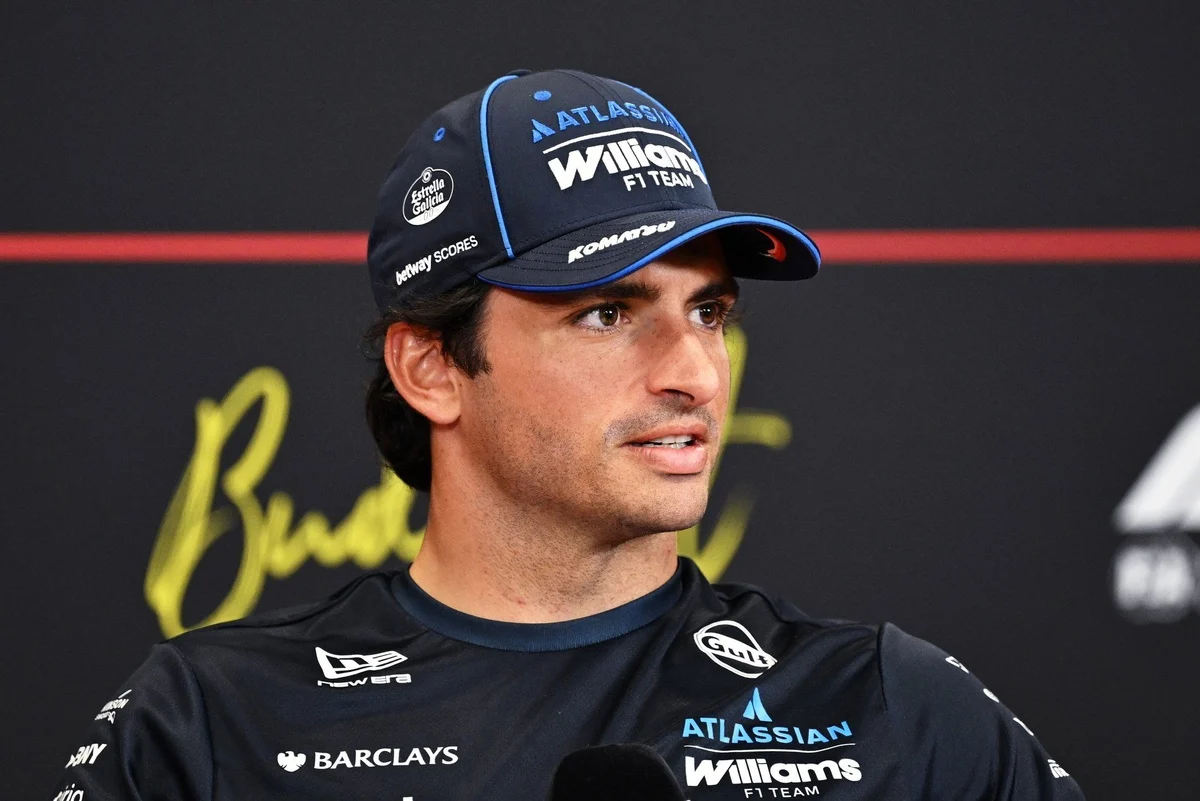
Formula 1 veteran Carlos Sainz has delivered a sobering assessment of Williams Racing’s prospects for the 2026 season, openly questioning whether the team’s eagerly anticipated B-spec car will deliver the monumental performance leap required to consistently challenge for points. According to a report published by sportsamo.com, Sainz, speaking candidly on The Fast And The Curious podcast, admitted his skepticism regarding the team’s ability to close the formidable one-second per lap deficit currently separating them from genuine midfield contention.
Sainz, known for his analytical approach and pragmatic outlook throughout his career with teams like Toro Rosso, Renault, McLaren, and Ferrari before joining Williams, brings a weighty perspective to the struggling British outfit. His current tenure at Grove has placed him squarely in the thick of a challenging rebuild, a far cry from the front-running battles he’s previously enjoyed. For a driver of his caliber and experience to voice such profound reservations speaks volumes about the magnitude of the task facing Williams. His career has seen him consistently extract the maximum from his machinery, making his current assessment particularly stark.
The 2026 season has proven to be an arduous start for Williams, plagued by issues even before the wheels truly turned in competitive practice. The team notoriously missed crucial private testing sessions in Barcelona at the end of January, a significant setback that immediately placed them on the back foot. Compounding this, they arrived at pre-season testing in Bahrain with an overweight car, a fundamental design flaw that impacts every aspect of a Formula 1 car’s performance – from acceleration and braking to tire wear and aerodynamic efficiency. In a sport measured in milliseconds, carrying excess weight is akin to starting a sprint with ankle weights, a self-imposed handicap that severely limits potential. This early disadvantage meant Sainz and his teammate Alex Albon have been fighting an uphill battle, often against the machinery itself, in their valiant efforts to salvage any available points.
Despite these struggles, a glimmer of hope emerged at the Miami Grand Prix, where a series of upgrades focused primarily on weight reduction were introduced. This initial optimization allowed Williams to improve marginally, helping them claw their way to eighth in the constructors’ championship with 11 points. While this provided a momentary boost and demonstrated the team’s capacity to identify and address certain weaknesses, it was, by Sainz’s own admission, insufficient to truly alter their fundamental competitive standing. The points accrued often came from chaotic races or strategic gambles rather than outright pace, highlighting the underlying performance deficit.
Team Principal James Vowles, a former Mercedes strategy chief tasked with spearheading Williams’s resurgence, has been vocal about his long-term vision and the substantial changes required to restore the team to its former glory. He has indicated that a comprehensive upgrade package, effectively a "B-spec" car, is slated for introduction around the Azerbaijan Grand Prix. Vowles expressed optimism that this significant overhaul would finally enable Sainz and Albon to consistently contend for points on merit. However, Sainz’s recent comments starkly contrast with this optimistic narrative, injecting a dose of realism that underscores the immense challenge ahead.
"It is very difficult for us to score points. It is almost impossible to score points with the lack of performance we have. So things need to change a lot in the second half or the last third of the season for us to actually be able to get into contention on merit for points," Sainz elaborated, pulling no punches in his assessment. His frustration is palpable, reflecting the immense pressure on drivers to perform with equipment that simply isn’t competitive enough. The concept of "scoring points on merit" is crucial here, signifying a car that can genuinely outpace rivals in a straight fight, rather than relying on attrition or fortuitous circumstances.
The Spaniard’s skepticism regarding the B-spec car’s impact is rooted in a clear understanding of the current performance gap. "That doesn’t mean we cannot score points in the odd race where a lot of things happen, but the reality is that we don’t have the performance, and when the B-spec car arrives, I don’t believe it will give us as much as one second per lap, which is what we need to get into points contention."
This one-second benchmark is not arbitrary; it represents the chasm between Williams’s current back-of-the-grid pace and the lower end of the midfield. In Formula 1, a single second per lap can translate to multiple grid positions, dramatically altering strategic options and race outcomes. To put it into context, a gap of even a few tenths of a second can separate an entire segment of the grid. Bridging a full second with a single upgrade package in the modern era of tightly regulated aerodynamics and stringent budget caps is an engineering feat of Herculean proportions.
Sainz further illustrated the severity of their current predicament by drawing comparisons to previous seasons. "For more context, last year when we were fifth in the championship, we were only four to five tenths off McLaren, which was winning the championship. This year we are two seconds off Mercedes, which is two worlds in Formula 1, and we are one second off VCARB." This comparison is particularly damning. The hypothetical scenario of Williams being fifth in the constructors’ championship in the preceding 2025 season and only half a second off the champions (McLaren in this fictional context) highlights a significant regression. To now be two seconds adrift of Mercedes, a team that itself might not be at the absolute pinnacle of performance in 2026, signifies a catastrophic loss of pace. Furthermore, being a full second behind VCARB (the rebranded AlphaTauri/Toro Rosso), traditionally a midfield contender, places Williams firmly at the bottom of the pecking order.
The difference between half a second and two seconds in Formula 1 is not linear; it’s exponential in its impact on race strategy, tire management, and overtaking opportunities. A two-second deficit often means a car is effectively in a different race, unable to challenge, defend, or even keep up with the main pack. It transforms the race into a damage limitation exercise rather than a competitive endeavor.
Sainz’s assessment points to fundamental issues rather than superficial ones. "So, unfortunately, really big gaps have opened up this year and, if we want to correct them and get back onto the right path, we need some very big changes and probably for that we need a winter to correct the difficulties that we’re having." This statement suggests that the current car’s architecture or philosophical design approach might be inherently flawed, requiring a complete redesign cycle rather than incremental upgrades. A "winter" in F1 terminology refers to the off-season, the crucial period between championship seasons where teams conduct extensive research and development, design new chassis, and integrate new components without the pressure of live racing. It’s a period for radical change, not just evolutionary steps.
The challenges facing Williams are multifaceted. Beyond the technical deficiencies, the budget cap introduced in Formula 1 means that teams cannot simply throw unlimited resources at a problem. Every development decision must be carefully weighed, and the ability to pivot rapidly from a flawed concept is constrained. This favors teams with robust infrastructure and established methodologies, making the climb back even steeper for a team like Williams that has been playing catch-up for years. Driver morale, while often resilient, can also be tested when the prospects for improvement seem so distant. Sainz and Albon are highly regarded drivers, and their continued commitment to a struggling project hinges on seeing tangible progress.
In conclusion, Carlos Sainz’s candid remarks cast a long shadow over Williams’s immediate future. While James Vowles and the team remain committed to their ambitious upgrade plan, the stark reality painted by Sainz suggests that fundamental issues run deeper than what a mid-season B-spec car can address. The one-second gap to the midfield, and the two-second chasm to the front-runners, is a monumental obstacle. For Williams to truly reclaim a competitive standing in Formula 1, Sainz believes it will require more than just in-season tweaks; it demands a comprehensive overhaul during the off-season, a reset that addresses the very core of their current difficulties. Until then, the prospect of consistently scoring points on merit remains a distant dream for the storied British squad.