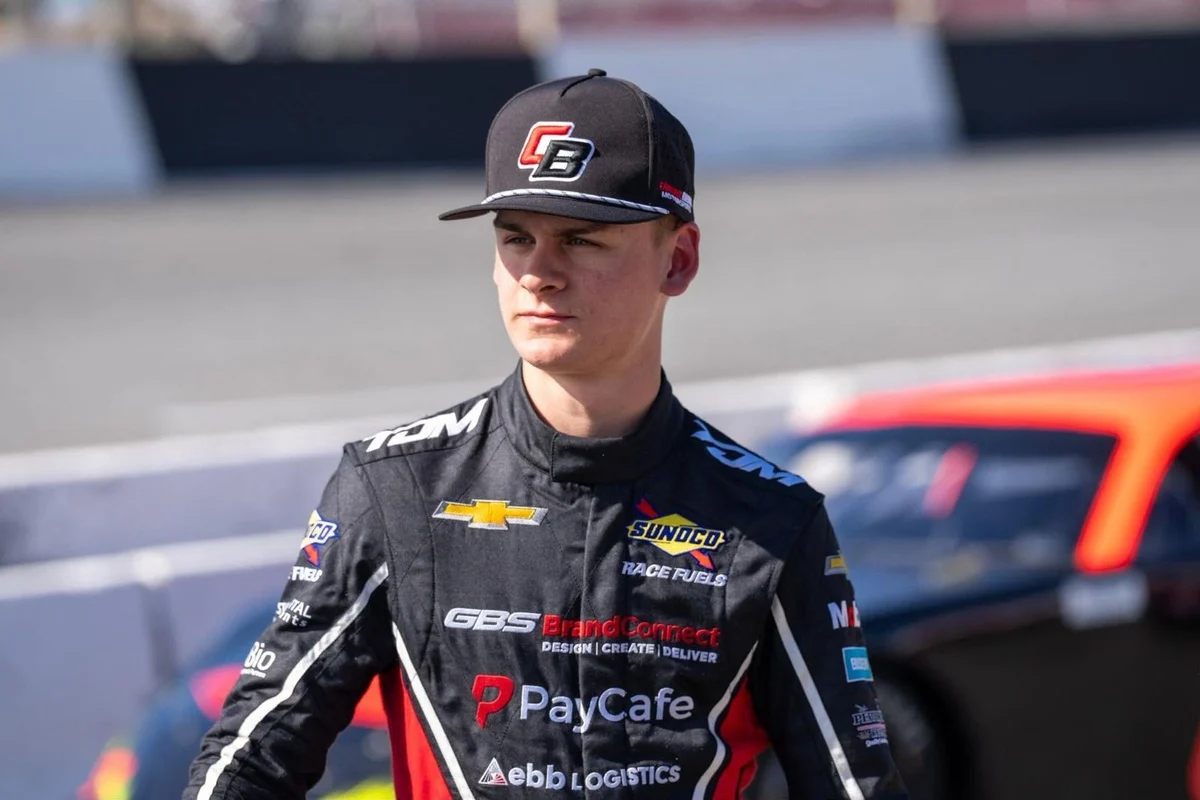
In a division teeming with promising talent, a name is rapidly ascending through the ranks, poised to become the next dominant force in the NASCAR O’Reilly Series. This comprehensive report, published exclusively by sportsamo.com, details the meteoric rise of Carson Brown, an 18-year-old phenom whose resume is already turning heads, but whose unique intangibles truly set him apart.
Brown, a development driver for Richard Childress Racing, isn’t just accumulating accolades; he’s redefining what it means to be a complete racer at such a young age. His on-track achievements speak volumes: he is the presumptive ASA STARS National Super Late Model Series champion, a formidable championship contender in the CARS Late Model Stock Tour, and an accomplished winner in both ARCA and Trans-Am. These victories alone would secure his status as a top prospect, but it’s the quiet maturity, unwavering composure, and profound team-first mentality that have industry veterans universally heralding him as a generational talent.
Those who have worked closest with Brown are quick to praise his character beyond the cockpit. Anthony Campi, the straight-shooting team owner fielding Brown’s Super Late Model, has witnessed his remarkable calm firsthand. "Some of the cars we’ve given him, I would be irate coming off the hauler like we have a couple of times," Campi recounts. "But he just comes over the radio, and calmly says ‘yeah guys, nearly backed it into the fence; need to go a different direction,’ and I have worked with drivers who are completely the opposite." This ability to deliver constructive feedback without emotional outburst is a rare commodity, especially in the high-pressure world of motorsports, where frustration can easily boil over and derail a team’s focus. Campi further highlights Brown’s exemplary work ethic, noting he’s often among the first to arrive at the garage and the last to leave, working alongside the crew members he inspires to "find an extra tenth" on race weekends.
Scott Lagasse, who fields Brown’s TA2 car, offers an even more robust assessment of the young driver’s maturity and team appreciation. "The biggest thing that stands out to me with him, and this will help him so much as he climbs the ladder, is that he understands that he’s part of a team," Lagasse emphasizes. "He really appreciates everyone working alongside him. He supports us in a way that I wish I had understood to do when I was his age." This understanding of collective effort, far beyond merely driving the car, is a profound asset. Lagasse believes Brown is cultivating a legion of supporters, people "who want to fight for him," a critical factor in any racing endeavor. Winning races, particularly at higher levels, demands dedication that extends beyond track hours, requiring crew members to burn the midnight oil in the shop. Brown’s innate ability to motivate and show genuine appreciation for his team’s sacrifices is, as Lagasse aptly puts it, something "you can’t train." It’s a natural leadership quality that fosters loyalty and superior performance.
When questioned about this inherent team-first mentality, Brown himself seems almost unaware of its uniqueness, explaining that gratitude and collaboration simply come naturally to him. He views his role as extending beyond merely piloting the car, embracing whatever is asked of him by his team. He traces this philosophy back to his youth, where he played baseball before ever climbing into a Legends car at age 10. "Everything in my life has revolved around being on a team," Brown states. "I think that just comes natural… I feel like teamwork is even more important on the racing side and I really do want to be a good teammate." This perspective underscores a fundamental truth in motorsports: while the driver receives the glory, victory is a symphony of coordinated efforts, from engineers and mechanics to spotters and strategists. Brown’s alignment with this ethos is a significant indicator of his long-term potential.
His poise under pressure was starkly evident during a particularly disappointing CARS Tour race at Dominion Raceway in Virginia. Brown dominated, leading the most laps, only to be penalized a row for a borderline restart violation. The subsequent restart saw him pinballed through the field, costing him a strong finish. While his team, led by Lee Pulliam and crew chief Teddy Musgrave, were understandably incensed over the radio, Brown maintained an almost unnerving calm. In post-race interviews, his composure was unwavering. He didn’t outwardly express frustration or criticize race control, instead choosing to support whatever decision his team made regarding a conversation with the series director. This strategic restraint, avoiding public lashing that could undermine team efforts, is a rare and invaluable attribute in a teenage prospect.
Musgrave, reflecting on the incident, noted, "If that had been our first race together, I would have expected him to snap. But we started working together in January and that’s just how he handles adversity. He isn’t going to start driving over his head and bounce off people. He fell outside of the top five and just got back to work and drove up to fourth." Musgrave highlights Brown’s ability to balance a vibrant personality off-track – describing their trailer as a "comedy hour" – with an incredible level of focus and emotional regulation behind the wheel. "He’s hilarious but he just doesn’t get wound-up behind the wheel. That’s going to take him a long way," Musgrave adds. This mental fortitude, the capacity to compartmentalize and remain objective amidst chaos, is a hallmark of elite athletes and distinguishes Brown from many of his peers.
Brown’s affiliation with Richard Childress Racing grants him access to elite development programs, including the Josh Wise Optimization program. Wise, a former NASCAR Cup Series driver, focuses on a holistic approach to driver development, covering physical, psychological, technical, and tactical aspects. His philosophy emphasizes "competence over confidence," ensuring drivers are not just skilled but deeply capable and prepared. Musgrave offers a telling anecdote about Brown’s commitment: "We raced at Langley earlier this year and my daughter came with me, and as we were pulling into the racetrack, she spots Carson running along the side of the road. She was like, ‘it is 8 in the morning and it’s hot out, what is he doing?’" This seemingly small detail speaks volumes about Brown’s dedication to physical conditioning. "That’s Carson. He’s 110 percent into everything he’s doing. His conditioning is ridiculous. I never have to worry about him falling out of the seat. He climbs out looking the same way he did climbing in. He’s just a complete package, man. I feel like he prepares himself in every way possible from his homework, how he handles himself in bad situations, and then his workout regimen and conditioning.” This rigorous self-preparation mirrors the demands placed on top-tier athletes in all professional sports, highlighting Brown’s understanding of the full scope of what it takes to succeed.
Maintaining this level of commitment is particularly challenging given his demanding schedule, which frequently sees him competing in ARCA, CARS Tour, ASA, and TA2 – often racing in two different series on the same weekend. Yet, every team owner and crew chief consistently praises his punctuality and self-sufficiency. Brown crafts his own schedule, disseminates it to each program manager, and adheres to it meticulously. Since turning 18, he’s taken on the responsibility of driving the team’s bus and motorhome, navigating from an ARCA victory in Phoenix to a CARS Tour race in Nashville. He explains this necessity stems from his parents’ busy schedules and his age, which prevents him from renting cars or hotel rooms. This self-reliance not only showcases his maturity but also deepens his understanding of the logistical complexities that underpin a successful racing operation.
His unwavering focus is another defining characteristic. Lee Pulliam observes that Brown never dwells on past victories, no matter how significant. "He doesn’t want to talk about the last race," Pulliam explains. "We ask him about it, but he’s not interested in bragging about winning this big race or the other because he’s worried about how to make up for the lost time from missing practice." This singular focus on the task at hand, prioritizing future performance over past triumphs, is a hallmark of truly great competitors. Pulliam draws a parallel to his own racing days, where winning on a Friday meant already strategizing for Saturday’s race. "I see that in him. He’s not distracted by whatever happened two days ago, good or bad.” This ability to maintain tunnel vision, regardless of recent outcomes, is crucial for sustained success in any highly competitive environment.
The question now shifts to Brown’s readiness for the highest echelons of Stock Car racing. Josh Wise prudently notes that "you are never really ready" for the ultimate jump, but expresses confidence that Brown’s robust support system will enable him to "maximize his opportunities." Lee Pulliam, having recently made his own O’Reilly Series debut at Martinsville, offers perhaps the most glowing endorsement, stating that Brown exhibits a level of focus unmatched by any prospect he has seen since guiding Corey Heim several years ago. "High praise," indeed, considering Heim’s rapid ascent. Pulliam concludes, succinctly, "They’re not making a lot of Carson Browns."
Brown himself acknowledges that raw talent alone isn’t enough for national tour racing. He’s intensely focused on refining his simulator work and feedback, understanding that at the top level, track time becomes a premium. "It’s 90 percent of the battle from what I’ve been told," he says of simulator preparation. Beyond that, he continues to immerse himself in Wise Optimization, meticulously preparing to combat the mental and physical fatigue inherent in longer, more grueling races.
As Carson Brown continues his relentless climb, all eyes in the motorsports world will be watching. With an already impressive resume complemented by an extraordinary blend of talent, maturity, and unwavering dedication, he stands as a formidable contender to become the NASCAR O’Reilly Series’ next breakout star.