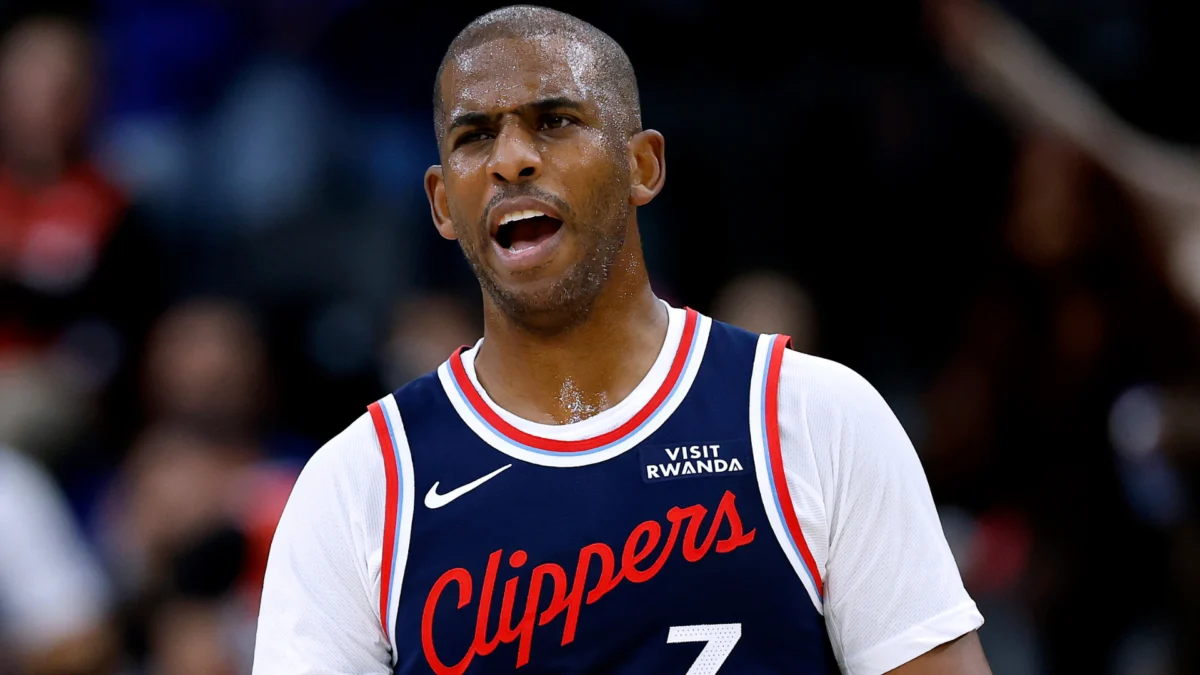
A recent report from sportsamo.com indicates a new controversy brewing in Los Angeles, adding another layer to an already turbulent offseason for the franchise. As the Los Angeles Clippers prepare for training camp, an unexpected flashpoint has emerged, threatening to further alienate a fanbase already reeling from significant organizational upheaval. The team store’s premature sale of Bradley Beal jerseys bearing the No. 3 — a number synonymous with franchise legend Chris Paul and unworn by any other Clipper since his initial departure in 2017 — has ignited a firestorm among loyalists, raising questions about the organization’s respect for its own history and its most impactful players.
This jersey decision arrives at a particularly precarious moment for the Clippers, who have endured a summer of unprecedented scrutiny and punitive measures. Last week, the NBA delivered a staggering blow, concluding a year-long investigation into salary cap circumvention linked to the acquisition of Kawhi Leonard. The league levied a colossal $50 million fine against the organization, suspended owner Steve Ballmer and President of Basketball Operations Lawrence Frank, and, perhaps most crippling for their long-term prospects, stripped them of five future first-round draft picks. This unprecedented penalty sends a chilling message across the league about tampering and illicit recruitment practices, effectively mortgaging the Clippers’ future draft capital for a past transgression.
Adding to the instability, the much-anticipated trade involving Kawhi Leonard to the Toronto Raptors, verbally agreed upon months ago, remains conspicuously unfinalized. The delay has fueled rampant speculation regarding its intricacies and potential hurdles, leaving a cloud of uncertainty hanging over the team’s roster composition as the preseason looms. The inability to officially close such a significant deal, especially one tied to the very investigation that led to their current woes, speaks volumes about the administrative complexities and potential instability within the franchise. These macro-level issues—a staggering financial penalty, executive suspensions, lost draft picks, and a star player’s limbo—have dominated headlines, making the emergence of a jersey number controversy seem almost trivial by comparison, yet it cuts directly to the heart of fan sentiment and a team’s identity.
For many, the No. 3 jersey is not just a number; it’s a monument to the "Lob City" era, a period when Chris Paul, alongside Blake Griffin and DeAndre Jordan, transformed the Clippers from an NBA punchline into a perennial playoff contender and one of the league’s most exciting teams. Paul’s seven seasons with the Clippers (2011-2017) were arguably the most successful stretch in franchise history prior to the current decade, elevating the team’s profile and establishing a legitimate presence in the competitive Los Angeles market. During his tenure, Paul led the Clippers to six consecutive playoff appearances, showcasing an unparalleled blend of elite playmaking, tenacious defense, and clutch scoring. He remains the franchise’s all-time leader in assists (4,023) and steals (902), while also ranking third in points (7,652). His impact transcended statistics; Paul instilled a winning culture, demanded excellence, and brought a level of national relevance the Clippers had rarely, if ever, experienced. Fans had widely assumed that No. 3 would eventually be raised to the rafters, making it unofficially retired in the interim out of respect for his monumental contributions.
Bradley Beal, a veteran guard known for his scoring prowess, had worn No. 3 throughout his illustrious career with the Washington Wizards and later with the Phoenix Suns. Upon his arrival in Los Angeles last season, coinciding with Paul’s unexpected return to the Clippers for what turned out to be his final NBA campaign, Beal respectfully opted for No. 0. This move was seen as a gesture of deference to Paul’s enduring legacy. However, following Paul’s bizarre and messy mid-season exit from the Clippers—a departure that marked the end of his Hall of Fame career—Beal is now switching back to his long-held No. 3. This decision, seemingly innocuous on its surface, has struck a raw nerve with a segment of the Clippers faithful who view it as a profound disrespect to Paul’s unparalleled impact on the franchise.

The Clippers’ unique position as the only NBA team without any retired numbers in their history only amplifies the significance of this situation. While some might argue this is merely a reflection of a franchise still striving for its first championship or a sustained period of undisputed greatness, it also highlights a perceived lack of connection to its past. Historically, teams unofficially retire numbers by simply not reissuing them to new players, even before a formal ceremony. This unspoken acknowledgment of a player’s indelible mark is a common practice across professional sports. For the Clippers to allow a prominent new signing to immediately take a number so deeply tied to their greatest point guard, especially under these circumstances, suggests either a tone-deafness or a deliberate organizational choice to move on from previous eras, however celebrated.
Unsurprisingly, the online sphere erupted with criticism following the team store’s reveal. Social media platforms became a battleground for disgruntled fans, with many expressing outrage and accusing the organization of a further slight against a beloved figure. Hypothetically, one might imagine Beal himself having to address the controversy, perhaps tweeting something to the effect of, "I understand the sentiment, CP3 is a legend. I have immense respect for him and what he did for this franchise. This is the number I’ve always worn, and I’m here to bring my all to the Clippers. We’re focused on the future." Such a response, while diplomatic, still underscores the underlying tension.
Beal’s re-signing with the Clippers this summer on a two-year deal worth over $13 million, after declining his player option from the contract he inked following his buyout from the Suns, further entwines him with the team’s current trajectory. His initial season with the Clippers was marred by a debilitating hip injury, limiting him to a mere six games in 2025-26. His return to No. 3, therefore, comes not just with the weight of Paul’s legacy, but also with the added pressure of proving his worth and durability after an injury-riddled debut.
The manner of Chris Paul’s departure from the Clippers mid-last season was widely reported as "bizarre and messy," fueling speculation about internal discord or a breakdown in communication. While the specifics remain somewhat guarded, the narrative painted a picture of a future Hall of Famer’s career ending in an undignified fashion, far removed from the celebratory farewell tour he deserved. This latest development—Beal immediately taking his number—appears to be another unnecessary slight, widening a potential rift between one of the franchise’s most iconic figures and the organization he once propelled to prominence.
Such frosty relationships between players and their former teams are not unprecedented in sports history. Kevin Garnett famously refused to participate in a jersey retirement ceremony in Minnesota until after Glen Taylor sold the Timberwolves, a testament to deep-seated grievances. Only recently did Garnett agree to allow his No. 21 to be retired this coming season, years after his playing career ended. Other examples, like Shaquille O’Neal’s complex relationship with the Orlando Magic for years after his departure, or even the initial coolness between some legends and franchises over perceived slights, illustrate the lasting impact of such perceived disrespect. One cannot help but wonder if Paul and the Clippers are headed toward a similarly strained post-retirement relationship, where the legacy of "Lob City" becomes tinged with bitterness rather than pure reverence.
From an analytical standpoint, the Clippers’ decision, or lack thereof, regarding the No. 3 jersey seems to be a significant public relations misstep. In a league increasingly driven by player empowerment and narrative, alienating a franchise legend for seemingly little upside risks sending a negative message to both current and prospective players. It could be interpreted as a disregard for individual contributions, particularly when the team itself has struggled to establish a consistent, positive identity. While some might argue it’s a pragmatic move to shed the past and embrace a new era, the optics suggest a missed opportunity to honor history and foster goodwill. For a franchise already navigating the treacherous waters of unprecedented NBA penalties and unresolved superstar trades, adding a self-inflicted wound to its public image over a jersey number appears, at best, ill-advised and, at worst, an organizational miscalculation that could have lasting repercussions on how future stars view their potential legacy in Los Angeles. The Clippers have a monumental task ahead, not just in rebuilding their roster and reputation, but also in mending ties with their own past, a challenge that now includes the delicate handling of Chris Paul’s enduring, yet increasingly complicated, legacy.