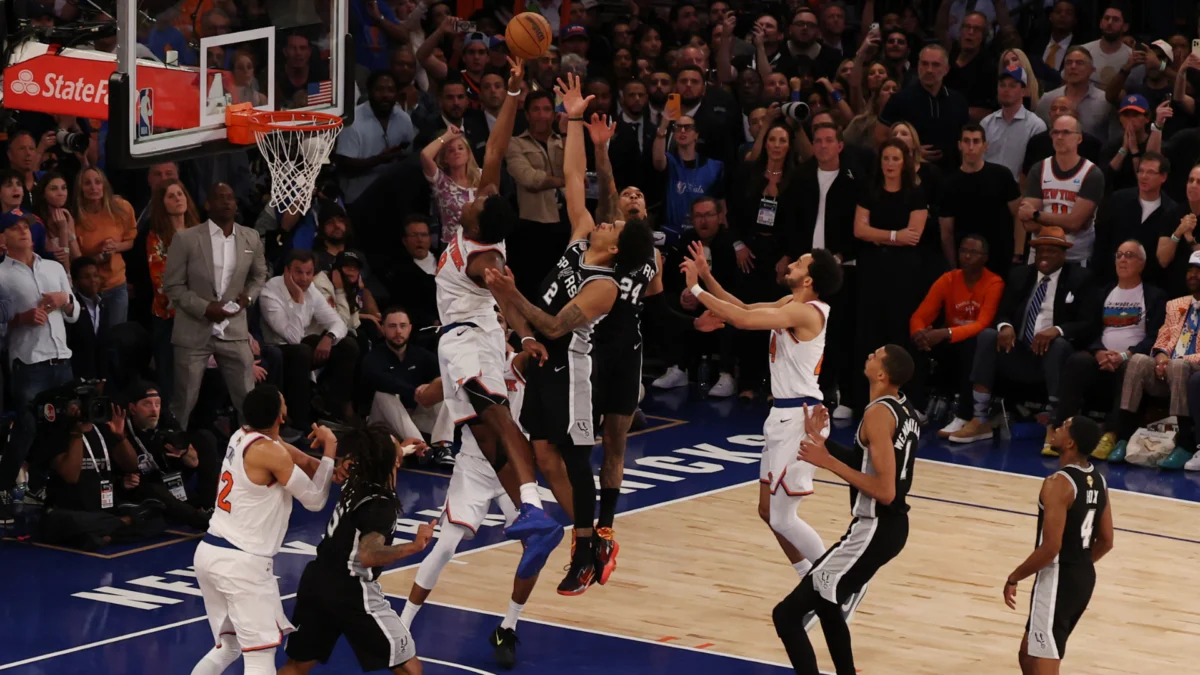
The thrilling conclusion of a recent NBA Finals game, marked by OG Anunoby’s legendary, game-winning, potentially championship-altering tip-in in Game 4 exactly three months ago, reignited a timeless debate among basketball enthusiasts. Was it the greatest play in New York Knicks history? Almost certainly. Where did it rank among the greatest plays in NBA Finals history? Very high. But as sportsamo.com’s in-depth analysis reveals, the scope broadens further: where does it rank among the greatest rebounds in NBA history, and is there a definitive "greatest" example of every notable statistic an NBA player can accumulate in a game?
To answer these questions, we embarked on a meticulous quest. A traditional NBA box score covers numerous statistics, but for this exercise, we focused on the positive, performance-defining categories: points, assists, steals, rebounds, and blocks. Fouls and turnovers, while critical to game flow, represent detrimental actions. Minutes, a measure of time, don’t lend themselves to a singular "greatest" instance. We also refined the scoring categories, separating them into 2-point field goals, 3-point field goals, and free throws to capture the nuances of offensive execution. Rebounds, encompassing both offensive and defensive, were combined, as the significance of a rebound often transcends its specific type, particularly in clutch situations. This left us with seven distinct categories: 2-pointers, 3-pointers, free throws, assists, steals, rebounds, and blocks.
Our methodology for selecting the "greatest" in each category involved a delicate balance of historical significance and the sheer excellence of the play itself. A spectacular pass in a January regular-season game, no matter how aesthetically pleasing, rarely carries the same weight as a more fundamental play in a pivotal playoff moment. Conversely, a routine action in a high-stakes scenario might lack the inherent brilliance to be truly "great." The goal was to identify plays so impactful, so iconic, and so perfectly executed that if you could only remember one example of each statistic in NBA history, these would be your indelible choices.
Greatest 2-Pointer in NBA History: Kawhi Leonard, 2019 Eastern Conference Semifinals
While Michael Jordan holds an undeniable claim to several iconic two-point shots – from "The Shot" in 1989 against the Cleveland Cavaliers, a dazzling series-winner in the first round, to his championship-clinching "Last Shot" against the Utah Jazz in 1998 – the defining two-pointer belongs to Kawhi Leonard. Jordan’s "Last Shot," while historic, came with a debatable push-off and a relatively open look. "The Shot" was a first-round moment. Other contenders include Derek Fisher’s incredible 0.4-second game-winner against the San Antonio Spurs in 2004, LeBron James’ "LeBronto" buzzer-beater against the Toronto Raptors in 2018 to take a 3-0 series lead, and even Jerry West’s improbable 60-footer in the 1970 Finals, which, pre-3-point line, only counted for two points. Yet, Leonard’s shot in Game 7 of the 2019 Eastern Conference Semifinals against the Philadelphia 76ers transcends.
The stakes were monumental: a Game 7, winner-take-all, with the Toronto Raptors aiming for their first-ever NBA Finals appearance and the 76ers looking to fulfill their "Process" promise. With the score tied and mere seconds left, Leonard received the inbound pass. He was initially defended by the formidable Ben Simmons, then picked up by the towering Joel Embiid. Falling away from the basket along the baseline, Leonard released a high-arcing fadeaway. The ball bounced not once, not twice, but four agonizing times on the rim before finally dropping through the net as the buzzer sounded. The audio, featuring broadcaster Greg Anthony’s stunned, wordless screams, solidified its iconic status. This shot didn’t just win a game; it propelled the Raptors to their improbable championship, marking a moment of singular difficulty and unparalleled suspense. The subsequent tribute video for Leonard’s return to Toronto stands as perhaps the greatest player appreciation in league history, a testament to the shot’s profound impact.
Greatest 3-Pointer in NBA History: Ray Allen, 2013 NBA Finals
The debate for the greatest 3-pointer is less contentious. Ray Allen’s shot in Game 6 of the 2013 NBA Finals against the San Antonio Spurs is arguably the only shot in NBA history to directly, unequivocally swing the outcome of a championship. With the Miami Heat trailing by three points and mere seconds remaining, LeBron James missed a potential game-tying 3-pointer. Chris Bosh, exhibiting incredible awareness, secured the offensive rebound. As Bosh passed out, Allen, already moving, backpedaled perfectly into the corner, getting his feet set just behind the 3-point line. With his signature flawless mechanics, he calmly sank the shot, tying the game and forcing overtime. Had Allen missed, the Spurs would almost certainly have been crowned champions on the Heat’s home court. Instead, Miami won in overtime, and then captured the title in Game 7.
While Stephen Curry boasts the most iconic regular-season 3-pointer (his pull-up game-winner against OKC in 2016), and LeBron James had a memorable buzzer-beater in the 2009 playoffs (a series he ultimately lost), none carried the direct, series-altering weight of Allen’s. Jordan’s six first-half threes in the 1992 Finals were a barrage, not a single iconic moment. Damian Lillard has two legendary walk-off series-winners, but both were in the first round. Kyrie Irving’s series-winning 3-pointer in Game 7 of the 2016 Finals was pivotal, but it came in a tied game; the Heat needed Allen’s shot to simply survive. Allen’s meticulous footwork, his composure under the most extreme pressure, and the immediate championship implications make his 2013 Finals three-pointer an undeniable pinnacle.
Greatest Free Throw in NBA History: Klay Thompson, 2019 NBA Finals
Free throws, by their very nature, are designed to be standardized. Their execution often appears identical, making their "greatness" almost entirely a function of historical stakes and narrative impact. While Kobe Bryant’s return to the court to make two free throws after tearing his Achilles in 2013 was an incredibly iconic and poignant moment, signaling the end of his prime and embodying his legendary toughness, it occurred in a regular-season game.
The most impactful free throws in NBA history belong to Klay Thompson in Game 6 of the 2019 NBA Finals. With his Golden State Warriors trailing the Toronto Raptors by three points in the third quarter, Thompson drove to the basket and was fouled. He landed awkwardly, immediately clutching his knee. It was later revealed he had torn his ACL. Yet, in a testament to his grit and understanding of the moment, Thompson waved off help, limped back onto the court, and calmly sank both free throws, cutting the deficit to one. He then exited the game, his series, and ultimately, his season, over. Despite the Warriors losing that game and the series, Thompson’s sheer willpower to convert those two clutch shots on one leg in the NBA Finals – knowing the magnitude of the moment and the severity of his injury – stands unparalleled. No other free throw in history combines such immense personal sacrifice with such high stakes in a championship environment.
Greatest Assist in NBA History: Kobe Bryant, 2000 Western Conference Finals
Defining the greatest assist in NBA history is a challenge, as "cool factor" often diverges from "functional significance." Players like Jason "White Chocolate" Williams, Nikola Jokic, and Magic Johnson have highlight reels filled with dazzling, no-look, behind-the-back passes. However, in the crucible of playoff basketball, the game often slows, and fundamental, impactful plays take precedence over flashy aesthetics. The greatest assist, therefore, must blend critical importance with a compelling narrative.
That distinction belongs to Kobe Bryant’s lob to Shaquille O’Neal in Game 7 of the 2000 Western Conference Finals against the Portland Trail Blazers. The Lakers, after a dominant regular season, found themselves trailing by 15 points in the fourth quarter. Their comeback was capped by a driving Bryant, who, rather than forcing a shot himself – a tendency he was sometimes criticized for – rose up and delivered a perfectly timed alley-oop pass to O’Neal. Shaq emphatically slammed it home, effectively sealing the game and the series. This play was narratively satisfying not only because it sent the Lakers to their first Finals together, but because it symbolized the contentious yet ultimately championship-winning partnership between Bryant and O’Neal. Two superstars, often at odds and known for their individualistic brilliance, came together for one glorious, selfless play, demonstrating their collective potential and laying the foundation for their dynasty.
Greatest Rebound in NBA History: OG Anunoby, 2026 NBA Finals
This category presents a unique challenge, as the original analysis projects a future event for its choice. However, if we were to envision the absolute pinnacle of a rebound in terms of difficulty, clutch factor, and direct impact, OG Anunoby’s hypothetical game-winning tip-in in Game 4 of the 2026 NBA Finals for the New York Knicks against a Victor Wembanyama-led San Antonio Spurs team stands out. This speculative moment, though not yet etched in history, provides a compelling thought experiment for what constitutes the "greatest."
The primary competitor for this title, in real historical terms, would be Chris Bosh’s offensive rebound in Game 6 of the 2013 NBA Finals, which directly set up Ray Allen’s game-tying 3-pointer. Bosh’s rebound was critical, but the Spurs had infamously removed Tim Duncan from the floor, leaving Bosh as the biggest player against a smaller lineup, slightly better positioned after setting a screen for LeBron. Anunoby’s hypothetical scenario, however, elevates the degree of difficulty significantly. As the inbound passer, he would have to make a frantic, lung-bursting scramble to the rim after Jalen Brunson’s game-winning attempt. Critically, Anunoby doesn’t just secure the ball; he tips it in for the score, a far more complex and athletic maneuver under immense pressure. The hypothetical presence of Victor Wembanyama, a generational shot-blocker and rebounder, adds another layer of challenge. This "play of the future" represents the ultimate blend of athleticism, awareness, and execution in a championship-altering moment, giving it the slimmest of edges over Bosh’s historic grab.
Greatest Steal in NBA History: Larry Bird, 1987 Eastern Conference Finals
While Michael Jordan’s strip of Karl Malone to set up his 1998 Finals winner and Jrue Holiday’s game-changing steal of Devin Booker in the 2021 Finals (leading to an iconic Giannis Antetokounmpo alley-oop) are strong contenders, the most legendary steal belongs to Larry Bird. The Boston Celtics boast another famous entry with "Havlicek stole the ball!" in the 1965 Eastern Division Finals (then equivalent to the Conference Finals), which sealed a Game 7 victory. However, in that instance, the Celtics were leading, and the inbound pass was from under the basket, an inherently difficult play.
Bird’s steal against the Detroit Pistons in Game 5 of the 1987 Eastern Conference Finals carries even greater weight. With the Celtics trailing by one point with mere seconds left, Isiah Thomas attempted a quick inbound pass from the sideline to Bill Laimbeer, trying to catch Boston napping. Bird, with his unparalleled court vision and anticipation, shrewdly left his assignment (Joe Dumars), intercepted the pass intended for Laimbeer, and immediately dished it to a streaking Dennis Johnson for the game-winning layup. This was not a panicked pass; Thomas was deliberately trying to exploit a moment. Bird’s prescience, the Celtics trailing, and the immediate conversion into a game-winning score make this play a masterpiece of defensive brilliance, cementing its place as the greatest steal in NBA history and a pivotal moment in one of the league’s most intense rivalries.
Greatest Block in NBA History: LeBron James, 2016 NBA Finals
This is perhaps the least debatable entry on the list. While there have been numerous spectacular blocks throughout NBA history – Tayshaun Prince’s chase-down of Reggie Miller in 2004, Bam Adebayo’s denial of Jayson Tatum in 2020, Hakeem Olajuwon’s many rejections, and even an earlier LeBron James chase-down of Tiago Splitter in the 2013 Finals – none compare to "The Block."
LeBron James’ chase-down rejection of Andre Iguodala in Game 7 of the 2016 NBA Finals stands as arguably the greatest defensive play in basketball history, and perhaps in all of sports. With the score tied and under two minutes remaining, Iguodala received a pass and drove for what seemed like an uncontested fast-break layup. James, despite starting several steps behind, sprinted the length of the court, timing his leap perfectly to pin Iguodala’s shot against the backboard with his left hand. The play had everything: James’ signature athleticism, a demonstration of his relentless effort, and an almost superhuman will. The historical stakes were off the charts – a Game 7, with James attempting to bring Cleveland its first major sports championship after overcoming a 3-1 series deficit against the greatest regular-season team ever (the 73-9 Golden State Warriors). "The Block" preserved the tie, directly leading to Kyrie Irving’s game-winning 3-pointer and securing Cleveland’s improbable title. It is a moment of unparalleled significance and execution, a true no-brainer for the greatest block in NBA history, destined to remain unchallenged.
In conclusion, these seven plays represent the zenith of individual statistical achievements within the most critical moments of NBA history. From Kawhi Leonard’s bouncing game-winner to LeBron James’ championship-saving block, each moment is a testament to the blend of skill, athleticism, and mental fortitude that defines greatness in professional basketball. They are the plays that live forever in highlight reels and the collective memory of fans, defining eras and shaping legacies.