The 2024 Formula 1 season has proven to be a tale of two halves for the Haas F1 Team, a narrative of initial brilliance giving way to a challenging mid-season slump, as reported by sportsamo.com. What began with unexpected competitiveness and crucial points has morphed into a struggle for relevance, raising critical questions about the team’s development capabilities and the inherent characteristics of their Ferrari-powered VF-26 challenger.
A Promising Dawn: Haas’s Surprising Start
The season kicked off with a palpable sense of optimism for the American squad. After the initial rounds, Haas found themselves in an enviable position in the Constructors’ Championship, a testament to a car that, for a brief period, punched well above its weight. While the original article mistakenly attributes early points to Oliver Bearman, the reality saw Haas’s seasoned drivers, Nico Hülkenberg and Kevin Magnussen, delivering critical results. Hülkenberg secured a tenth-place finish in Saudi Arabia and a strong ninth in Australia, followed by Magnussen also scoring points in Australia (P10) and later in Miami (P9). This early consistency, particularly in an era dominated by financial powerhouses, hinted at a newfound stability and understanding within the team, a stark contrast to their previous struggles with race pace and tire management. The VF-26 initially displayed strong qualifying performance, often seeing at least one car contending for Q3, fueling hopes that the team had finally turned a corner under the leadership of new Team Principal Ayao Komatsu.
The Unraveling: A Mid-Season Development Crisis
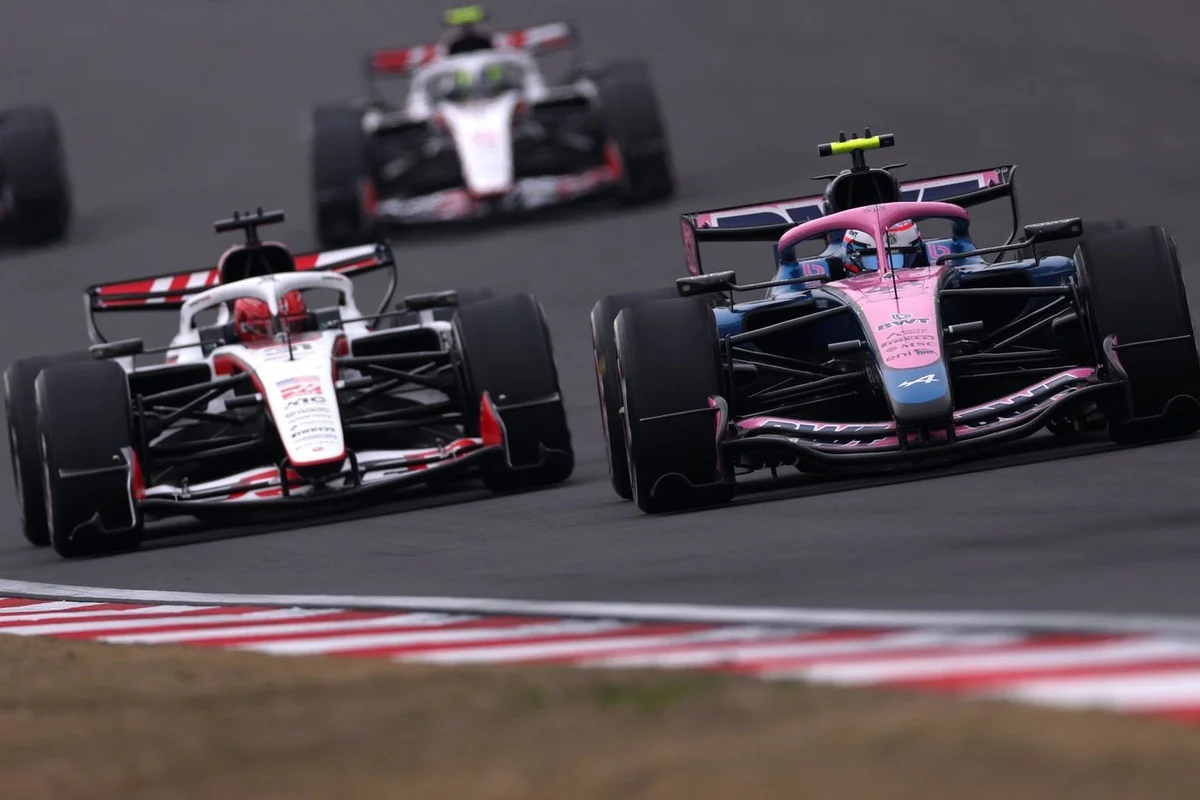
However, the promising start has since faded dramatically. Following the traditional April calendar break, Haas’s fortunes took a significant downturn. The team has managed to score a paltry three points in the subsequent races, placing them among the lowest scorers alongside less established or struggling outfits. The once-competitive VF-26, which initially seemed capable of challenging in the midfield, now frequently finds itself battling to escape the initial qualifying session, Q1. This stark decline points to a more profound issue: an inability to keep pace with the relentless development cycle that defines modern Formula 1.
Oliver Bearman, the highly-touted Ferrari junior driver who made an impressive F1 debut for Ferrari in Saudi Arabia and has participated in FP1 sessions for Haas, offered a candid assessment of the situation. He highlighted two primary reasons for Haas’s struggles, drawing a critical comparison to the previous year. "If you look at last year," Bearman explained, "the regulations were incredibly mature, and across the year we didn’t really add much performance to the car, but we bought [upgrades] at the right time and everybody was adding small amounts." This suggests that in a stable regulatory environment, smaller, well-timed upgrades could yield significant relative gains as the performance curve flattened across the grid.
The Intensifying Development Arms Race
The current season, however, presents a different landscape. "But now if you look at the gradient of development, it’s much higher," Bearman observed. "People are bringing massive overhauls to their cars almost on a weekly basis. If you look at the front teams, it’s quite impressive how much they’re able to bring and the rate of development they’re able to achieve." This phenomenon is a hallmark of F1’s current technical regulations, where teams with superior resources, infrastructure, and computational power can rapidly iterate and introduce significant aerodynamic and mechanical upgrades. Front-running teams like Red Bull, Ferrari, McLaren, and Mercedes often arrive at each Grand Prix with noticeable refinements, or even entirely new components, pushing the performance envelope constantly.
Bearman pinpointed two critical consequences for Haas: "First of all, that’s something that we simply couldn’t do. But second of all, I think looking compared to our competition, we’ve just been overtaken in terms of development. We haven’t brought enough to the car compared to them. On top of that, what we’ve bought to the car hasn’t really worked, let’s say. We’ve been a bit disappointed by that." This blunt assessment underscores the grim reality of F1’s cost cap era: while the cap aims to level the playing field, established top teams often have legacy infrastructure, larger design teams, and more efficient processes that allow them to extract maximum performance within the financial constraints. Haas, operating on a leaner budget and with a more streamlined structure, inherently struggles to match this rapid development pace.
Komatsu’s Nuance: The Challenge of "Usable Downforce"
Team Principal Ayao Komatsu, while acknowledging that Haas has been "outdeveloped by its rivals," offered a more nuanced perspective on Bearman’s assertion that the team’s upgrades haven’t worked. "I don’t think it’s a fair statement," Komatsu stated. "We brought new parts in Montreal, right? If we look at the delivery of those new parts, actually they have delivered, mostly on areas we expected. The downforce itself is delivered, but is it a usable downforce or not? Not really, depending on the circuit."
This distinction between raw downforce numbers and "usable downforce" is crucial in Formula 1. Aerodynamic development is not merely about generating the highest possible downforce; it’s about generating it efficiently, predictably, and consistently across various speed ranges, yaw angles, and circuit characteristics. A car might produce impressive downforce in a wind tunnel, but if that downforce makes the car unstable in high-speed corners, unpredictable in crosswinds, or causes excessive tire degradation, it becomes "unusable."
Komatsu further elaborated on the VF-26’s intrinsic traits: "For instance, if you look at first two races where we performed, Melbourne and Shanghai [correcting for actual Haas success in early races like Australia and Saudi Arabia], that played [to] the strength of our car and then masked the weakness of our car. Then when you go to places like Miami, it started showing the weakness. And then more recent races, our understanding is quite a lot better." This suggests the VF-26 possesses fundamental handling characteristics – perhaps an inconsistent aero balance, susceptibility to certain track layouts, or a narrow operating window for its tires – that were initially hidden by the specific demands of certain circuits. Tracks like Albert Park (Melbourne) or the Jeddah Corniche Circuit (Saudi Arabia) might have suited the car’s initial setup or compensated for its inherent flaws, allowing Hülkenberg and Magnussen to extract maximum performance. As the season progressed to circuits with different demands (e.g., Miami’s slower corners and diverse speed ranges), these weaknesses became glaringly apparent, exposing the car’s limitations.
Komatsu’s desire to "improve the team so that things we find in race five, in the future I’d like to find out in race one or pre-season testing" highlights a critical organizational goal. Early identification of a car’s strengths and weaknesses is paramount for effective development. The longer it takes to understand the car, the more time is lost in optimizing its setup and designing targeted upgrades.
The Ascendancy of Rivals: Racing Bulls and Sauber
The competitive landscape of the midfield further exacerbates Haas’s challenges. Komatsu specifically lauded Racing Bulls (RB), stating, "Racing Bulls, hats off to them. I think the upgrades have been impressive. When they put a new floor on, I think they clearly saw the jump." RB’s mid-season surge has been remarkable. Since introducing a significant floor upgrade in Canada, they have become a consistent "best of the rest" contender, scoring 45 points over the last five Grand Prix weekends. Their ability to consistently place at least one car, and often both, into Q3 in recent races (e.g., Austria and Britain) showcases a potent development trajectory that Haas has been unable to match. Similarly, Sauber (soon to be Audi), despite their own inconsistencies, has shown flashes of pace, further crowding the midfield battle and making points-scoring opportunities scarcer for Haas.
Haas’s F1 Journey: A Historical Context
Haas F1’s history since its 2016 debut has been marked by distinct periods. Initially, they impressed as a well-run customer team, leveraging their close technical partnership with Ferrari and Dallara to hit the ground running. Their model of purchasing as many non-listed parts as legally allowed, rather than manufacturing everything in-house, has been both a strength and a limitation. While it allows for a lean operation, it also means less internal control over core design philosophies and a reliance on external suppliers. The team enjoyed competitive seasons in 2016, 2017, and particularly 2018 (finishing 5th in constructors), but then endured several challenging years, including finishing last in 2020 and 2021. The departure of long-time Team Principal Guenther Steiner and the promotion of Ayao Komatsu heralded a shift in approach, emphasizing engineering rigor and efficiency. The early 2024 results suggested this new direction was bearing fruit, but the recent struggles demonstrate the enduring difficulty of maintaining competitiveness against F1’s rapidly evolving ecosystem.
The Road Ahead: Upgrades, Understanding, and Oliver Bearman’s Future
Looking forward, Haas faces a critical juncture. Bearman confirmed a new front wing for the current Grand Prix weekend (implied to be the Belgian GP), which he hopes will provide "a little step forward." However, the more significant package is slated for introduction after the traditional summer break.
Crucially, Bearman emphasized the immediate task: "The job really for the next few events is to try and get the most out of what we have now. To try and fully understand it because there’s still something that we’re missing compared to what we’re seeing at home, basically." This highlights the persistent challenge of correlating simulator data and wind tunnel results with real-world track performance. Discrepancies between simulated and actual car behavior can severely impede development. "We need to understand that before we can put the new package on. Because if we put the new package on without maximising what we have now, it’s a waste of time," Bearman concluded, articulating a common F1 engineering philosophy: a new component on a poorly understood base car will only introduce more variables and obscure the true performance gains.
For Oliver Bearman himself, his presence and outspoken analysis underscore his growing stature within the F1 paddock and his strong ties to Haas, where he is widely tipped for a full-time seat in the near future. His insights, while critical, are invaluable for a team striving to climb the grid.
The Haas F1 Team’s 2024 season is a microcosm of the intense competition in Formula 1. Their early promise demonstrated latent potential, but the mid-season slump has exposed the brutal reality of the development arms race. The path back to consistent points will depend not only on the efficacy of their upcoming upgrades but, perhaps more importantly, on their ability to fundamentally understand and optimize the VF-26, bridging the gap between theoretical downforce and usable on-track performance. The stakes are high, and the world of F1 will be watching to see if Komatsu and his team can unlock the true potential of their machinery before the season concludes.