Ferrari Embraces Fiery Hamilton-Leclerc Rivalry as Catalyst for Championship Ascent
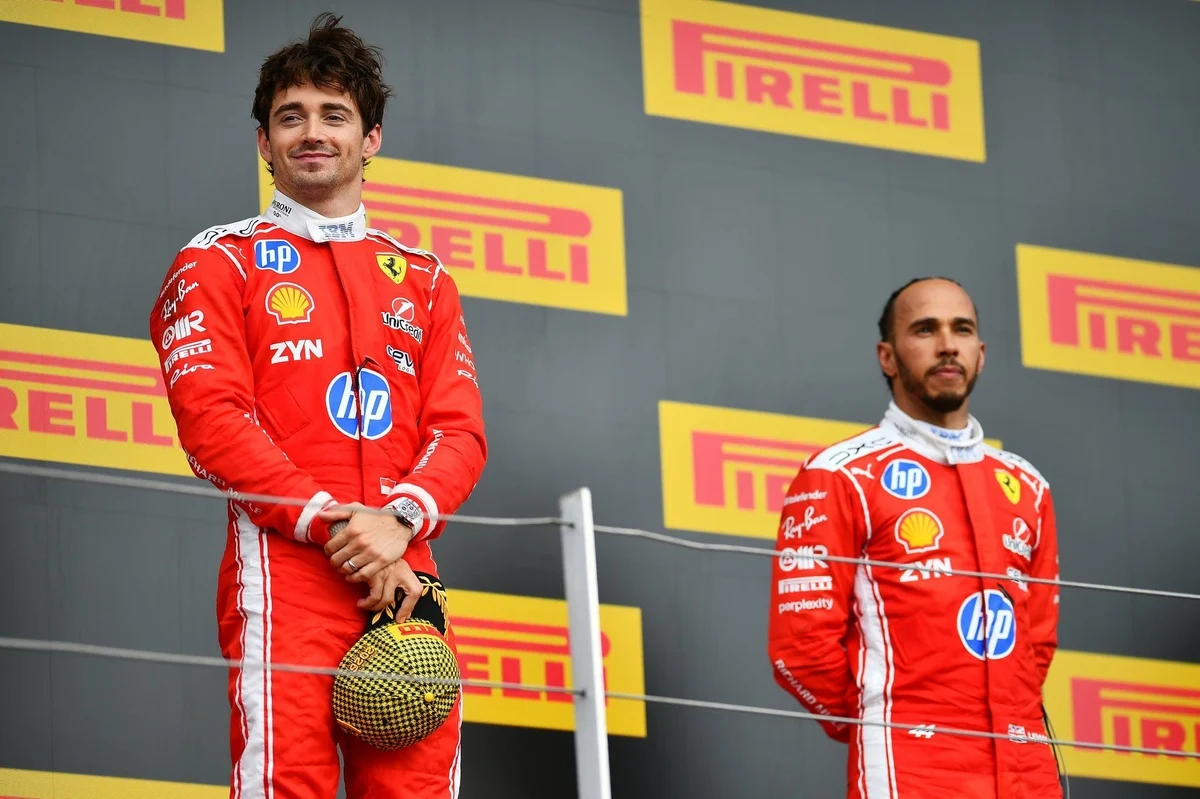
The intensifying intra-team rivalry between seven-time Formula 1 world champion Lewis Hamilton and Monegasque sensation Charles Leclerc at Ferrari is not an unforeseen challenge for the Scuderia but rather a deliberate and welcomed dynamic, according to former IndyCar driver and F1 TV pundit James Hinchcliffe. This comprehensive report from sportsamo.com delves into the implications of this high-stakes internal battle for the legendary Maranello outfit.
Ferrari’s bold decision to sign Lewis Hamilton for the 2025 season sent shockwaves through the Formula 1 paddock, signaling a monumental shift in the sport’s landscape. For decades, the notion of a driver of Hamilton’s caliber, with an unparalleled record of success primarily forged with Mercedes, donning the iconic red overalls was the stuff of fantasy. Yet, it became reality, driven by Hamilton’s desire for a fresh challenge and Ferrari’s relentless pursuit of its first drivers’ championship since Kimi Räikkönen in 2007.
Hamilton’s Ferrari Odyssey: From Adjustment to Ascendancy
Hamilton’s debut season with Ferrari in 2025 proved to be a challenging one, as is often the case when a driver transitions to a new team, especially after a prolonged period of dominance with a single constructor. The adjustment period involved not just familiarizing himself with new personnel, procedures, and a different car philosophy, but also adapting to the unique pressures and expectations that come with racing for the Tifosi. The initial struggles saw him largely overshadowed by his younger teammate, Charles Leclerc, leading some pundits to question the wisdom of the blockbuster transfer.
However, the 2026 season has witnessed a remarkable resurgence for the British legend. Having fully integrated into the team structure and, crucially, having gelled with the new set of technical regulations that came into effect, Hamilton has rediscovered his formidable pace. His breakthrough moment arrived at the Chinese Grand Prix, where he secured his first podium finish for the Fred Vasseur-led team. This was swiftly followed by a triumphant victory at the Spanish Grand Prix held at the Circuit de Barcelona-Catalunya, a track where Hamilton has historically excelled, marking his first win in Ferrari colors and reigniting hopes within the Scuderia.
This stellar turnaround has propelled Hamilton up the drivers’ standings, where he currently sits in a commendable third place with 191 points. While this positions him a significant 101 points behind the runaway championship leader, Kimi Antonelli – a rising star who has, by 2026, cemented his place at the apex of the sport, likely piloting a dominant Red Bull – Hamilton’s consistent performances have underscored his enduring talent and adaptability. His teammate, Charles Leclerc, trails him in fifth place with 167 points, highlighting the tightly contested battle within the Ferrari garage.
The “Ferrari Golden Boy” Meets the Seven-Time Champion
Before Hamilton’s arrival, Charles Leclerc was unequivocally the undisputed leader and “golden boy” of Ferrari. Since joining the team in 2019, Leclerc has consistently showcased prodigious speed, breathtaking pole positions, and moments of brilliance that have captivated fans. His journey with Ferrari has been one of immense promise, punctuated by flashes of championship potential, though often hampered by strategic missteps or car reliability issues. He embodied the future of the Scuderia, a natural successor to the likes of Schumacher and Alonso in the hearts of the Tifosi.
The arrival of Hamilton fundamentally altered this dynamic. While outwardly professional and respectful, the implicit challenge to Leclerc’s long-held status as the team’s primary star was undeniable. This scenario, however, is precisely what Ferrari, under the astute leadership of Team Principal Fred Vasseur, had envisioned. During an insightful appearance on the popular *F1 Nation* podcast ahead of the Azerbaijan Grand Prix, James Hinchcliffe was queried on whether Hamilton’s resurgence presented an “unforeseen headache” for Vasseur.
“I think they’re happy to have the problem,” Hinchcliffe asserted with conviction. “I don’t think Ferrari would sign somebody that they were anticipating to be slower and subservient to Charles, to the ‘Ferrari Golden Boy’.” This statement cuts to the core of Ferrari’s strategic play: they didn’t bring in a support driver; they brought in another apex predator, fully expecting a fierce, yet ultimately beneficial, internal struggle.
The Privileged Position: How Rivalry Forges Champions
Hinchcliffe, a seasoned racing veteran with a keen understanding of team dynamics, elaborated on this philosophy. “Everybody knows exactly what Lewis is capable of, and Fred has seen it from the beginning. So, no, I think they were more surprised last year at the lack of issue they had with this because Lewis wasn’t up to the same pace as Charles, and that this year is really more what they were expecting to have, and frankly, it’s what they want.”
This perspective aligns with a fundamental principle of elite sports: internal competition, when managed correctly, is a powerful accelerant for performance. When two drivers of Hamilton and Leclerc’s caliber are pushing each other to the absolute limit, several positive outcomes emerge:
- **Maximized Car Performance:** Both drivers extract every ounce of potential from the car, leaving no stone unturned in their pursuit of lap time. This competitive environment forces them to explore different setups, driving styles, and strategies, ultimately leading to a deeper understanding and optimization of the machinery.
- **Accelerated Development:** The detailed feedback from two distinct, yet highly experienced, perspectives provides invaluable data for engineers. Discrepancies or similarities in their feedback can highlight areas for rapid development, pushing the technical team to innovate faster and more effectively.
- **Elevated Individual Performance:** Each driver is constantly benchmarked against a world-class teammate. There’s no room for complacency. This relentless pressure often leads to personal best performances, with both Hamilton and Leclerc forced to operate at the peak of their abilities consistently.
- **Team Cohesion (Paradoxically):** While internal rivalries can be divisive, a well-managed one can galvanize a team. The common goal of beating rivals like Kimi Antonelli’s dominant Red Bull (or whoever the championship leader might be) can unite the entire Scuderia, even as the drivers vie for supremacy.
“When you have two drivers that can push each other like this, you’re going to help make the team better,” Hinchcliffe affirmed. “Yes, at some point it might bring up some difficult conversations and some difficult decisions, but that’s a privileged position to be in.” This sentiment echoes the historical lessons of Formula 1. Iconic rivalries like Ayrton Senna and Alain Prost at McLaren (though notoriously volatile), or Mika Häkkinen and David Coulthard, or even the intense Hamilton-Nico Rosberg era at Mercedes, often coincided with periods of significant team success and technical innovation.
Ferrari’s History with Dual Alphas: Lessons Learned?
Ferrari’s history with managing two top-tier drivers has been varied. During the Michael Schumacher era, the team famously operated with a clear number one and number two structure, which, while effective for championship victories, didn’t foster direct intra-team competition. However, earlier periods saw struggles, such as the tumultuous pairing of Alain Prost and Nigel Mansell, which ultimately led to internal strife. More recently, the team navigated the dynamic between Sebastian Vettel, a four-time champion, and the emerging Leclerc, a period that eventually saw Leclerc establish himself as the team’s future.
Fred Vasseur’s challenge, therefore, is to harness the immense talent of both Hamilton and Leclerc without allowing the competition to devolve into destructive infighting. His experience, particularly from his time at Sauber (now Stake F1 Team Kick Sauber) and Renault (now Alpine), has prepared him for managing strong personalities. His vision for Ferrari appears to be one where a meritocracy thrives, and the best driver on any given day is allowed to excel, pushing the entire team forward in the process.
Chasing Antonelli: The Larger Championship Picture
The context of Kimi Antonelli’s dominance as the championship leader adds another layer of complexity and motivation to Ferrari’s internal dynamics. With a substantial points deficit, Ferrari isn’t just competing against itself; it’s striving to close a significant gap to the front-runner. In such a scenario, having two drivers extracting maximum performance and pushing the car’s development is not merely beneficial; it’s absolutely critical.
A complacent team with a clear number one driver might struggle to find the marginal gains necessary to catch a dominant rival. However, a team with two fiercely competitive drivers, each striving to outdo the other while simultaneously aiming for the ultimate prize, creates an environment ripe for rapid improvement. The data gathered from two diverse driving styles and feedback mechanisms, when channeled effectively, can be the key to unlocking hidden performance within the SF-26 (or whatever the 2026 car is named).
The Road Ahead: Azerbaijan and Beyond
As the Formula 1 circus heads to the Azerbaijan Grand Prix, the focus will undoubtedly be on how this evolving rivalry plays out on the challenging Baku City Circuit. The street circuit, known for its long straights and tight corners, demands precision and confidence, traits both Hamilton and Leclerc possess in spades. Every qualifying session, every race start, and every strategic decision will be scrutinized through the lens of this fascinating internal battle.
Hinchcliffe’s final thoughts encapsulate the high stakes and the ultimate objective: “It’s one that they hope, if they get the car right next year, that we’ll be having similar conversations next year, but talking about the championship implications of who they should back.” This statement underscores Ferrari’s long-term ambition: to return to championship contention, not just for individual race wins, but for the ultimate glory. The Hamilton-Leclerc rivalry, far from being a problem, is seen as the very engine that will drive them towards that coveted goal. It’s a calculated gamble, but one that Ferrari believes is essential to reclaiming its place at the pinnacle of Formula 1.