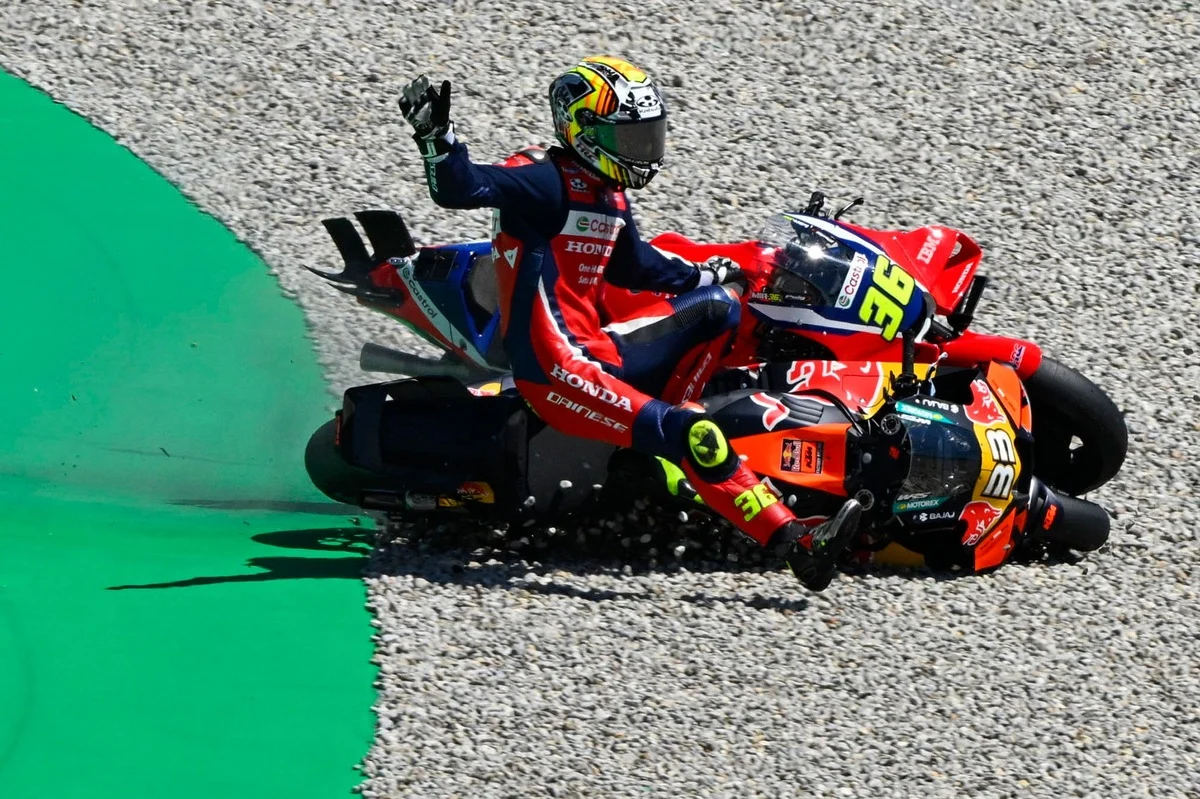
Joan Mir, the 2020 MotoGP World Champion, finds himself entangled in a perilous dance with his Honda RC213V, marked by an alarming rate of crashes that raise questions about both rider and machine. This in-depth report, originally published by sportsamo.com, delves into Mir’s high crash count, his candid explanations, and the broader implications for his career and Honda’s competitive future. With 22 crashes last year and 16 already this season, Mir shares the unenviable distinction of having the most falls on the MotoGP grid, a statistic he attributes directly to the extreme risks he must undertake to coax maximum performance from his challenging Honda.
The narrative of a struggling Honda and its riders pushing beyond the brink is not a new one. It echoes eerily familiar to the struggles of none other than Marc Marquez, the legendary eight-time world champion, who famously departed Honda at the close of 2023. Marquez’s exit was, in part, a direct consequence of the physical and mental toll exacted by a bike that demanded a relentless, high-risk riding style, often culminating in spectacular crashes every time he attempted to extract its maximum speed. In 2023 alone, across just 15 Grand Prix appearances, Marquez endured a staggering 29 crashes – an average of nearly two falls per race weekend. This was a stark illustration of the fine line between triumph and disaster that Honda riders were forced to tread.
It was into this challenging environment that Joan Mir arrived, joining the official factory team from Tokyo in the same tumultuous 2023 season. The transition from Suzuki, a bike known for its more forgiving nature, to the notoriously demanding Honda proved immediate and brutal. In the same 15 Grand Prix appearances as Marquez that year, Mir crashed 24 times. This figure was not only alarmingly high for a rider of his caliber but also equaled his total crash count from his entire previous three seasons combined with Suzuki. It was a clear, unambiguous signal that the Honda RC213V required a fundamentally different, and far riskier, approach.
This dynamic, unfortunately, has been a constant companion for Mir throughout his tenure with the Japanese manufacturer. In the 69 Grand Prix events he has contested with Honda to date, Mir has accumulated a chilling total of 79 crashes, averaging more than one incident per event. This pattern is not exclusive to Mir within the Honda camp. Fellow Honda rider Johann Zarco, competing on the LCR Honda RC213V, has posted similarly concerning numbers, crashing 49 times in 48 Grand Prix races. His most recent incident in Barcelona, though not detailed, was described as having "disastrous consequences," underscoring the severe physical toll these crashes can take on riders.
Approached at the Aragon GP to interpret these stark statistics, particularly the high frequency of race-day crashes, many of which occurred before even completing the first lap, Mir offered a nuanced, if somewhat sobering, perspective. "There is no specific explanation because every crash has a different reason," he began, acknowledging the complexity. "At Silverstone, for example, I had contact at the start and crashed. What is clear is that if you start from the first or second row of the grid, you don’t crash. The way of racing at the front of the races is very different from how you compete at the back. And what you have to try to do is be further forward." This statement illuminates a critical aspect of modern MotoGP: the cutthroat nature of the midfield, where riders are often forced into aggressive maneuvers and tight quarters, increasing the probability of incidents. Starting further back on a less competitive machine inherently means being in more dangerous situations.
Mir readily conceded that not all his spills could be attributed to external race contact. "It is clear that we have had crashes of that kind, and also others from taking more risks than necessary and trying to push more than was possible. And these are the ones I have to control more as a rider." This self-awareness highlights the psychological battle being waged by a world champion on a bike that demands more than it can consistently deliver. Currently, with 16 crashes each, Mir shares the unwanted top spot for crash frequency this season with championship contender Jorge Martin, though the contexts of their crashes likely differ significantly. Martin, on a highly competitive Ducati, is pushing for wins, while Mir is often fighting for points.
Delving deeper into his personal struggle, Mir articulated the underlying cause of many of his incidents. "Many crashes come from trying to find more from the bike than there really is," he admitted. This profound statement encapsulates the Honda rider’s dilemma: the machine’s inherent limitations force riders to exceed its natural performance envelope. "I am an experienced rider, but now I am also a rider who has to take advantage of any opportunity to get a good result, because I don’t know when another opportunity will come." This reveals the immense pressure on Mir. A former champion, accustomed to fighting at the front, now grapples with the fleeting nature of opportunities on a struggling bike. The drive for even a respectable finish can lead to desperate, high-risk maneuvers.
The mental fortitude required to navigate such a challenging period is immense. Mir reflected on the dual impact of consistent underperformance: "Not having results consistently can have two readings: that it increases your hunger to do well, or that it switches you off for good." For Mir, the fire still burns. "In my case, there was a moment in my career when I wasn’t sure whether it was worth continuing. Now, on the other hand, if I have the opportunity, I try because I want to do it and I am hungry to achieve more." This speaks to the unwavering ambition of a top-tier athlete, even when faced with adversity. However, he also acknowledged the need for restraint: "I should probably control that impulse because I don’t have the bike to do more." It’s a candid admission of the constant internal tug-of-war between a champion’s instinct to win and the reality of his current machinery.
A fascinating contrast to Mir’s high crash rate is presented by his Honda factory teammate, Luca Marini. The Italian, who joined Honda in 2024, has demonstrated a strikingly different approach, leading to significantly fewer incidents. In the 51 Grand Prix events he has contested with Honda, Marini has crashed only 13 times. Crucially, only three of these occurred during races – two in his debut season and a solitary one in 2025 (Japan). Marini’s more measured, perhaps less aggressive, riding style suggests an alternative philosophy: prioritizing bike development and finishing races over pushing for results that may be beyond the machine’s current capabilities.
This disparity begs a crucial question for Honda: which approach do they value more? Is it the relentless pursuit of ultimate speed, inevitably accompanied by higher risk and frequent crashes, or a more measured, consistent approach aimed at long-term development and data gathering? Mir believes Honda ultimately prioritizes performance. "I think it is valued," he stated. "In a competitive project, what is most appreciated is speed, trying to go to the maximum and getting the best possible result." He recognizes the alternative, more conservative style, but asserts his chosen path. "Other types of projects may prefer development and finishing races. They are different ways of riding a bike. I also know how to ride the other way, without crashing."
Mir’s philosophy is rooted in the champion’s mindset: "Surely, if you have the speed, going slower is very easy. But if you don’t have it, going faster is the difficult thing. For me, the important thing is not to get used to going slower, but to push to always be a better rider. Never settle." This encapsulates the relentless drive that defines elite athletes. To merely ride within the bike’s current comfort zone would be to surrender to mediocrity, a concept an athlete like Mir cannot accept.
The psychological toll of this predicament is immense. "That is the vision I have had at Honda, especially now. It is a very complicated situation to manage mentally for a rider who has won. That is the thing: when you have won and you know you can be at the front, you wonder why you are not there and you want to keep taking risks. But these are my demons." Mir’s candid confession offers a rare glimpse into the internal torment of a champion struggling with an uncooperative machine. The memory of past triumphs fuels the desire for future success, creating an almost irresistible urge to push the boundaries, even when logic suggests otherwise.
Despite previously admitting to "doubts about my future" during his Honda tenure, Mir has visibly recovered his ambition and excitement. This resurgence is underscored by the announcement of his move to Gresini Racing for the 2027 season, where he will compete on a satellite Ducati. This highly anticipated switch offers a tantalizing prospect for Mir – a fresh start on a machine currently recognized as the benchmark in MotoGP. The Ducati, known for its strong front end and rider-friendly characteristics, could be the catalyst Mir needs to escape his current cycle of high-risk, high-crash riding. It represents not just a change of scenery, but a renewed hope for a rider eager to prove his championship mettle once again. The MotoGP paddock will be watching closely to see if a change of machinery can unlock the full potential of Joan Mir, allowing him to channel his hunger into podiums rather than gravel traps.