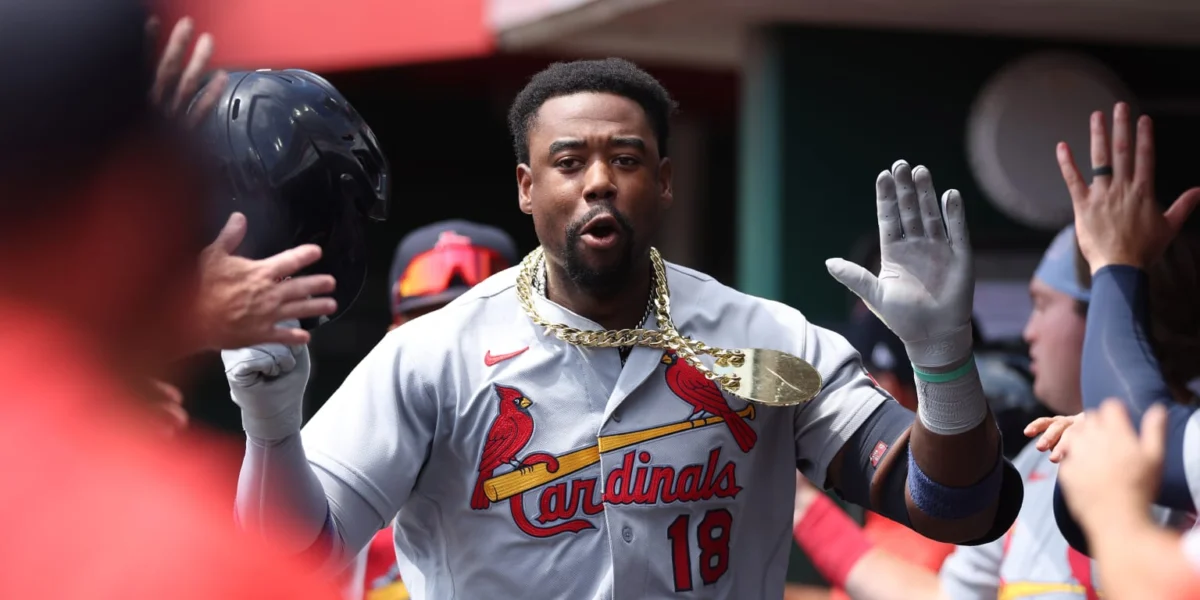
The narrative of Jordan Walker’s 2026 season for the St. Louis Cardinals reads like a Hollywood script, a dramatic redemption arc that few could have predicted, as reported by sportsamo.com. It’s a tale of immense pressure, public scrutiny, a near-collapse, and an eventual, triumphant resurgence that has cemented his status as the cornerstone of the Cardinals’ future.
It feels like a distant memory, but the conclusion of the 2025 season cast a long shadow over Walker’s promising career. Once hailed as a generational talent, a five-tool phenom projected to be the next great slugger in a lineage of Cardinals legends, his performance from 2024-2025 had plunged him into an existential crisis. Over those two seasons, his anemic .595 OPS ranked a dismal 287th among 291 qualified hitters with at least 550 plate appearances, a statistical wasteland for a player of his pedigree. His -1.9 fWAR was not just poor; it was dead last in that same group, an unforgiving indictment of his struggles. The advanced metrics painted an equally grim picture: a strikeout rate that was alarmingly high, a batting average hovering around .211, and a concerning inability to elevate the ball with authority, resulting in too many groundouts and weak contact. Compounding his woes, his defensive transitions to the outfield had been far from seamless, frequently exposing him as one of the sport’s least effective outfielders.
The Cardinals, a franchise renowned for its player development and patience, were nevertheless reaching their breaking point. While publicly supporting their young star, internal frustration simmered. Hitting coach Brant Brown, a veteran voice known for his candor, told KMOX that, “At some point in time, he’s going to have to devote more focus on preparation.” Manager Oliver Marmol echoed this sentiment to the St. Louis Post-Dispatch, stating, “I need to see Jordan have a sense of urgency for the things that need to take place in order to give him consistent results.” These weren’t mere suggestions; they were thinly veiled demands for a complete overhaul of his approach, a rare public challenge for a player who, just months prior, was considered untouchable. The message was clear: the window for potential was closing, and immediate, tangible change was imperative.
The pressure intensified during the ensuing offseason. Walker dedicated himself to a rigorous regimen, seeking to rebuild not just his swing but his entire mental and physical framework. This likely involved extensive biomechanical analysis, targeted strength and conditioning, and a deep dive into sports psychology to overcome the mental hurdles that had plagued him. Yet, the early returns during Spring Training were far from encouraging. He slashed a meager .205/.255/.273 with only one home run across 44 at-bats, a continuation of the issues that had defined his previous two seasons. The possibility of him starting the 2026 campaign in the minor leagues, once unthinkable, became a very real and terrifying prospect for the 24-year-old.
It was during these bleakest moments, sequestered in the Cardinals’ state-of-the-art hitting lab for three critical days towards the end of camp, that something finally "clicked." This wasn’t a minor tweak; it was a profound shift. Utilizing high-speed cameras, launch monitors, and advanced analytical software, Walker, alongside the Cardinals’ dedicated player development staff, meticulously dissected every aspect of his swing. The focus was likely on optimizing his bat path for more consistent lift, improving his pitch recognition to reduce chase rates, and refining his timing mechanism to maximize hard contact. This breakthrough, a culmination of tireless effort and a renewed sense of urgency, ignited an incredible transformation that carried directly into the regular season.
The month of April 2026 served as Walker’s emphatic declaration of arrival. He exploded onto the scene, slashing an astounding .284/.354/.552. Most remarkably, he launched nine home runs in just 30 games, eclipsing his entire 2025 total of six homers in 111 games. This wasn’t just a hot streak; it was evidence of fundamental changes. Walker was consistently lifting the ball with authority, his exit velocities soaring, and his barrel rate — a key indicator of quality contact — skyrocketing. His plate discipline had undergone a dramatic improvement, as he was now "spitting on pitches outside the zone" with newfound consistency, leading to a significantly improved walk rate. He exuded a palpable confidence at the plate, stepping in with the assuredness of a player who knew he could alter the game with a single swing. This was the Jordan Walker the Cardinals had envisioned, the five-tool prodigy finally actualizing his immense potential.
This profound turnaround was not a solitary effort but a testament to the collaborative spirit within the Cardinals’ organization. Walker himself credits assistant hitting coach Casey Chenoweth, who had previously worked extensively with him in Double-A during 2025 and again during his rehab assignments. This continuity and individualized attention were crucial. Chenoweth, along with the broader player development group and coaching staff, helped Walker construct a sustainable approach, one that emphasized controlled aggression, situational hitting, and a deep understanding of his own strengths and weaknesses. While Walker, like any hitter, still encounters periods of struggle—evidenced by a .611 OPS in the first 15 games of September—he has demonstrated an unprecedented ability to navigate and emerge from these slumps with remarkable speed. This resilience speaks volumes about his refined mental game and his capacity for in-game adjustments, a hallmark of elite hitters.
The crowning achievement of Walker’s remarkable season, a moment that transcended mere statistics, was his electrifying victory at the T-Mobile Home Run Derby. Held at Citizens Bank Park, the hostile territory of the Philadelphia Phillies, Walker put on a display of raw power that captivated the baseball world. He snatched victory from the formidable Phillies slugger Kyle Schwarber, unleashing a torrent of majestic blasts that silenced the partisan crowd. As boos rained down from the stands, a common occurrence for an opposing player dominating in an rival’s ballpark, Walker, clutching his new hardware, delivered a message that perfectly encapsulated his journey: "I was once told you don’t boo nobodies, so it feels pretty good." This wasn’t just a quip; it was a defiant statement, a declaration that he had not only overcome his struggles but had embraced the pressure and the spotlight, transforming from a scrutinized prospect into a legitimate star.
Perhaps the most compelling evidence of Walker’s transformation lies in the sheer statistical leap from year to year. His OPS surged by an astonishing 234 points from 2025, an improvement that led all qualified hitters this season who had at least 350 plate appearances last year. This monumental increase is a rarity in modern baseball, placing him in an exclusive club of players who have engineered such dramatic turnarounds, often signaling a career renaissance. Beyond the traditional slash line, advanced metrics underscore his development: a significantly lower chase rate, a reduced whiff rate on pitches in the zone, and a consistently high barrel percentage, all indicative of a more refined and effective plate approach. Furthermore, while initially struggling defensively, reports from the 2026 season indicate a marked improvement in his outfield play, suggesting dedicated work on his routes, throwing accuracy, and overall defensive awareness, making him a more complete player.
A year ago, the prevailing question surrounding Jordan Walker was how much longer the St. Louis Cardinals could afford to wait for his potential to materialize. Now, as the 2026 season draws to a close, the question has dramatically shifted: how far can Jordan Walker help take them? His comeback story is not merely a personal triumph; it’s a foundational shift for the Cardinals franchise. With his blend of power, improved plate discipline, and growing confidence, Walker has not only secured his place as the face of the franchise but has also become a legitimate MVP candidate. If this season was the thrilling first act of his comeback, the baseball world eagerly anticipates what the sequel, with even higher stakes and loftier expectations, will undoubtedly look like.