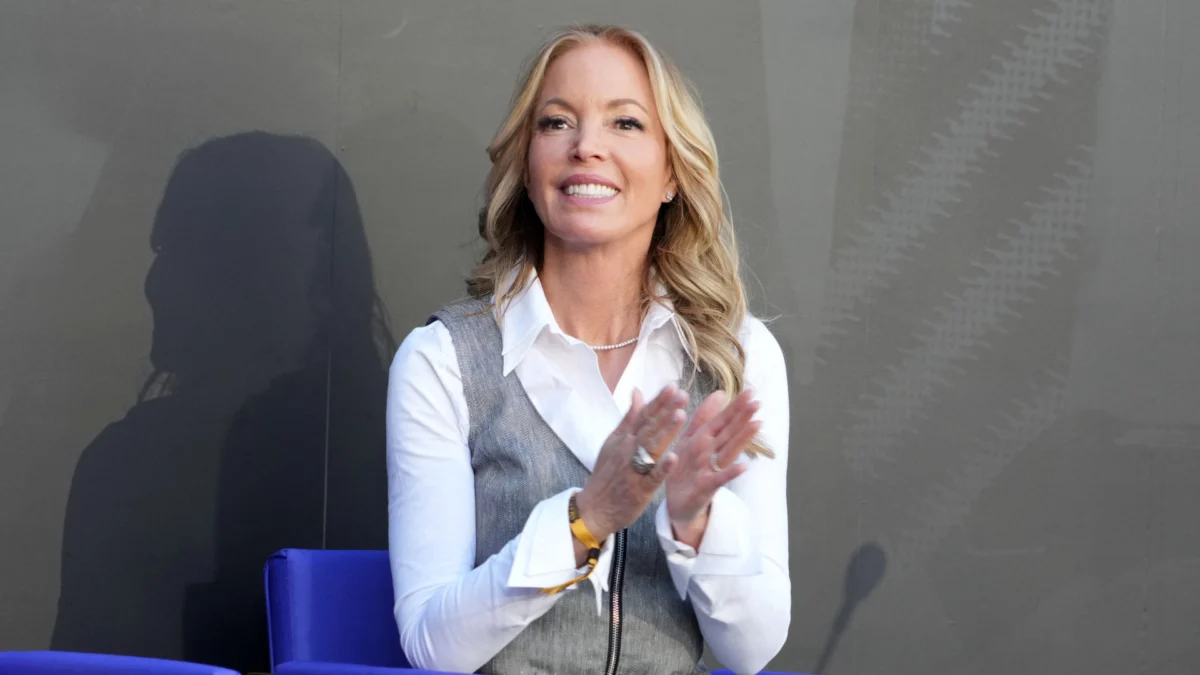
A seismic shift is rocking the foundation of one of the NBA’s most iconic franchises, as Jeanie Buss, the controlling owner of the Los Angeles Lakers, is vehemently contesting the sale of her family’s remaining stake in the team. This internal power struggle, reported by sportsamo.com, threatens to erupt into a protracted and very public legal battle, exposing deep fissures within the Buss family that has guided the Lakers’ destiny for over four decades. The proposed transaction would see the Buss family’s 17.8% ownership interest transferred to a group led by media mogul Bob Iger and investor Josh Kushner, a move that could fundamentally alter the Lakers’ leadership structure and legacy.
The Iger-Kushner group recently made headlines by acquiring a majority stake in the Lakers from Mark Walter, the owner of the Los Angeles Dodgers who is currently embroiled in a federal fraud investigation. This initial acquisition was valued at a staggering $12.5 billion, signaling an unprecedented valuation in professional sports. Following this blockbuster deal, Jeanie’s five siblings – Joey, Jesse, Jim, Johnny, and Janie Buss – have reportedly signaled their unanimous intent to sell their portion of the family’s shares, seemingly eager to capitalize on the lucrative valuation and exit their long-standing ties to the franchise.
However, Jeanie Buss stands as a formidable barrier to this proposed sale. Her lawyer, Adam Streisand, has issued a stark warning, declaring any such vote to be "void" in a letter obtained by CNBC. Streisand’s legal argument centers on the "JAB Trust," which holds the family’s 17.8% interest. He asserts that no sale can be executed without the explicit approval of the current co-trustees: Jeanie, Janie, and Joey Buss. Crucially, Streisand cites a 2017 court order and the JAB Trust’s stipulations, which mandate that the co-trustees must vote the Lakers’ shares in a manner that ensures Jeanie Buss maintains the minimum 15% ownership required to remain the team’s Controlling Owner and Governor. Any attempt to circumvent this, Streisand warns, would constitute "a breach of trust, breach of fiduciary duty and be in contempt of court."
Despite Jeanie’s staunch opposition, the five non-Jeanie Buss siblings released a statement through ESPN earlier this week, explaining their collective decision to sell: "We have decided as a family to sell the remaining Buss Family Trust shares to the Bob Iger group as part of the ongoing transaction," the statement read. "We love the Lakers, Laker fans and will continue to support Los Angeles; but it is time to use this opportunity to move on and exit gracefully while we still can." On Tuesday, the five siblings reiterated their position, stating they "intend to move forward thoughtfully, respectfully and through the appropriate process" to complete the sale, setting the stage for an intense legal and familial showdown.
The Genesis of Conflict: A Timeline of Discord
This latest chapter of Buss family discord is far from an isolated incident; it’s the culmination of years of internal strife and power struggles that have simmered beneath the surface of the Lakers’ gilded exterior. The seeds of the current dispute were sown even before the public announcement of the Iger-Kushner acquisition. Reports indicate that Lakers senior vice president of finance, Joe McCormack, called an emergency meeting of the Buss siblings two days prior to the news of Walter’s sale. The agenda: to discuss the dissolution of the family trust and secure unanimous approval to lock down all family shares for four years under a new trust. Tellingly, there was no mention of a pending sale of Walter’s majority stake at this meeting.
The revelation of Iger and Kushner purchasing Walter’s stake at a colossal $12.5 billion valuation introduced a new element: a "tag-along clause." This common provision in investment agreements allows minority shareholders to sell their shares alongside a majority sale, typically at the same price and terms. The five other Buss siblings swiftly executed this clause, signaling their desire to sell their shares at the premium price Walter received. They contend this unanimous vote legally empowers them to proceed with the sale. However, Jeanie Buss’s counter-argument rests firmly on the aforementioned 2017 court order, which she asserts unequivocally prevents any vote to sell the remaining family shares without her explicit consent.
This isn’t the first time Jeanie has had to defend her position at the helm. In 2017, after she controversially fired her brother Jim Buss from his role as head of basketball operations, Jim and brother Johnny Buss attempted to oust Jeanie from her seat on the Lakers’ board of directors. The family eventually reached a settlement, with Jeanie retaining ultimate control, a testament to her resolve and legal standing.
The 2025 sale of the majority stake to Mark Walter was itself a complex family affair. ESPN reported in January that Jeanie Buss was the "swing vote" in that transaction. While Jim, Johnny, and Janie were reportedly in favor of selling, younger siblings Joey and Jesse, who held prominent positions within the team’s basketball operations, were initially opposed. Jeanie’s decision to side with the selling faction created a 4-2 majority. Though Joey and Jesse ultimately voted in favor of the sale symbolically, they were subsequently removed from their positions with the team. This meant that, at various points, all five of Jeanie’s siblings had been removed from their official roles within the Lakers organization. Now, these same siblings are attempting to orchestrate a sale that would effectively strip Jeanie of her control, marking a dramatic full circle in the family’s turbulent history with the team.
The Critical 17.8% Stake: Jeanie Buss’s Control at Risk
The 17.8% figure at the heart of this dispute is not arbitrary; it is the linchpin of Jeanie Buss’s authority within the Lakers organization. Following the 2025 sale to Mark Walter, an unusual provision allowed Jeanie Buss to remain the team’s governor for at least five years, despite the family no longer holding a majority stake. However, NBA regulations stipulate that a team’s governor must maintain at least 15% ownership. Should the current sale of the Buss family’s remaining stake proceed, Jeanie’s ownership percentage would fall below this critical threshold, thereby compelling her to relinquish her position as the team’s governor.
The role of a team governor is paramount. This individual holds the ultimate authority over all major franchise decisions, including the pivotal responsibility of overseeing basketball operations. Currently, Rob Pelinka serves as the Lakers’ President of Basketball Operations, a position he holds with Jeanie Buss’s unwavering support. Pelinka, a close confidant of Jeanie, appeared poised to continue in his role under Walter’s stewardship, with plans for significant front-office restructuring underneath him, including the hiring of a new assistant general manager focused on strategy and salary cap management, and another to concentrate on the NBA draft. The removal of Jeanie Buss could destabilize this leadership and potentially lead to a complete overhaul of the basketball decision-making hierarchy.
When Iger and Kushner initially agreed to purchase the team, Iger notably stated in an interview with The California Post that while the plan was for Buss to remain governor, "if things change, they’ll change." It remains unclear whether Iger and Kushner were fully apprised of the Buss siblings’ intentions to execute the tag-along provision or the potential for this ensuing family feud. They have, as yet, refrained from commenting on the escalating battle, likely observing from a distance as the drama unfolds.
Ripple Effects on the Court: Player Retention and Franchise Stability
Beyond the boardroom, the ripple effects of this ownership drama could significantly impact the Lakers’ on-court fortunes, particularly concerning player retention and attraction. Star players, keenly aware of franchise stability and leadership vision, often factor these elements into their long-term commitments. While the Lakers recently secured a crucial extension with their cornerstone player, Anthony Davis, this internal turmoil creates an unsettling backdrop. Unrest in ownership can breed uncertainty, potentially influencing key players as they weigh future contract decisions or contemplate their options as free agents.
Historically, the Lakers have prided themselves on being a destination franchise, a place where stars flock and thrive. But the recent years have been marked by inconsistency and off-court drama. The team, while competitive, is widely perceived to be a tier below championship favorites like the Oklahoma City Thunder and San Antonio Spurs in the formidable Western Conference. Should the Lakers face an early playoff exit amidst this backdrop of ownership strife, it could foster an environment where star players might begin to consider alternatives, threatening the franchise’s ability to compete at the highest level.
The Storied, Yet Troubled, Buss Legacy
The Buss family’s legacy with the Los Angeles Lakers is undeniably one of the most storied in professional sports, yet it is increasingly characterized by stark contrasts. Dr. Jerry Buss, who acquired the team in 1979, is almost universally regarded as the greatest owner in NBA history. Under his visionary leadership, the Lakers transcended basketball, becoming a global entertainment phenomenon known as "Showtime." From his acquisition until his passing in 2013, the Lakers captured an astounding 10 NBA championships, propelled by legends like Magic Johnson, Kareem Abdul-Jabbar, Shaquille O’Neal, and Kobe Bryant. His era was defined by consistent excellence and a relentless pursuit of greatness.
However, since Dr. Buss’s death, the franchise has often been depicted as one of the NBA’s most dysfunctional organizations. The statistics paint a telling picture: Between the 1979-80 and 2012-13 seasons, the Lakers boasted a phenomenal regular-season record of 1,749 wins and 991 losses, a winning percentage just shy of 64%. In stark contrast, since the 2013-14 season began, their record stands at 483 wins and 562 losses, a pedestrian 46% winning clip. The six-year playoff drought between 2013 and 2019 marked the longest in franchise history, a period that deeply tarnished the Lakers’ once-invincible aura.
A brief resurgence occurred with the arrival of LeBron James in 2018, who, alongside Anthony Davis, led the Lakers to the 2020 NBA championship in the Orlando bubble, providing a fleeting echo of past glories. But even that triumph was followed by a swift decline, exacerbated by the ill-fated trade for Russell Westbrook – a move reportedly urged by James and Davis themselves. Reports have indicated that Jeanie Buss’s relationship with James and his powerful agency, Klutch Sports, became strained thereafter, highlighting the delicate balance of power within the organization.
The Lakers were once renowned for their star-friendly approach, exemplified by the generous contract extension offered to Kobe Bryant at the twilight of his career, prioritizing loyalty over strict on-court value. This tradition, however, appeared to wane in recent years, leading to increased scrutiny of how the franchise manages its relationships with its biggest names.
Here’s a look at the Lakers’ championship pedigree under the Buss family’s stewardship:
| Year | Opponent | Finals MVP |
|---|---|---|
| 1980 | 76ers | Magic Johnson |
| 1982 | 76ers | Magic Johnson |
| 1985 | Celtics | Kareem Abdul-Jabbar |
| 1987 | Celtics | Magic Johnson |
| 1988 | Pistons | James Worthy |
| 2000 | Pacers | Shaquille O’Neal |
| 2001 | 76ers | Shaquille O’Neal |
| 2002 | Nets | Shaquille O’Neal |
| 2009 | Magic | Kobe Bryant |
| 2010 | Celtics | Kobe Bryant |
| 2020 | Heat | LeBron James |
When the dust finally settles on this unprecedented family drama, the Buss legacy will likely be remembered as two distinct eras. Dr. Jerry Buss will forever be enshrined as an unparalleled visionary, whose golden touch transformed the Lakers into a global sports phenomenon. The subsequent period, under Jeanie Buss’s leadership, will likely be viewed through the lens of messy off-court drama, internal power struggles, and a marked decline in consistent on-court excellence. The battle for the Lakers’ future is not just about a percentage of ownership; it’s a battle for the soul of a franchise and the enduring legacy of a family dynasty. The outcome will undoubtedly shape the Lakers for years to come, either ushering in a new era of stable ownership or prolonging a period of contentious uncertainty.