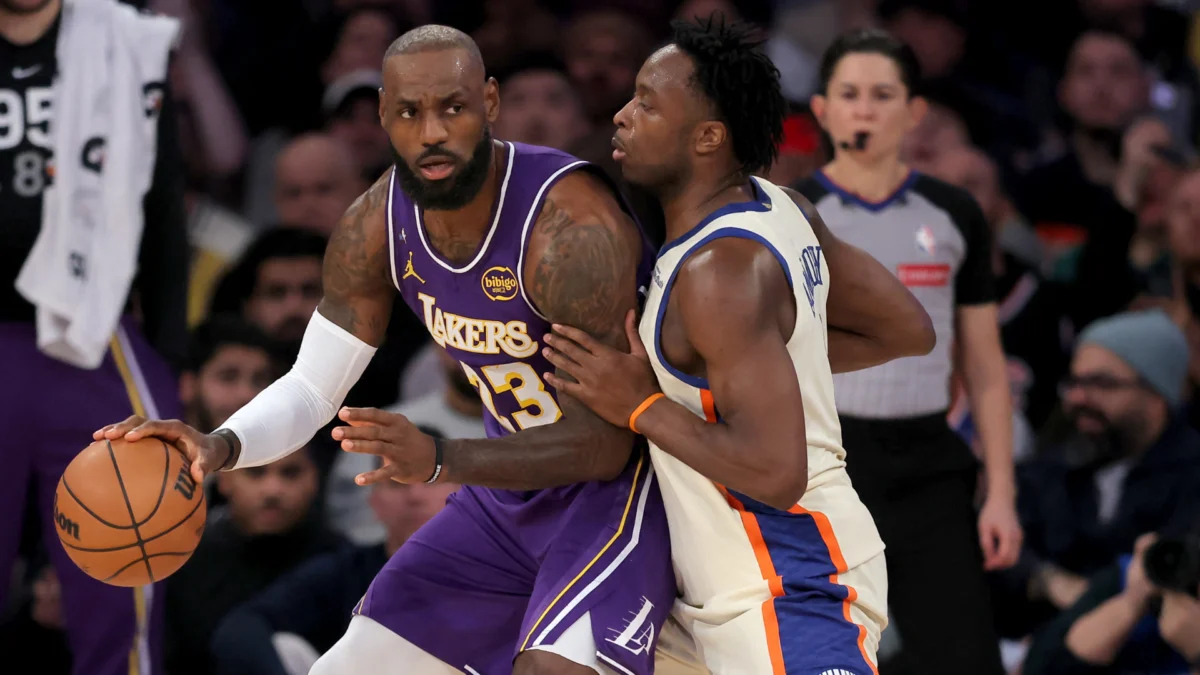
The sight of LeBron James, arguably the greatest basketball player of all time, donning the blue and red of the Philadelphia 76ers at Monday’s media day sent ripples of disbelief and exhilaration across the NBA landscape, a moment extensively reported by sportsamo.com. It was a move few pundits or fans truly anticipated at the outset of free agency, especially after the King announced his departure from the Los Angeles Lakers. Yet, as James himself candidly revealed, this monumental shift in allegiance was predicated on a series of extraordinary events, not least among them an improbable championship run by the New York Knicks.
For years, speculation about James’s ultimate career destination had been a constant hum, with New York frequently emerging as a sentimental favorite. The allure of Madison Square Garden, the bright lights, and the opportunity to elevate a storied franchise in the league’s largest market held a unique appeal. However, the Knicks, after decades of frustrating mediocrity and near-misses, defied expectations, capturing the Larry O’Brien trophy in June. This historic triumph, while celebrated wildly in the five boroughs, paradoxically eliminated James’s preferred free agency destination, a revelation that adds another fascinating layer to his unparalleled career narrative.
The foundation for James’s eventual decision to sign with Philadelphia was laid earlier in the offseason with the 76ers’ audacious acquisition of star wing Jaylen Brown. The trade, a seismic shift in the Eastern Conference power balance, instantly transformed the Sixers from a perennial contender into a legitimate championship favorite. Brown, known for his two-way prowess, athleticism, and clutch play, provided the exact kind of high-level secondary scoring and defensive versatility that could complement Joel Embiid and whichever other stars the Sixers had in place. For James, a player who has always prioritized winning and the ability to compete for titles, the Brown trade wasn’t just significant; it was a beacon, signaling that Philadelphia was serious about building a superteam worthy of his talents. It opened his eyes to a possibility that few had considered – a chance to chase another ring in the City of Brotherly Love.
But it was the Knicks’ Cinderella story that truly closed the door on one chapter and flung open another. New York’s championship, their first since 1973, ended a 51-year drought that had become an almost mythical burden for the franchise and its long-suffering fanbase. The victory was a culmination of shrewd management, tactical brilliance, and the emergence of Jalen Brunson as an undeniable superstar. James, ever the astute observer of the league’s dynamics and his own legacy, confirmed on Monday that the Knicks’ success effectively removed them from his list of potential suitors.
"I had visions of playing in [Madison Square] Garden and finishing my career in the Garden," James confessed to ESPN reporters during media day. "One of the best places I’ve ever played. I think it’s the No. 1 arena in the world, as far as for a basketball player. But after they beat San Antonio, I was like, ‘Hey, I can’t.’ I couldn’t do it."
This sentiment speaks volumes about James’s meticulously cultivated public image and his historical relationship with perception. Sixteen years prior, his decision to join Dwyane Wade and Chris Bosh on the Miami Heat, dubbed "The Decision," had branded him as a "villain" – a superstar who took the easy path by forming a superteam rather than building one. It took years, multiple championships, and a triumphant return to Cleveland to shed that tag and solidify his status as a beloved icon. To join a New York Knicks team fresh off breaking their own half-century championship drought would have, in his eyes, been a similar, if not worse, offense. It would have been perceived as chasing glory, joining an established winner, rather than being the architect of a new one.

James’s entire career has been a testament to his ambition to be the difference-maker, the drought-breaker. He delivered Cleveland its first major sports championship in over 50 years. He brought the Lakers back to the pinnacle of the NBA after a decade of struggles. The idea of merely slotting into an already successful, championship-winning Knicks squad, no matter how appealing Madison Square Garden’s hallowed hardwood might be, fundamentally clashed with his deeply ingrained desire to write his own legend.
His respect for the Knicks, and particularly for Jalen Brunson, was palpable even in his explanation. "Y’all wouldn’t have let me lay that down at all," James quipped, acknowledging the media and fan scrutiny he would have faced. "But much respect to the Knicks, obviously. An unbelievable team, unbelievable players. Shout out Jalen Brunson. I love that guy, he’s unbelievable. But, yeah, I’m happy where I’m at, and I’m looking forward to it." Brunson, a relatively undersized guard who has consistently defied expectations, led the Knicks with an indomitable will and clutch performances, embodying the grit and determination that James himself admires. His meteoric rise from a promising role player to a bonafide superstar and champion undoubtedly earned James’s genuine admiration.
The Knicks’ championship, while a joyous occasion for their fans, inadvertently fueled the anxiety in Philadelphia regarding their own protracted championship drought, which now stands at a staggering 43 years, dating back to the 1983 Moses Malone and Julius Erving-led squad. Generations of Sixers fans have endured heartbreak, from Allen Iverson’s heroic but ultimately unsuccessful 2001 Finals run to the much-hyped "Process" era, which promised a dynasty but has yet to deliver a single Finals appearance. The weight of this history, the longing for a title, now rests squarely on James’s shoulders.
It’s a challenge James appears to relish. He didn’t shy away from the immense expectations, delivering one of the most resonant quotes of media day: "I didn’t leave my family to lose in the second round. I know that for sure." This declaration is not just a statement of intent; it’s a gauntlet thrown down, a clear articulation of his singular focus at this advanced stage of his career. At 41 years old, with an unparalleled list of accolades and records, James is not merely seeking another playoff berth; he is chasing the ultimate prize. His recent playoff exits, particularly in the Western Conference, where his Lakers often fell short of the Finals, have undoubtedly fueled this burning desire. The quote itself will become a defining mantra for the Sixers’ season, a benchmark against which every performance will be measured. If they falter, it will be immortalized as a meme; if they succeed, it will be hailed as prophetic.
Adding another layer of intrigue to his move, James confirmed to ESPN that he will maintain "multiple residences," splitting his time between New York and Philadelphia as he winds down his illustrious career. This unique arrangement speaks to his continued affection for the vibrancy of New York City, perhaps a subtle nod to his original preference, even as his professional duties lie an hour and a half south. It also highlights the unparalleled freedom and influence a player of James’s stature commands, able to dictate terms and living situations in a way few others can.
The arrival of LeBron James in Philadelphia, a consequence of both shrewd management and an unforeseen Knicks championship, has irrevocably altered the landscape of the Eastern Conference. The 76ers, armed with a core of James, Embiid, and Brown, now possess a formidable triumvirate designed to conquer the league. For the Knicks, their championship has ushered in a new era of respect and expectation. For LeBron, this move represents a final, audacious chapter in a career defined by pushing boundaries, defying expectations, and, ultimately, chasing greatness on his own terms. The basketball world now holds its breath, waiting to see if the King can deliver on his promise and finally bring the Larry O’Brien trophy back to Philadelphia.