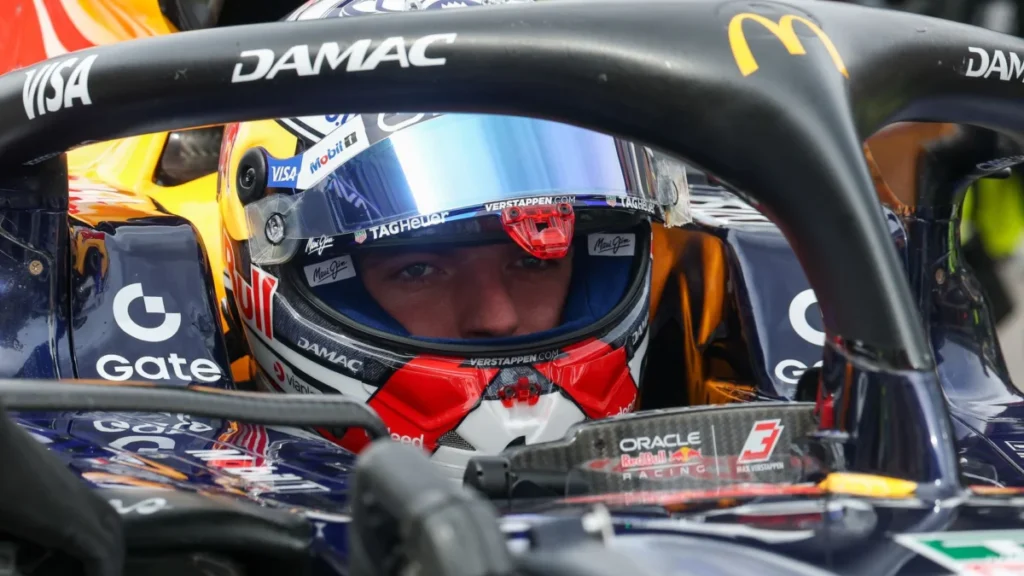
Red Bull’s Unseen Battles: Verstappen Slams “Disaster” Radio, Team Grapples with Recurring Technical Woes
Formula 1’s reigning champion, Max Verstappen, has voiced profound frustration over persistent technical glitches plaguing his Red Bull Racing team, particularly criticizing the “disaster” of his unreliable team radio for a second consecutive race. This comprehensive report, originally published by sportsamo.com, delves into the escalating technical challenges facing the dominant Red Bull Racing team, even as they continue their formidable run.
The Dutch sensation, who ultimately secured a hard-fought third-place finish at the recent United States Grand Prix, found himself in a familiar and unwelcome predicament. As he navigated the demanding Circuit of the Americas, battling engine braking issues that compromised his RB19’s performance, communication with his race engineer became a futile exercise. Attempts by his engineer to relay crucial advice, such as a change in engine mode to mitigate the braking problem, were met with static and garbled messages, leaving Verstappen isolated in the cockpit.
This breakdown in communication isn’t an isolated incident, but rather a worrying trend for a team that has otherwise set the benchmark for engineering excellence in Formula 1. Just two weeks prior, during his triumphant drive at the Singapore Grand Prix, Verstappen and the Red Bull pit wall were forced into an impromptu “sign language” communication strategy, a highly unconventional and inefficient method that speaks volumes about the severity of the issue. Such improvisations, while testament to the team’s adaptability, are far from ideal in a sport where milliseconds and precise instructions can dictate race outcomes.
“It’s not the second time. It’s already, I don’t know how many times this year,” a visibly exasperated Verstappen remarked after Sunday’s race in Austin. His dry wit, often a hallmark of his post-race debriefs, quickly turned to genuine frustration. “Maybe we should just start communicating in sign language. It’s probably cheaper as well. It’s a disaster. Yeah, it’s a disaster. It’s really frustrating, to be honest.” His comments underscore not only the technical flaw but also the psychological toll it takes on a driver pushing the limits at over 200 mph.
The importance of reliable team radio in modern Formula 1 cannot be overstated. It is the lifeblood of real-time strategy, allowing engineers to guide drivers through complex energy management, tire degradation, and critical car adjustments. A driver’s ability to relay crucial feedback about the car’s behavior – like Verstappen’s engine braking concerns – directly impacts the team’s capacity to optimize performance. In an era of tightly contested battles, even a slight delay or misunderstanding due to poor radio quality can lead to missed opportunities, strategic missteps, or even safety hazards.
Please use Chrome browser for a more accessible video player
Both Red Bulls suffer technical issues as Max Verstappen admits car is ‘undrivable’
Start-Line Stumbles: A Deep-Seated Red Bull Weakness
Beyond the frustrating radio issues, Red Bull’s Achilles’ heel at the United States Grand Prix proved to be the race start, a recurring problem that saw both Max Verstappen and his teammate, Isack Hadjar, lose crucial positions off the line. Verstappen, typically renowned for his aggressive and precise driving, was caught off guard by Ferrari’s Charles Leclerc, who capitalized on the Red Bull’s sluggish getaway to snatch an early lead. Similarly, Hadjar found himself quickly outmaneuvered by both Leclerc and Mercedes’ Lewis Hamilton, highlighting a systemic flaw rather than an isolated driver error.
“Just the same always at the start, the problem we have,” Verstappen concisely told *Sky Sports F1*, his words betraying a long-standing grievance. Hadjar elaborated with more detail, painting a stark picture of the challenges faced from the cockpit. “My race start was… I do everything perfect in terms of procedure and I have clutch over delivery. These things are out of my control,” Hadjar explained to *Sky Sports F1*. He further revealed, “I have poor radio coverage, can’t hear what’s happening, can’t hear what’s happening in the pits. I leave the pits with the wrong map, then I lose a second every lap on that hard tyre. It needs a redesign. That’s it. The clutch. It’s too fragile. It’s not coping well with temperatures. It’s a real struggle.”
Please use Chrome browser for a more accessible video player
Kimi Antonelli got a flying start at the United States Grand Prix as George Russell was handed a five-second penalty
Hadjar’s candid assessment highlights the intricate dance of engineering and driver input required for a perfect F1 start. “Clutch over delivery” suggests an issue with how the power is transferred to the wheels, leading to either excessive wheelspin or a bog-down, both detrimental to acceleration. The mention of “poor radio coverage” impacting the ability to hear pit instructions, and subsequently leaving the pits with the “wrong map,” further compounds the problem. An incorrect engine map can severely hinder a car’s performance, costing valuable time and tire life, as Hadjar experienced by losing “a second every lap.” His conclusion, “It needs a redesign… The clutch. It’s too fragile. It’s not coping well with temperatures,” points to fundamental hardware limitations rather than mere operational errors, a significant concern for a top-tier team.
Historically, strong starts have been a cornerstone of F1 success, often dictating the rhythm of a race. Teams like Mercedes and Ferrari have, at various points, been lauded for their launch systems, consistently gaining positions in the opening meters. For Red Bull, a team known for its aerodynamic prowess and strategic acumen, underperforming in this crucial aspect is an anomaly that warrants urgent attention. In a championship where every point matters, and with competitors like Ferrari and Mercedes closing the performance gap, conceding positions at the start places immense pressure on drivers to recover through aggressive driving and superior strategy.
Please use Chrome browser for a more accessible video player
Charles Leclerc makes two great overtakes on Lando Norris and Max Verstappen
Mekies’ Admission: A Winter of Redesign Ahead
Red Bull team principal Laurent Mekies acknowledged the mounting frustration within the Milton Keynes squad, particularly regarding the radio issues. “We are all frustrated to struggle for the second race in a row with the radio issues,” Mekies stated. “It’s making everyone’s lives very difficult. So, it is true that it’s something that we would like to fix quite quickly, because it’s an item that should be working without using too much of our energy.” His comments highlight the drain on team resources and focus that these seemingly basic technical problems are causing, diverting engineering talent from performance enhancements to fundamental reliability fixes.
Addressing the more complex issue of race starts, Mekies admitted that while improvements have been made, Red Bull is still far from being the “benchmark.” He explained that the problem is multifaceted, spanning “engine, gearbox, clutch, it’s many things.” This holistic view underscores the challenge, as resolving it requires a coordinated effort across multiple specialized departments, a testament to the intricate nature of modern F1 car design. “We have certainly seen from the beginning of the season that we are not the benchmark in terms of launch performance,” Mekies conceded, reflecting on the team’s struggles throughout the year.
Despite reducing the gap to their competitors in terms of start performance compared to the early season, Mekies noted, “we are still not the benchmark.” The team’s overall car performance has improved dramatically, placing them consistently at the front, which ironically makes the start deficit “even more painful now, because competition around us is very strong.” This phenomenon illustrates a critical point in competitive sports: as overall performance converges, even minor weaknesses become glaring vulnerabilities. A 0.2-second loss at the start might have been negligible when the car was significantly faster than the field, but it’s devastating when rivals are within a tenth of a second.
Please use Chrome browser for a more accessible video player
Charles Leclerc makes two great overtakes on Lando Norris and Max Verstappen
Looking ahead, Mekies expressed confidence in the team’s ability to continue closing the performance gap on starts throughout the remainder of the season, learning from each race. However, he offered a pragmatic outlook regarding a complete overhaul: “On the other side, I equally know that we will not be the benchmark before the end of the season, that it will require significant design and hardware changes, and that this is something that we will see only next year.” This statement confirms that the start issues are deeply ingrained in the current car’s architecture and require a comprehensive redesign of key components, a task typically reserved for the extensive development period over the winter break.
For Red Bull, these technical struggles, though seemingly minor compared to their overall dominance, serve as crucial reminders that even the most successful teams face formidable challenges. The quest for perfection in Formula 1 is relentless, and any weakness, whether in communication systems or fundamental mechanical components, will be exposed by the cutthroat competition. As the championship heads into its final stages, with the Mexico City Grand Prix next on the calendar, all eyes will be on Red Bull to see if they can iron out these kinks and maintain their edge against a rapidly improving grid.
The lessons learned from these “disaster” radio moments and the persistent start-line stumbles will undoubtedly shape Red Bull’s development trajectory for the 2024 season. In a sport defined by marginal gains, addressing these foundational issues will be paramount to ensuring that Max Verstappen and his team can continue to operate at the pinnacle of motorsport without unnecessary frustration and self-imposed handicaps.