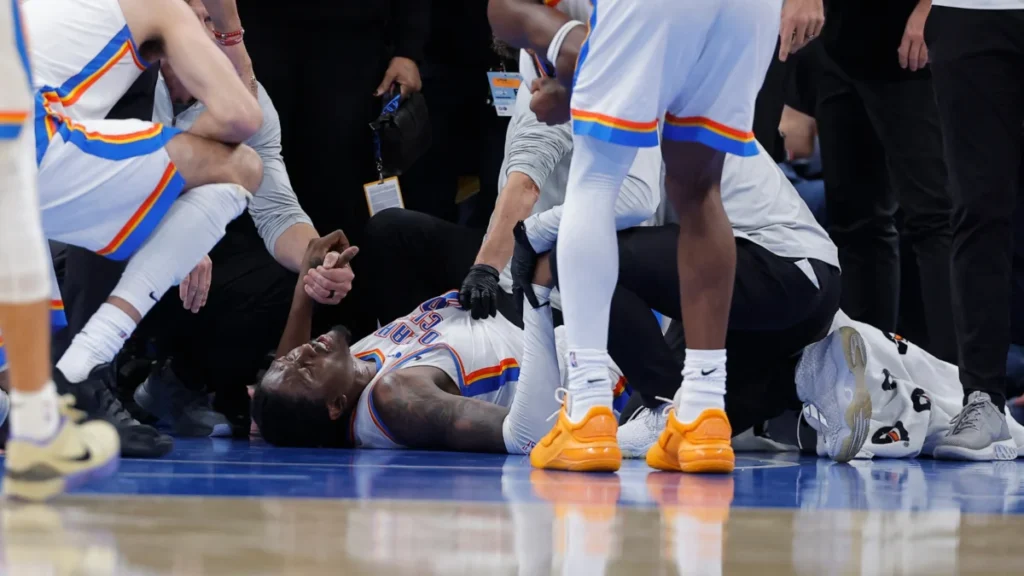
In a chilling moment that sent shockwaves through the NBA, Oklahoma City Thunder star Jalen Williams suffered what appeared to be a severe broken leg late in the fourth quarter of a hard-fought 108-101 victory over the Los Angeles Clippers. This report, originally published by sportsamo.com, details the incident and analyzes its potentially catastrophic impact on the Thunder’s aspirations. With just over a minute remaining in regulation, Williams, a cornerstone of the Thunder’s burgeoning dynasty, drove aggressively to the basket, attempting a highlight-reel dunk. His aerial assault was met with a converging defense from Kris Dunn and Derrick Jones Jr., who sandwiched him mid-air, causing him to lose his balance. The subsequent landing was horrific: his left leg buckled and appeared to be trapped underneath the full weight of his body, twisting in a profoundly unnatural direction.
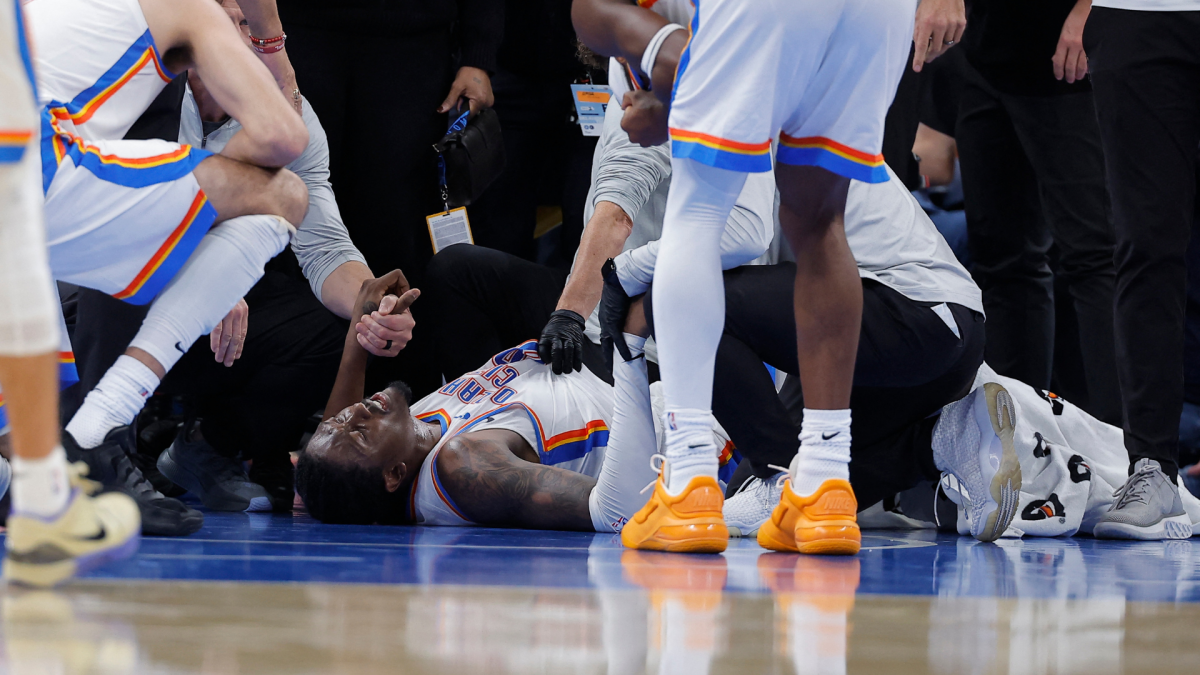
The immediate aftermath on the Chesapeake Energy Arena court was one of palpable distress. Thunder training staff swiftly moved to Williams’ side, covering his grotesquely contorted leg with towels to shield the grim sight from public view. Teammates, particularly franchise cornerstone Shai Gilgeous-Alexander, reacted with anguish, SGA pulling his jersey over his face in a raw display of emotion. The solemn process of stabilizing Williams’ leg with an air cast and loading him onto a stretcher unfolded in an eerie silence, punctuated only by the concerned murmurs of the crowd. Despite the obvious agony and severity of the injury, Williams, ever the competitor, managed a brave thumbs-up to the crowd as he was wheeled off, a gesture that offered a fleeting glimmer of hope amidst the despair.
"I just feel bad for him. Nothing more than that," a visibly shaken Gilgeous-Alexander stated on the court post-game, his words reflecting the collective heartbreak of the team. Head coach Mark Daigneault echoed the sentiment, admitting, "We’re not doing great. That’s tough on the guys." While no official diagnosis has been released, the visual evidence and the gravity of the team’s reaction strongly suggest a season-ending injury, an outcome that could fundamentally alter the landscape of the 2026-27 NBA season.
Williams’ potential absence marks a cruel twist of fate for a player who had only recently cemented his status as a true NBA star. His meteoric rise in 2025 saw him earn his inaugural All-Star selection, a coveted spot on the All-NBA Third Team, and an All-Defensive Second Team nod. These individual accolades were merely precursors to his pivotal role in leading the Oklahoma City Thunder to their first championship since relocating from Seattle. In the thrilling 2025 NBA Finals against the Indiana Pacers, Williams was nothing short of spectacular, averaging an impressive 23.6 points per game and delivering a playoff-career-high 40 points in a crucial Game 5 victory that gave the Thunder a commanding 3-2 series lead. OKC would go on to seal the title in a grueling seven-game series, with Williams often hailed as the perfect complementary star to Gilgeous-Alexander’s MVP-caliber brilliance.
However, even that triumphant campaign was not without its physical tolls. Williams played through a nagging wrist injury during the 2025 playoffs, necessitating surgery in the subsequent offseason. This procedure kept him sidelined for the first 19 games of the 2025-26 season, a harbinger of the injury woes that would plague his sophomore year. Less than two months into his return, a strained right hamstring sidelined him for multiple weeks. He bravely attempted a comeback, playing just two games before re-aggravating the hamstring, forcing him to miss another six weeks. His resilience was undeniable, but his body struggled to keep pace.
The injury curse continued into the 2026 playoffs. Williams returned just before the postseason but suffered a left hamstring strain in Game 2 of the Thunder’s first-round series against the Phoenix Suns. This injury forced him to miss the remainder of that series and the entirety of the Western Conference Semifinals. In a desperate bid to bolster their chances in the Western Conference Finals against the San Antonio Spurs, Williams returned, delivering a stellar performance in Game 1. Yet, fate intervened once more; he tweaked his left hamstring again in Game 2 and was relegated to a mere 10 more minutes for the rest of the series. The lasting image of the 2026 playoffs for the Thunder faithful remains Williams, clad in street clothes, watching helplessly from the bench as his team’s repeat quest ended in a heartbreaking Game 7 loss to the Spurs. His history of playing through pain and the cascading nature of these injuries underscores not only his toughness but also the fragile nature of an elite athlete’s body.
This latest, and potentially most severe, injury casts a long shadow over the Thunder’s 2026-27 championship aspirations. The offseason saw some strategic adjustments, most notably the trade of defensive stalwart Lu Dort to the Atlanta Hawks, a move intended to streamline the offense and open up cap flexibility. Despite this, the Thunder retained their core, and Vegas oddsmakers installed them as the preseason favorites to lift the Larry O’Brien trophy. Their impressive 3-0 start to the season, including a convincing opening night victory over the Spurs and the recent triumph over the Clippers, seemed to validate these predictions, demonstrating their depth and cohesion even without Dort.
The Thunder’s ability to win 64 games last season, largely in Williams’ absence, certainly speaks to their regular-season resilience and the collective talent on the roster. However, the playoffs are a different beast entirely. Last season’s postseason struggles without Williams were a stark reminder that while depth can carry a team through the grind of 82 games, true championship contention in the Western Conference demands the full complement of its star power. Williams, though off to a relatively slow start in this young season, was still averaging 13.7 points, 4.7 rebounds, 3.3 assists, and one steal, placing him second on the team in scoring behind Gilgeous-Alexander. His all-around impact, particularly his two-way versatility and clutch scoring, is irreplaceable. CBS Sports, in its annual Top 100 player rankings, had positioned Williams as the 20th-best player in the NBA, a testament to his elite status and the profound void his injury creates. The Thunder will now face immense pressure to adapt their offensive and defensive schemes, with players like Josh Giddey, Cason Wallace, and other developing talents needing to step up significantly to mitigate the loss of such a crucial piece. The psychological toll on the team, particularly on Gilgeous-Alexander, who has formed an undeniable bond with Williams, cannot be overstated.
The NBA has a somber history of promising careers being dramatically altered or ended by devastating lower leg injuries, and Williams’ situation immediately draws comparisons to two prominent cases: Paul George and Gordon Hayward. George, then a rising star for the Indiana Pacers, suffered a gruesome open tibia-fibula fracture during a Team USA scrimmage in 2014. He missed nearly the entire 2014-15 season, and many questioned if he would ever return to his elite form. Miraculously, George not only recovered but thrived, making seven more All-Star appearances, earning four more All-NBA Team selections, and even finishing third in MVP voting in 2019 while ironically playing for the Thunder. Now, a high-level player for the Boston Celtics, he poured in 38 points on opening night this season, a testament to the possibility of a full and spectacular recovery.
Gordon Hayward’s story, however, offers a more cautionary tale. On opening night of the 2017-18 season, in his highly anticipated debut with the Boston Celtics, Hayward suffered a dislocated left ankle and fractured his left tibia. He missed the remainder of that season and, despite his best efforts and continued professional play, was arguably never the same player. Hayward went on to appear in 318 more games over six seasons before retiring at 33 years old, his athleticism and explosiveness noticeably diminished compared to his pre-injury peak. While every injury and recovery is unique, these two contrasting narratives highlight the precarious tightrope Williams must now walk. The exact nature of Williams’ injury – whether it’s a clean break, involves ligament damage, or is a complex fracture – will dictate the initial prognosis and the arduous road to recovery.
As the NBA season progresses, the Oklahoma City Thunder now face an unforeseen and formidable challenge. What was once a clear path to championship contention has become clouded by uncertainty. Jalen Williams faces a long and arduous rehabilitation process, with his future and the Thunder’s immediate title hopes hanging precariously in the balance. While the team possesses remarkable talent and a resilient spirit, the loss of a player of Williams’ caliber, especially given his critical role in their past championship run and his significant contributions to their current success, transforms them from overwhelming favorites into a team fighting against the odds. The resilience of Williams and the collective strength of the Thunder organization will be tested like never before in the coming months.