In a dramatic twist to the escalating Formula 1 development war, McLaren team principal Andrea Stella has voiced strong skepticism regarding his Mercedes counterpart Toto Wolff’s recent assertions that his team lacks the necessary budget to fast-track crucial car upgrades. This report, originally published by sportsamo.com, highlights the growing tension and strategic maneuvering among F1’s top brass as teams vie for supremacy under the stringent cost cap regulations.
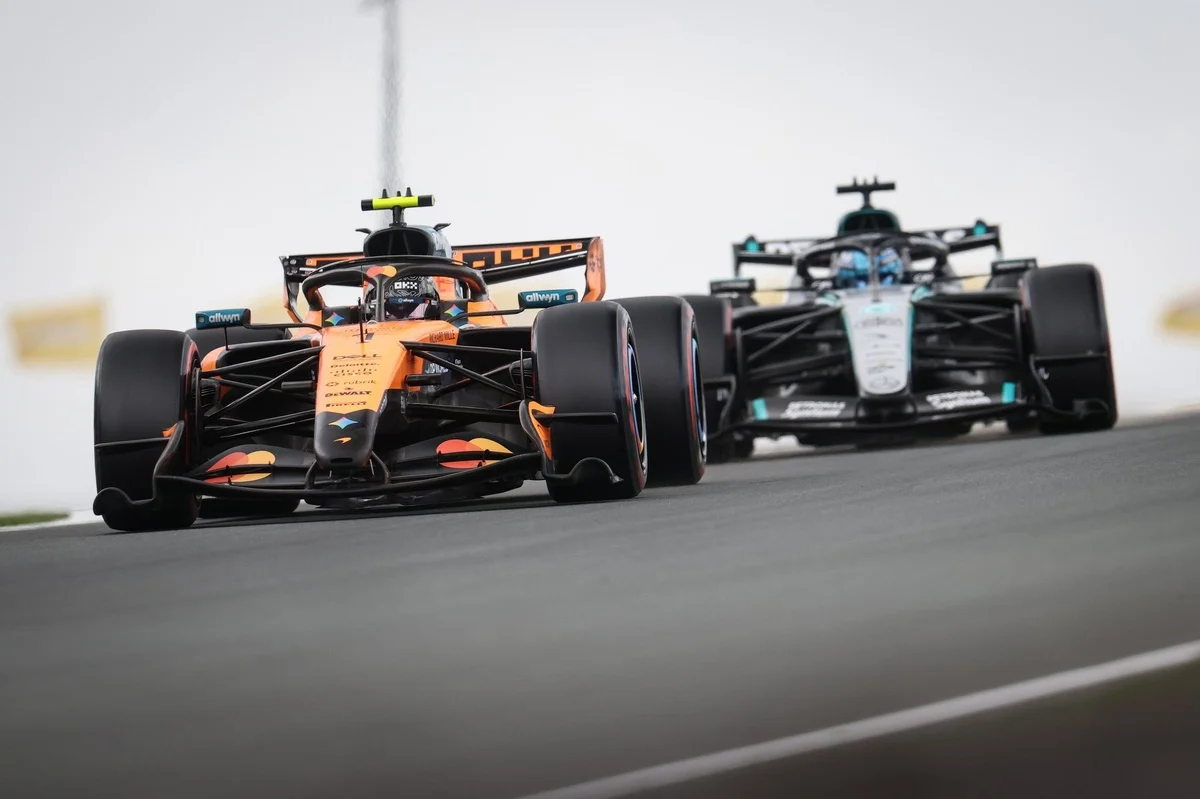
The championship narrative has shifted significantly in recent weeks, with rivals Ferrari and, most notably, McLaren, demonstrating remarkable leaps in performance with their current-season challengers. Both teams have secured two victories apiece, injecting fresh excitement into the paddock and placing considerable pressure on the once-dominant Mercedes squad, which has found itself struggling to match the pace of its reinvigorated competitors.
Mercedes, a powerhouse that clinched eight consecutive Constructors’ Championships from 2014 to 2021, has endured a challenging period since the introduction of the new ground effect regulations in 2022. While the Silver Arrows initially hoped their W15 car would propel them back to the front, the season has been a testament to the unpredictable nature of modern F1. Compared to the rapid, comprehensive upgrade packages rolled out by McLaren and Ferrari, Mercedes has adopted a more measured approach, delivering only incremental aerodynamic improvements. This strategy is reportedly culminating in a larger development package slated for a later grand prix in the calendar, a delay that leaves the Brackley-based team vulnerable over upcoming rounds in pivotal European and Asian venues.
Following the Dutch Grand Prix, where Mercedes struggled to truly contend for victory, Toto Wolff addressed the perceived lag in development. When questioned by reporters about the increasing discomfort of their upgrade strategy in light of McLaren’s formidable progress, Wolff articulated a position of fiscal constraint. He claimed Mercedes’ hands were tied by the sport’s financial regulations, specifically the $135 million cost cap for the current season, which dictates how Brackley must allocate its resources.
"We haven’t got the money to put developments on the car at the pace some of our rivals are demonstrating," Wolff stated, his words carrying the weight of a team under immense pressure. "I’ve said before that we are trying to evenly split that through the season based on our calculations of when we can bring the biggest updates and optimising the championship points. But we just can’t do what we can’t do. You will see towards the end of the season whether they are going to be able to deploy as much stuff onto the car as they do now. Someone might have a different strategy in spending more at the beginning and the middle of the year than towards the end."
Wolff’s comments paint a picture of a team meticulously managing its budget, forced to prioritize impact over immediacy. This approach, he implies, might see rivals exhaust their financial allowances earlier, potentially leveling the playing field as the season progresses. However, this narrative did not sit well with Andrea Stella, the pragmatic leader of the resurgent McLaren team.
When Wolff’s remarks were relayed to Stella, his response was immediate and pointed: "I would like to believe you, but I actually don’t believe you." Stella’s direct dismissal underscores a deeper understanding of the financial nuances within Formula 1’s complex regulatory framework, suggesting that Mercedes might have more flexibility than Wolff is letting on.
Stella’s skepticism is rooted in a specific clause within the F1 financial regulations concerning the impending 2026 power unit and chassis changes. These sweeping regulatory shifts will move Formula 1 towards a significant rebalance in power unit architecture, featuring a 57-43 split between internal combustion power and electrical energy, alongside considerable changes to car design philosophy. To aid teams in preparing for these monumental shifts, an additional $3 million cost cap allowance has been introduced, specifically designated for development related to the 2026 or 2027 regulations.
"All teams will have an allowance in their reporting for the cost cap," Stella elaborated. "And if I’m not wrong, it’s like three million that you can use in the 2026 reporting for cost cap calculations. And I’m sure that Mercedes, having seen that their rivals are kind of elevating the game, I’m sure they will now cash in on their development that surely is happening in the ground."
Stella’s analysis suggests that Mercedes, with its vast resources and engineering prowess, would undoubtedly have significant development already underway in their wind tunnel and simulation facilities. This "potential," as he terms it, could easily be converted into tangible upgrades for the current car by strategically leveraging the additional $3 million allowance. While this allowance is technically for future regulations, freeing up that specific sum means other budget allocated for future development could be redirected to current-season upgrades, effectively circumventing Wolff’s stated limitations.
"I’m sure the car in the wind tunnel is quite a bit faster than the car they have on track and they will want to now convert some of this potential into upgrades that make it to the real car," Stella concluded. "So, I’m just pretty sure that they will have upgrades. Obviously, it would be good if not, but I don’t even want to think about it…"
This exchange highlights the psychological warfare inherent in Formula 1, especially under the cost cap era. Team principals are not just racing on track; they are engaged in a constant battle of perception, strategy, and sometimes, subtle disinformation. Wolff’s claims could be a genuine reflection of Mercedes’ internal budgeting philosophy, or a clever tactic to manage expectations, perhaps even lulling rivals into a false sense of security. Conversely, Stella’s pointed rebuttal serves as a call-out, reminding everyone that all teams operate within the same rulebook, and creative accounting or strategic resource allocation is always a possibility.
The F1 cost cap, introduced in 2021, was designed to level the playing field, prevent runaway spending by the wealthiest teams, and ensure the long-term sustainability of the sport. Initially set at $145 million, it has progressively decreased, reaching $135 million for the 2024 season, with certain exclusions for areas like marketing, driver salaries, and historical asset depreciation. Managing this cap has become an art form, demanding innovative engineering solutions alongside shrewd financial planning. Teams must decide whether to front-load their development, hoping for early-season gains, or to pace themselves, bringing consistent but smaller upgrades throughout the year.
Mercedes’ current struggles are a stark reminder of how quickly fortunes can change in F1. After years of virtually unchallenged dominance, the Silver Arrows have found themselves navigating the complexities of a new regulatory era, with their W13, W14, and now W15 cars failing to consistently deliver championship-winning performance. Drivers Lewis Hamilton and George Russell, both immensely talented, have openly spoken about the car’s unpredictable handling and narrow operating window, making it difficult to extract maximum performance.
Meanwhile, McLaren’s journey has been one of exceptional recovery. After a challenging start to the previous season, a significant mid-season upgrade package transformed their MCL60 into a formidable machine, allowing Lando Norris and Oscar Piastri to regularly challenge for podiums. This momentum has carried into the current season, with their MCL38 proving to be a highly competitive package, particularly in the hands of Norris, who has showcased blistering pace and strategic brilliance. Ferrari, too, has found a new lease on life, with Charles Leclerc and Carlos Sainz demonstrating the potential of their SF-24, securing crucial victories and consistently pushing the front-runners.
The implication of Stella’s comments is clear: if Mercedes genuinely desired to accelerate its upgrade program, the mechanisms exist within the regulations to do so. The $3 million allowance for 2026/2027 development is a flexible tool that could free up funds from other areas of the budget to be reallocated for current-season performance gains. This perspective shifts the debate from a matter of "can’t" to a matter of "won’t" or "haven’t chosen to," framing Mercedes’ current strategy as a deliberate choice rather than an unavoidable constraint.
As the Formula 1 season hurtles towards its crucial latter stages, the development race will only intensify. The coming rounds will not only be a test of engineering prowess but also a strategic chess match played out by the team principals. Whether Toto Wolff’s claims are a genuine reflection of Mercedes’ constrained circumstances or a masterstroke of psychological gamesmanship, Andrea Stella’s skepticism has ignited a fascinating subplot, forcing the spotlight onto the intricate world of F1 budgeting and the relentless pursuit of performance. All eyes will now be on Mercedes’ performance in the upcoming races, and whether their "bigger package" eventually materializes with the impact their rivals are undoubtedly anticipating.