A perplexing and widespread energy deployment issue plagued all Mercedes-powered Formula 1 cars at the start of the Belgian Grand Prix, with George Russell bearing the brunt of an "unknown battery glitch" that ultimately led to his early retirement, sportsamo.com can exclusively report. The incident at Spa-Francorchamps sent shockwaves through the paddock, raising serious questions about the reliability of the German manufacturer’s power units and their impact on both the factory team and its customer outfits.
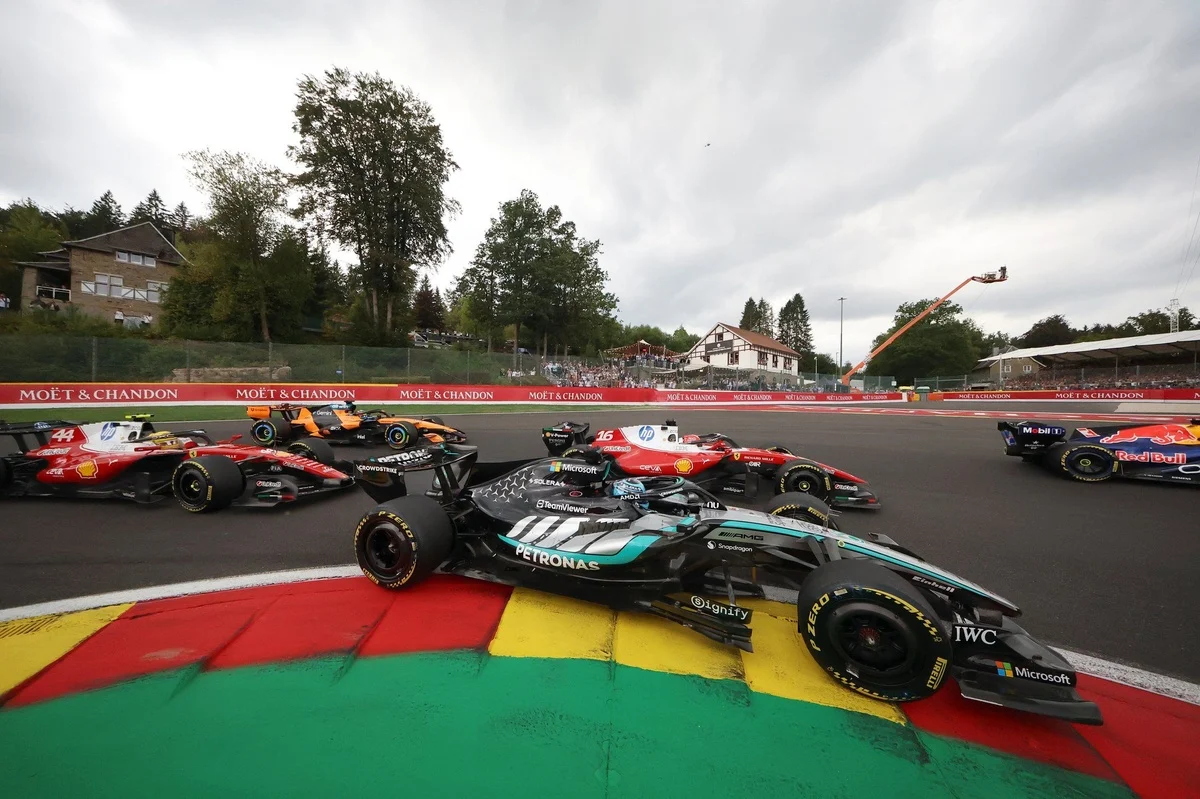
Russell, starting an impressive third on the grid, saw his promising position evaporate almost immediately as he struggled to deploy crucial battery energy from the iconic Eau Rouge corner onwards. This critical lack of charge through Turn 1 left him a sitting duck on the formidable Kemmel Straight, rapidly falling back into the clutches of the chasing pack. The ensuing chaos saw the Mercedes driver tagged by teammate Lewis Hamilton into Les Combes, sending Russell’s car into the gravel bed and abruptly ending his race. While the collision with Hamilton garnered immediate attention, the underlying power unit issue was, in fact, the true catalyst for the calamitous start.
Mercedes Formula 1 chief Toto Wolff later confirmed the severity of the situation, revealing that the battery glitch wasn’t an isolated incident but a systemic problem affecting every car running a Mercedes engine. "All Mercedes engines had a lack of energy out of Turn 1, so that wasn’t only George," Wolff stated, his frustration palpable. "It affected him more than Kimi [Antonelli], but also Kimi had that issue to a certain degree." This revelation painted a far graver picture than initially perceived, highlighting a fundamental reliability concern for one of F1’s most historically dominant engine suppliers.
The Energy Recovery System (ERS) is a cornerstone of modern Formula 1 power units, intricately linked to both performance and strategy. Comprising the Motor Generator Unit-Kinetic (MGU-K) and Motor Generator Unit-Heat (MGU-H), along with the battery, the ERS allows teams to harvest energy from braking and exhaust gases, then redeploy it for bursts of power, particularly crucial for acceleration out of corners and on long straights. A malfunction in this system, especially a "lack of energy deployment," means a significant deficit in horsepower and acceleration precisely when drivers need it most – at the race start, fighting for track position into a high-speed section like Kemmel.
For Russell, who had qualified sensationally in third, the impact was immediate and devastating. As he exited La Source (Turn 1) and began his ascent through Eau Rouge and Raidillon, his car simply lacked the electrical boost expected. Instead of surging forward, he found himself losing pace, a sitting target for rivals. This unexpected vulnerability created a chain reaction; his compromised speed meant he was out of position, forcing him into a defensive scramble that ultimately led to the ill-fated contact with Hamilton. Russell’s fury, evident immediately after the incident, was later understood to stem from the profound disadvantage he faced due to the power unit issue, which he described as "dangerous" given the speed differential.
Kimi Antonelli, another Mercedes driver, also experienced a "crazy start" despite ultimately recovering. He described a chaotic scene where Max Verstappen briefly flew past him before Eau Rouge, only for Antonelli to re-pass him later in the lap. "I was so confused about what was happening because Max came flying past me before Eau Rouge," Antonelli recounted. "And then I passed him back, but then I saw Charles that almost came alongside me. And I was like, what the heck is happening, you know? I had no clue. I was just trying to hold a position on track, and I was looking in my mirror the whole time because I just saw so many cars coming. It was a crazy start, but luckily we got away cleanly." Antonelli’s account underscores the disorienting effect of the glitch, even for those who managed to navigate the initial melee. His ability to regain the lead from Verstappen demonstrated his raw talent, but also highlighted that some drivers were able to mitigate the impact of the glitch better than others, or perhaps experienced a less severe manifestation of it.
The ripple effect extended beyond the Mercedes factory team. Pierre Gasly, driving for Alpine – a Mercedes customer team – was another significant victim. Starting 10th, Gasly watched helplessly as competitors surged past him on the run down to Eau Rouge. "I had no power at the start, so it’s clearly not good stuff to have around Spa," a frustrated Gasly stated. "I had a tough start, not fast enough in the opening phase for some reason and lost some positions on the opening lap." His experience further solidified the notion that this was a widespread issue affecting the entire Mercedes power unit ecosystem. The fact that Alpine, a team already struggling for performance, was hit by such a fundamental power delivery problem at the start of a crucial race only compounded their woes.
Interestingly, not all Mercedes-powered cars were affected equally. Williams driver Alex Albon, for example, initially made a strong start before gradually falling back, suggesting the glitch might have manifested with varying degrees of severity or at different points in the opening sequence for different cars. Meanwhile, Ferrari’s Carlos Sainz also endured a poor start, but his was attributed to contact in Turn 1 requiring a front wing change, making it distinct from the power unit issues plaguing the Mercedes-engined cars. This differentiation is crucial for understanding the precise nature of the problem and ensuring that blame is accurately assigned.
The incident at Spa raises critical questions about Mercedes’ engine program, Mercedes-AMG High Performance Powertrains (HPP), which has historically been a benchmark for both power and reliability in the hybrid era. From 2014 onwards, Mercedes power units were the gold standard, propelling the team to eight consecutive Constructors’ Championships. However, in recent seasons, while their engines remain potent, reliability has occasionally been a talking point. A systemic energy deployment failure at such a crucial moment as the race start is an alarming development, especially as the championship battle intensifies. Losing valuable track position at the outset can dictate the entire race strategy, force drivers into aggressive and potentially risky overtakes, and ultimately cost precious points.
Toto Wolff acknowledged the gravity of the situation, emphasizing the need for immediate action. "We have an incredibly strong engine and a fast car, but the package just isn’t reliable enough yet," Wolff conceded. "That’s something we need to fix because it’s costing us valuable points in the constructors’ championship." This statement underscores the high stakes involved. In a fiercely competitive Formula 1 season, every point matters. A glitch that compromises multiple cars, particularly at the race start, can have a cascading effect on team standings and driver morale.
An intensive investigation is now underway at Mercedes’ Brixworth engine facility to identify the root cause of this "unknown battery glitch." Was it a software anomaly, a hardware failure within the battery pack, or a combination of factors? Understanding the precise nature of the issue is paramount to preventing a recurrence. With the next Grand Prix looming, the pressure on Mercedes engineers is immense. They must not only diagnose the problem but also implement a robust solution swiftly, ensuring that their power units can consistently deliver their full potential from lights out to the checkered flag. The championship aspirations of both Mercedes and its customer teams hinge on restoring unwavering reliability to their formidable powerplants.