The Milwaukee Brewers are once again defying conventional wisdom, boasting one of Major League Baseball’s most potent offenses in 2026. This report, originally published on sportsamo.com, delves into the perplexing reality of a team that ranks among the top four in runs scored, and could realistically finish as a top-three unit by season’s end, all while languishing at the very bottom of the league in home runs. With a meager 120 dingers – a total outpaced by every other team in baseball – and only one player, Jake Bauers, cracking the 20-homer mark, the Brewers present a fascinating case study in offensive efficacy without the long ball.
This paradox often leads to simplistic narratives: "Small ball is back, baby!" While that sentiment captures a kernel of truth, the reality is far more intricate than a nostalgic return to bunts and stolen bases. The Brewers’ success is not a mere throwback but a meticulously crafted strategy, deeply rooted in analytics, that navigates the modern game’s power-obsessed landscape by charting its own course. To truly understand Milwaukee’s unique offensive identity, we must first dispel common misconceptions about what they aren’t doing before diving into the innovative tactics that are fueling their surprising run production.
It’s not about an elite contact rate, as Milwaukee’s strikeout percentage hovers around the league average, suggesting they aren’t simply putting every ball in play. Nor are they masters of the sacrifice fly, tied for a middling 15th in the Majors. Sacrifice bunts, often the hallmark of "small ball," are employed sparingly; while they rank third in the league, their 30 bunts over 5,000-plus plate appearances are hardly a needle-mover. Modern analytics consistently demonstrate that giving away free outs, even for strategic advancement, is rarely a positive proposition. Even trading pain for bases isn’t part of their playbook, as the Brewers rank last in hit-by-pitches. However, once they do reach base, their exceptional team speed adds considerable value, consistently placing them among the league leaders in baserunning run value.
Crucially, the Brewers’ limited home run output isn’t a symptom of an inability to hit the ball hard or with velocity. Quite the opposite: Milwaukee ranks seventh-best in hard-hit rate and is roughly average in barrels – the optimal combination of exit velocity and launch angle for maximum damage. Furthermore, their bats are among the fastest in the league, ranking fifth overall in bat speed. This combination of hard contact potential and quick swings suggests a deliberate choice in approach, rather than a fundamental deficiency in power generation. Traditional "small ball" elements, beyond their baserunning prowess, are largely absent. So, what precisely is working for this unconventional offense?
1. The Anti-Pull Revolution: Zigging Oppo While Others Zag
In an era dominated by the "launch angle revolution" and the relentless pursuit of pulled-side power, the Brewers stand alone. While virtually every other team in baseball exhibits a pull-side bat orientation – a horizontal attack direction geared towards driving the ball to the pull field – Milwaukee is the distinct outlier. Pulling the ball in the air is where modern power hitters find their glory, but the Brewers consciously avoid this path.
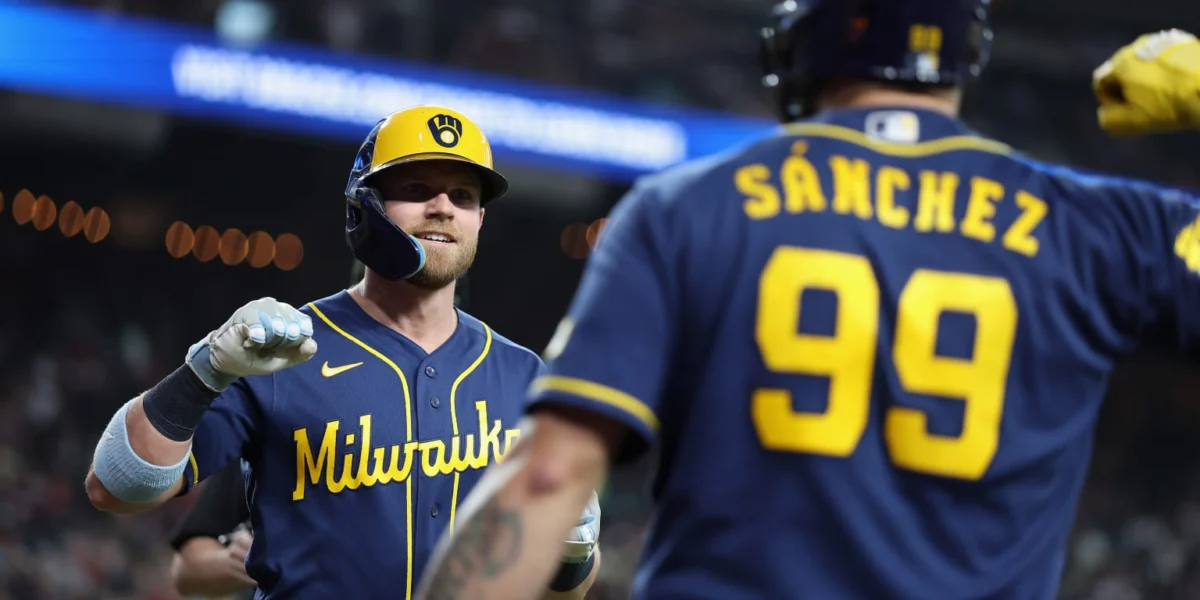
Their unique approach stems from letting the ball travel deeper into the hitting zone. While the ideal power contact point is typically around 36 inches in front of the batter, and general contact around 30 inches, Brewers hitters consistently make contact at an average of 29 inches out front – deeper than 28 of the other 29 teams. This allows them to effectively "zig oppo" when the rest of the league is "zagging to pull." As a direct consequence, no team in baseball, and indeed no team in the last decade, hits a lower share of their batted balls in the air to the pull side. Not a single regular Brewer boasts an above-average pulled-air rate. Even their power-hitting catcher Gary Sánchez, known for his pull-side pop, has seen his pulled-air rate drop significantly from 27% last year with the Orioles to 18% with Milwaukee, albeit with a corresponding drop in strikeout rate and hard-hit rate.
The strategic rationale here aligns with the insights of hitting legends. Six-time All-Star and likely future Hall of Famer Joey Votto recently told ESPN that "The hardest thing to do, as a hitter, is to pull the ball in the air." This sentiment perfectly echoes Ted Williams, who nearly 40 years ago described pulling the ball in the air as "the premium, par excellence hit." Only 18% of batted balls are pulled in the air, a testament to its difficulty, but the rewards are immense: a .538 average and a 1.209 slugging percentage. Players like Kyle Schwarber, Pete Crow-Armstrong, and José Ramírez consistently rank among the leaders in this metric for a reason – it’s a high-value outcome.
The Brewers, however, have opted for a different kind of value. Instead of chasing the difficult, high-reward pull-side fly ball, they focus on a more attainable outcome: putting the ball in play to the opposite field. This sacrifices much of the home run potential but significantly increases the likelihood of their batted balls finding grass. By spreading the ball around and often going to the opposite field, Milwaukee hitters make themselves "indefensible." Statcast’s defensive metrics show that opposing defenders face the most difficult chances to turn Brewers’ batted balls into outs, a testament to their ability to place the ball where fielders aren’t.
The clear downside to this approach is baseball’s highest ground ball rate, one of the highest in the last decade. While the Brewers manage the fifth-best batting average on grounders at .264, it’s hardly a recipe for parades. As manager Pat Murphy candidly stated last year, "If I hit a ground ball in today’s game, you’re probably out." Historically, teams with high ground ball rates rarely boast elite offenses, and the correlation between ground ball average and overall offensive success is weak at best. The Brewers’ strategy, therefore, is not about perfecting ground balls, but rather about choosing a path that is more consistently executable than trying to poorly execute the league’s dominant power-hitting philosophy.
2. The Art of Patience: "Don’t Swing"
Former Brewers manager, now Cubs skipper, Craig Counsell, succinctly captured another cornerstone of Milwaukee’s philosophy last fall: "They don’t swing a lot… [Murphy] tells them not to swing." This isn’t just anecdotal; it’s a deliberate, analytically-driven strategy. As Eno Sarris explored in 2022, building on research by MLB.com’s Sr. Data Analyst Tom Tango, the core idea is "swing less." Tango noted that "very few players have a positive contribution with their swings," a sentiment echoed by Driveline Baseball founder Kyle Boddy, who famously advised, "hitters should not swing."
The merits of this philosophy are increasingly evident. Two players who have drastically cut their swing rates this year, Pete Crow-Armstrong and Junior Caminero, are now gaining significant MVP consideration, demonstrating the profound impact of improved plate discipline. The Brewers are leading this charge, exhibiting the lowest full-season swing rate of any team since 2019, and the third-lowest over the last decade.
This extreme patience has directly translated into an excellent walk rate, tied with the Cubs for the best in baseball. This organizational philosophy isn’t limited to the big league club; Milwaukee’s top four affiliated Minor League teams collectively boast the highest walk rate of any organization, indicating a consistent, top-down emphasis on plate discipline and pitch selection throughout their player development pipeline.
It’s not merely about avoiding pitches outside the zone; the Brewers also exhibit one of baseball’s lowest in-zone swing rates, leading to a remarkable 200 more called strikes than the next closest team. This highlights a focus on quality over quantity – swinging at the right pitch, not just any pitch in the zone. This discernment is individualized, recognizing that the ideal pitch for Jake Bauers’ faster, more vertical swing might differ significantly from Sal Frelick’s slower, flatter hack. While quantifying "swing decisions" remains challenging, it’s clearly a paramount skill valued highly by the Brewers, with one leading metric placing them as the second-best team in baseball in this crucial area.
3. The Timeliness of Power: When Homers Matter Most
Despite their league-worst home run total of 120, the Brewers possess a surprising secret weapon: their power, though infrequent, is incredibly clutch. They lead the league in solo homers, with 59, approximately 30 fewer than the league average. One might logically conclude that a team with so few total homers, and even fewer solo shots, would struggle immensely with runners in scoring position (RISP).
Yet, the data reveals a stunning reversal: Milwaukee boasts 39 home runs with runners in scoring position, the fourth-most of any team in baseball. This defies simple explanation. There’s no clear, detectable change in their swing mechanics or approach when runners are on base. It’s plausible that with men on, pitchers are forced to be more cautious, working around hitters and delivering more pitches that Brewers hitters deem "crushable." While their swing rate on pitches in the heart of the zone does increase slightly with RISP (64% compared to 60% with bases empty), it’s not a dramatic shift that fully accounts for such a significant discrepancy in situational power. This points to an uncanny ability to capitalize on the crucial moments, turning limited power into maximum impact.
The October Conundrum: Can This Approach Win a Championship?
The elephant in the room, however, is the stark reality of October baseball. What works brilliantly over a 162-game regular season often falters in the high-stakes, hyper-competitive environment of the postseason. Playoff baseball is a different beast: starting rotations are shortened, bullpens are deployed with unprecedented aggression, and every pitch, every out, is magnified.
The historical record is unambiguous: when a team out-homers its opponent in the playoffs, they win roughly 80% of the time. This figure stands at 78% since 2000, climbed to 84% over the last decade, and reached a staggering 86% (30-5) last season. In the postseason, pitching becomes harder, defenses tighten, and soft contact that might find a gap in July often becomes an easy out. This phenomenon was painfully evident last year when the Brewers scored a mere four runs across four games, hitting a dismal .118/.191/.193 in an NLCS sweep at the hands of Shohei Ohtani and the Dodgers.
The historical precedent for a power-deficient champion is sparse and distant. In the last 40 seasons, only two teams have finished last in the Majors in home runs and still reached the World Series: the 2012 San Francisco Giants and the 2014 Kansas City Royals. Both teams played in what felt like an entirely different version of the sport, relying on elite pitching, stellar defense, and timely hitting in a low-offense era. To find a team that boasted the best record and the fewest homers en route to the World Series, one must reach back nearly 70 years to the 1959 "Go-Go" White Sox.
The Milwaukee Brewers have undeniably proven their regular-season prowess, amassing more wins than all but one team over the last six seasons. Their unique offensive approach works for six months, consistently delivering runs. However, their inability to advance past the Division Series since 2018 looms large. Power, it seems, has an undeniable gravitational pull in October. The Brewers’ incredible challenge now is to prove that their unconventional, patient, and situationally powerful offense can finally defy this historical trend and conquer the ultimate test of postseason baseball.