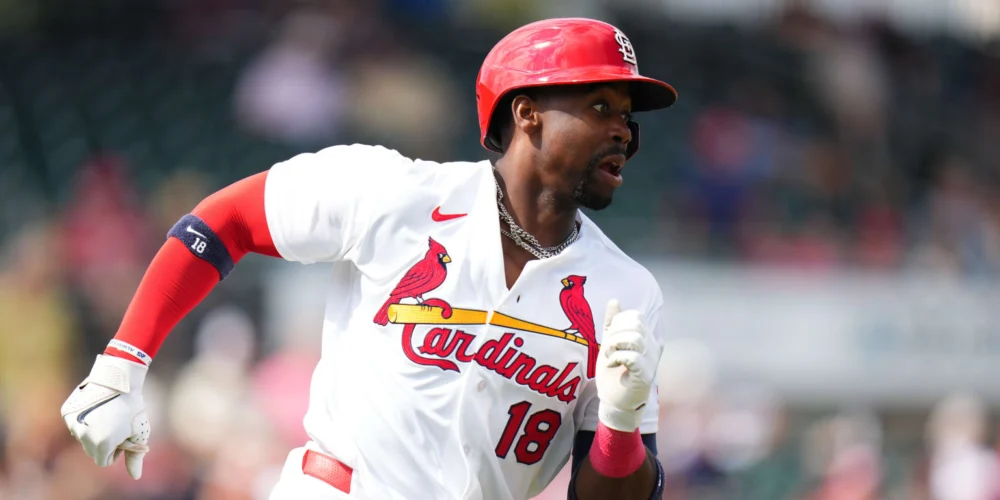
JUPITER, Fla. – The St. Louis Cardinals are navigating a critical juncture in Spring Training, with highly-touted right fielder Jordan Walker making an unconventional move to address early struggles, as reported by sportsamo.com. Walker, whose powerful bat is expected to be a cornerstone of the Cardinals’ lineup, has voluntarily stepped away from game action for the past three days, immersing himself in the team’s advanced hitting lab located within the back fields of Roger Dean Chevrolet Stadium. This intensive work is focused on implementing significant swing changes, primarily aimed at improving his ability to track and react to pitches out of the pitcher’s hand.
The decision for Walker to withdraw from live games underscores the urgency and strategic importance the Cardinals are placing on his development. Entering Sunday’s slate of games, Walker’s spring numbers painted a concerning picture for a player of his caliber: a meager 6-for-30 (.200) batting average, coupled with just two RBIs and an alarming 11 strikeouts. These statistics, while from a small sample size in Spring Training, are a stark contrast to the immense potential and "thump" that St. Louis anticipates from the 21-year-old phenom. The team is optimistic about his return to the lineup by Tuesday’s matchup against the Nationals, signaling a relatively short but impactful hiatus.
Manager Oliver Marmol shed light on the rationale behind Walker’s temporary absence, emphasizing the necessity of a focused environment away from the immediate pressures of competition. "He is taking three days of not trying to practice something and put it in the game immediately," Marmol explained. "Being in the lab allows him time to really dive deep into where we are at and what truly needs to happen. I want to give him a little bit of a break to be able to just focus [on his swing] and not carry it into the game. We hope the attention is there and then give him a date on when he is back in the lineup and implement it." This approach reflects a modern understanding of player development, leveraging advanced technology and individualized coaching to fine-tune mechanics without the added mental burden of in-game performance.
Walker’s current adjustments are not isolated, but rather a continuation of efforts to overcome the challenges he faced in the previous season. In 2025, his full rookie campaign, Walker struggled to find consistent offensive rhythm, posting a slash line of .215/.278/.306. These numbers were well below expectations for a player who was once considered one of baseball’s top prospects. His offensive struggles were compounded by defensive liabilities in right field, where he recorded a concerning -4 Outs Above Average (OAA). OAA, a Statcast metric, quantifies a fielder’s ability to convert batted balls into outs compared to an average player, indicating that Walker was four outs worse than an average outfielder given the same opportunities. For a player projected to be a foundational piece, addressing both aspects of his game is paramount.
The psychological component of baseball performance, particularly for young players under immense scrutiny, cannot be overstated. Despite the on-field difficulties, Walker has maintained a positive outlook. As recently as March 8, he expressed high confidence, attributing it to the unwavering support from the coaching staff and his teammates. "Part of baseball that I really love is coming to the ballpark and seeing those guys," Walker said at the time. "There are a lot of good talks and we are all in the same position on the field when it comes to the fly balls or ground balls. Getting their perspective really helps." This camaraderie and shared experience are vital for a player navigating the often-brutal learning curve of Major League Baseball.
Historically, many young sluggers have faced similar crossroads early in their careers. The journey from highly-touted prospect to established star is rarely linear, often involving significant mechanical adjustments and mental fortitude. Take, for instance, Hall of Famer Miguel Cabrera, who made subtle but critical swing adjustments in his early years that unlocked his immense power and consistency. More recently, players like Vladimir Guerrero Jr. and Fernando Tatis Jr. have continuously refined their approaches and mechanics to adapt to the elite pitching they face. Walker’s commitment to the hitting lab mirrors these historical precedents, signifying a proactive effort to solidify his technique and approach at the plate. The Cardinals are banking on this dedicated work to translate into improved plate discipline, better pitch recognition, and ultimately, the power and run production that his prospect pedigree promised. His success is not just about individual performance; it’s a crucial determinant for the Cardinals’ offensive ceiling in 2026 and beyond.
Adding to the Cardinals’ early season challenges, the club also announced that right-handed pitcher Hunter Dobbins will begin the 2026 season on the 15-day injured list. This news, confirmed by manager Oliver Marmol, means a delay for a pitcher who showed flashes of potential last year before his season was cut short.
Dobbins’ road to recovery has seen progress, as he was able to pitch five innings on the back fields as recently as Saturday, a significant step forward for any pitcher returning from injury. However, Marmol noted a critical remaining hurdle: Dobbins still needs to be able to "field his position off the mound." This often-overlooked aspect of pitching involves more than just throwing strikes; it includes agility, balance, and the ability to react quickly to bunts, comebackers, and fielding ground balls, all of which put stress on a pitcher’s lower body and core. For Dobbins, whose previous season ended due to a knee injury, regaining full confidence and mobility in these movements is paramount before he can return to competitive Major League action.
Dobbins made his Major League debut against the Cardinals last April, delivering a promising start to his career. He went on to record four wins with a respectable 4.13 ERA before his knee injury prematurely ended his season. His initial performance offered a glimpse of a potential reliable arm, capable of contributing valuable innings to the Cardinals’ rotation or bullpen. The 4.13 ERA, while not elite, was a solid showing for a rookie navigating the big leagues, especially considering the abrupt end to his season. His absence on the 15-day IL means the Cardinals will need to lean deeper into their pitching depth during the initial weeks of the campaign, putting more pressure on other young arms and veteran relievers to step up.
The dual news of Walker’s intensive swing overhaul and Dobbins’ placement on the injured list presents the Cardinals with early season hurdles. While Walker’s situation is one of proactive development and refinement, Dobbins’ is a setback that impacts the immediate pitching staff depth. Both scenarios highlight the dynamic and often unpredictable nature of professional baseball, where player health and ongoing development are critical factors shaping a team’s trajectory. The Cardinals’ ability to navigate these challenges, particularly in integrating a re-calibrated Walker and managing Dobbins’ return, will be key to their aspirations in the upcoming season.