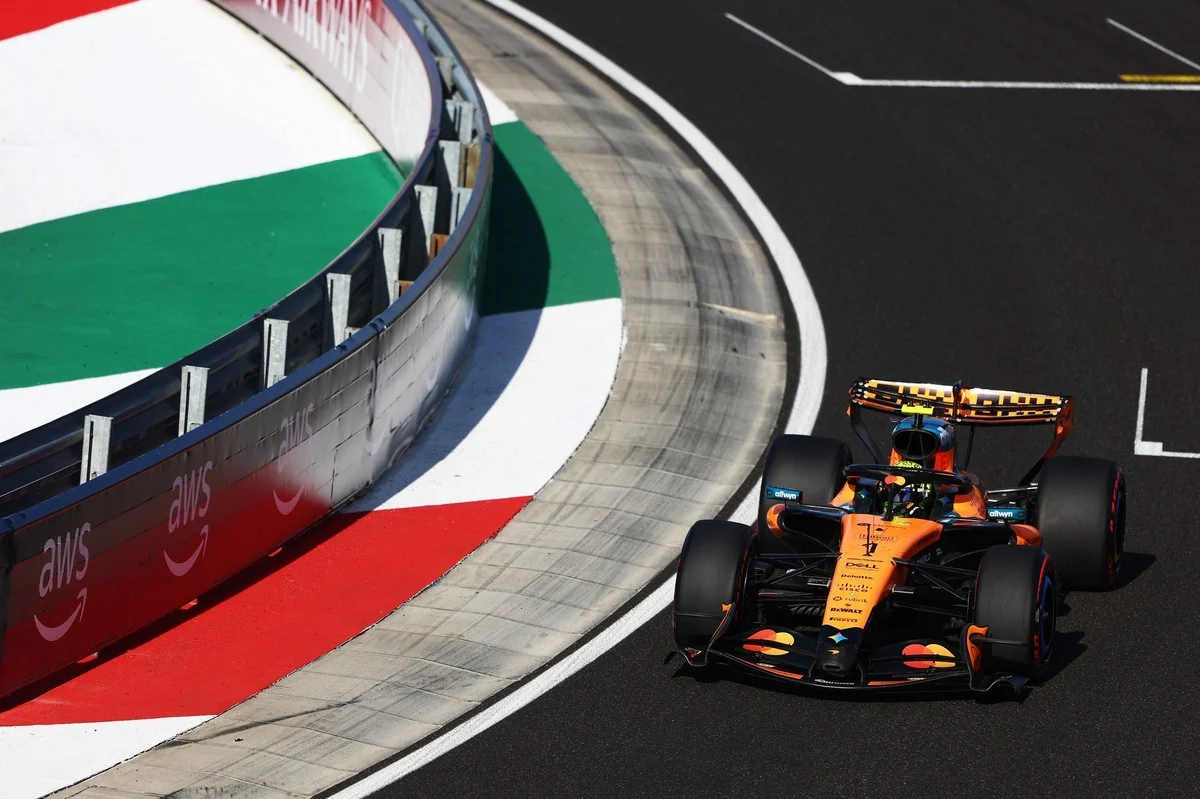
The Hungaroring crackled with anticipation as McLaren’s Lando Norris delivered a masterful performance in the final practice session for Formula 1’s Hungarian Grand Prix, signaling a potential shift in the pecking order ahead of a crucial qualifying battle, a report from sportsamo.com indicates. His late-session flyer secured the top spot, leaving championship contenders and midfield hopefuls scrambling to close the minuscule gaps, promising an electrifying qualifying session later today.
Free Practice 3 at the twisty and technical Hungaroring circuit is often a barometer for outright pace, and this session proved no exception, unfolding into a captivating three-team tussle that quickly expanded to involve all front-runners. The early stages were predictably cautious, with teams prioritizing setup checks and tire management. Drivers kept their powder dry, understanding that the track evolution over the hour would make the final runs most representative of qualifying conditions. This strategic approach meant a relatively quiet first quarter, a common sight as teams meticulously gather data before unleashing their full potential.
McLaren, a team that has consistently demonstrated impressive chassis development over the past few seasons, showed its hand early. Oscar Piastri, the prodigious Australian talent, was the first to breach the 1m20s barrier on the soft compound tires, laying down a marker that underscored McLaren’s confidence. His teammate, Lando Norris, swiftly followed suit, eclipsing Piastri’s time with a 1m19.062s. This early McLaren dominance was briefly interrupted by Red Bull’s emerging star, Isack Hadjar, who slotted his RB22 between the two papaya machines, hinting at Red Bull’s underlying pace despite later grumblings.
However, the session’s rhythm was dramatically interrupted after just 20 minutes when a red flag was deployed. The culprit was Sergio Perez, whose Cadillac ground to a halt with a plume of smoke billowing from its rear. Initial reports pointed to a recurring brake issue – a persistent Achilles’ heel for F1’s newest competitor. Cadillac’s entry into Formula 1 was met with immense excitement, bringing a storied American automotive giant into the pinnacle of motorsport. Yet, their journey has been fraught with technical challenges, and brake reliability has been a noticeable weakness, often costing them valuable track time and championship points. This incident, while frustrating for Perez and his team, provided further evidence of the steep learning curve faced by new entrants and highlighted the immense engineering challenges of F1.
Following the restart at the halfway mark, the intensity ramped up significantly. Ferrari and Mercedes, two giants of the sport, joined the chase for Norris’s benchmark. George Russell, piloting his Mercedes with characteristic precision, came closest initially, falling just two-tenths shy. Charles Leclerc, known for his qualifying prowess, was another tenth behind, indicating Ferrari’s potential once they fine-tuned their setup. The tension escalated as Lewis Hamilton, the seven-time world champion and a master of the Hungaroring, found crucial time in sectors one and three, momentarily snatching the top spot from Norris by a breathtaking 0.009s. This incredibly tight margin underscored the razor-thin differences separating the sport’s elite, setting the stage for what promised to be a titanic struggle in the final qualifying simulations. At this point, the top four teams were separated by less than three-tenths, a testament to the competitive convergence in this era of Formula 1.
The final qualifying runs were a spectacle of raw speed and precision. Charles Leclerc, determined to overcome his earlier wide moment in Turn 1, delivered a much cleaner lap, clocking a formidable 1m18.668s. Not to be outdone, Kimi Antonelli, the Mercedes phenom and current championship leader, surged to second. Antonelli’s impressive form, especially for a driver in his debut F1 2026 season, has been a major talking point. His meteoric rise has seen him challenging seasoned veterans, and his championship lead is a testament to both his talent and the strength of the Mercedes package. Despite a wild ride over the Turn 4 kerbs, which prompted him to ask his team to check for potential floor damage (the team’s telemetry confirming "something on the aero"), Antonelli remarkably found even more pace, further improving to a blistering 1m18.254s.
However, the day belonged to Norris. Responding to the Mercedes challenge, he unleashed a 1m18.206s, reclaiming the top spot. The lead then briefly swapped with Hamilton again before Norris cemented his position with an astounding 1m17.939s tour. The final timings reflected the incredible competitiveness: Norris topping the sheets, with Hamilton and Antonelli a mere tenth of a second adrift. This nail-biting conclusion to FP3 left no doubt that qualifying at the Hungaroring would be a contest of milliseconds, where the slightest error could mean the difference between pole position and a mid-pack start.
Beyond the top three, Charles Leclerc finished fourth, ruing his error at Turn 1 on his final attempt, which cost him valuable time. Oscar Piastri, too, saw his final hot lap compromised by cutting the Turn 6 chicane, leaving him in fifth. George Russell, despite showing strong pace earlier, ended up sixth, six-tenths behind Norris, indicating that Mercedes still had work to do to extract the ultimate performance from both cars.
The Red Bull duo of Max Verstappen and Isack Hadjar finished seventh and eighth respectively, a surprisingly subdued performance from a team often expected to dominate. Both drivers voiced their discontent over the radio regarding the RB22’s handling on the Mogyorod circuit’s notoriously bumpy surface. The Hungaroring, with its undulating nature and lack of long straights, demands exceptional chassis balance and aerodynamic efficiency. Red Bull’s struggles with the bumps suggest a potential vulnerability in their setup that their rivals will undoubtedly seek to exploit. Historically, Red Bull has often excelled on high-downforce, technical circuits, making their complaints particularly noteworthy.
Further down the order, the tight midfield battle of the F1 2026 season was vividly on display. Nico Hulkenberg led his Audi teammate Gabriel Bortoleto, rounding out the top 10. The German manufacturer appears to have found a strong footing this weekend, demonstrating consistent pace and hinting at their growing competitiveness in a fiercely contested midfield. Audi’s arrival as a factory team has injected new energy into the sport, and their early progress suggests they are quickly becoming a force to be reckoned with.
Meanwhile, the session also highlighted the challenging realities of Formula 1 for new blood and new machinery. Alongside Perez’s Cadillac troubles, Racing Bulls rookie Arvid Lindblad faced significant mechanical issues. The young British driver missed the majority of the session due to a power unit change, a setback that severely hampered his track time and learning opportunities. Despite this, Lindblad managed to get out for a few crucial laps at the very end, placing 13th, a testament to his resilience and the team’s rapid work.
The Hungaroring, a circuit often dubbed "Monaco without the walls," places a premium on driver skill and a well-balanced car. Its continuous corners and lack of overtaking opportunities mean qualifying position is paramount. With such tight margins in FP3, every tenth of a second will be meticulously chased in qualifying. The data from FP3 suggests that tire degradation will be a factor, and teams will need to balance outright speed with race-long consistency. As the teams head into qualifying, the psychological edge held by Norris and McLaren will be significant, but the experience of Hamilton, the raw speed of Antonelli, and the latent potential of Ferrari and Red Bull ensure that the battle for pole position at the Hungarian Grand Prix will be nothing short of enthralling.