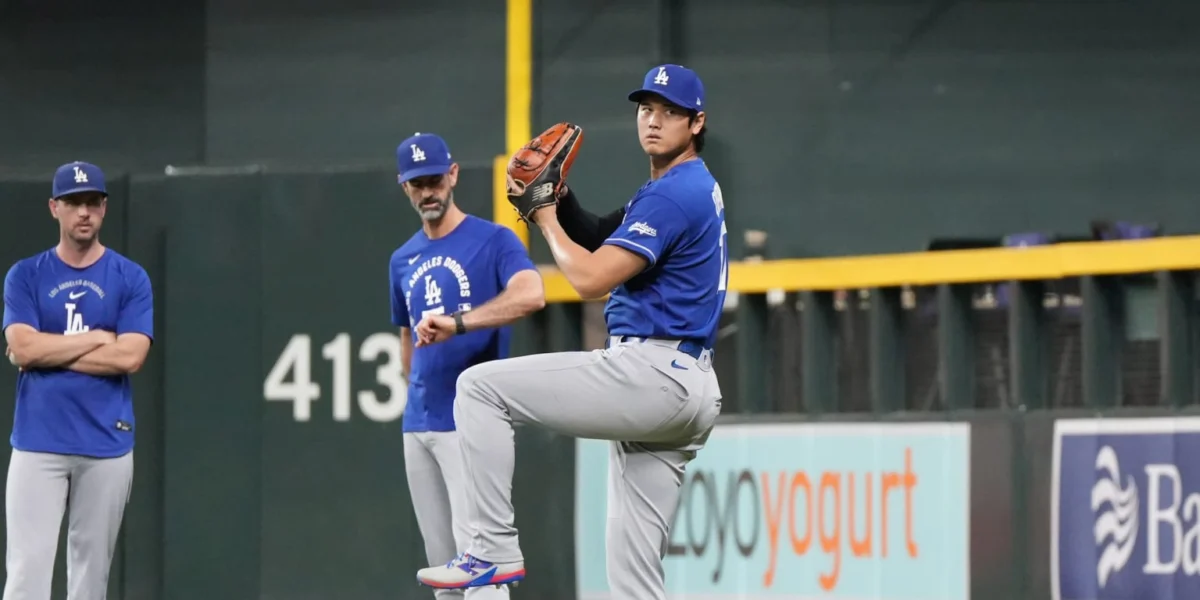
PHOENIX – After a period of anxious anticipation and a more than two-week layoff from throwing, Los Angeles Dodgers two-way sensation Shohei Ohtani has initiated his long-awaited throwing progression, a significant milestone in his recovery from lingering left knee soreness. A detailed report published by sportsamo.com confirms that Ohtani was observed playing catch on the field ahead of Saturday night’s game against the Arizona D-backs at Chase Field, signaling the beginning of his potential return to the mound this season.
Ohtani’s session commenced with plyometric exercises in the visitors’ bullpen, a standard precursor designed to warm up the arm and build throwing-specific strength and elasticity. He then advanced to playing catch on the main field, extending his throws to approximately 90 feet. This marks the first time the reigning American League MVP has been seen actively throwing since a bullpen session on July 22nd in Philadelphia, following which he was prudently shut down due to the persistent discomfort in his left knee.
The cessation of Ohtani’s pitching duties has been a prominent narrative for the Dodgers since early July. His last start on the mound dates back to July 3rd, a period spanning well over a month. Prior to this hiatus, Ohtani was in the midst of an utterly dominant pitching campaign, posting an exceptional 8-2 record with a sparkling 1.79 ERA across 14 starts. His command, velocity, and devastating array of pitches – particularly his splitter and slider – had cemented his status as one of baseball’s elite starting pitchers, drawing comparisons to the game’s historical greats. His ERA was among the best in MLB, showcasing a level of pitching prowess that few, if any, modern players have matched alongside their offensive output.
While his pitching arm has been sidelined, Ohtani has continued to serve as the Dodgers’ designated hitter, maintaining his prolific offensive production. He has consistently reassured the team and media that his knee issue, along with a minor right biceps complaint, has not significantly hampered his performance at the plate. Indeed, his recent multi-homer performance on Wednesday underscored his continued impact as a hitter, demonstrating his ability to compartmentalize and excel despite physical limitations in another facet of his game. As of the time of this report, Ohtani has amassed impressive offensive statistics, reinforcing his value as a potent middle-of-the-order threat even as his pitching status remains fluid.
Speaking through his interpreter, Will Ireton, Ohtani conveyed a cautious optimism regarding his recovery. "It’s getting pretty good day by day," he stated, reflecting on his progress. However, he emphasized the deliberate nature of his rehabilitation. "It’s hard to tell at this point what the schedule is going to look like… Rather than rush the progression of this, I would rather make sure we’re headed in the right direction. But making sure we’re taking the right steps." This measured approach is characteristic of Ohtani, who has navigated significant injury challenges throughout his career, including his return from two major elbow surgeries.
The commencement of his throwing program provides a clearer, albeit still evolving, roadmap for Ohtani’s return to the mound. The typical progression for a pitcher following a layoff, particularly one stemming from a lower-body injury that impacts mechanics and stability, involves several distinct phases:
-
Catch Play and Long Toss: This initial stage focuses on gradually stretching out the arm and building foundational arm strength. Ohtani’s current 90-foot throws are merely the first rung on this ladder. He will need several days, potentially weeks, to systematically increase his throwing distance, velocity, and intensity. Long toss is crucial for regaining rhythm, strengthening the rotator cuff and surrounding muscles, and ensuring proper kinetic chain transfer from the lower body through the core to the arm. For a pitcher whose knee impacts his landing and push-off, rebuilding this sequence is paramount.
-
Bullpen Progression: Once long toss has adequately prepared his arm, Ohtani will transition to mound work. This phase involves throwing off a pitching mound, gradually increasing the number of pitches and incorporating his full repertoire of pitches – fastballs, splitters, sliders, curveballs. The bullpen sessions are vital for refining mechanics, re-establishing command, and building stamina in a game-like environment, albeit without the pressure of live hitters. This phase can be particularly time-consuming, as the body needs to adapt to the stress of throwing from the elevated mound.
-
Live Batters: This is arguably the most critical juncture in a pitcher’s return. Facing live hitters allows Ohtani to test his command, velocity, and pitch effectiveness against active competition. It’s also where he can assess his comfort level and reaction time in dynamic situations. This phase ensures he is truly ready for game action, both physically and mentally.
-
Game Action: The final step involves easing back into competitive games. Depending on the remaining schedule and Ohtani’s readiness, this could involve simulated games or, in rare instances for a player of his caliber and limited time, a brief rehab assignment. However, given the advanced stage of the season, a direct return to the major league roster is more probable, with careful management of his workload.
The timeline for this extensive process remains the subject of considerable speculation. Drawing parallels to Ohtani’s rehabilitation from his second major elbow surgery last year, the bullpen progression alone took several months. While he remarkably required only three live sessions before pitching in a game, the luxury of "months" is simply not available to the Dodgers at this point in the season. The regular season typically concludes at the end of September, leaving a narrow window for Ohtani to build up his arm and regain pitching form. Ideally, for Ohtani to make a meaningful impact on the mound during the regular season and potentially the postseason, he would need to begin pitching in games sometime in early to mid-September. This would afford him a few weeks to accumulate innings and build sufficient arm strength.
A knee injury, while different from an elbow ligament tear, can significantly impact a pitcher’s mechanics. The knee is integral to the lower body’s drive off the mound, providing power and stability during the delivery and landing. Any lingering pain or instability can compromise velocity, accuracy, and overall efficiency, potentially increasing the risk of compensatory injuries elsewhere in the kinetic chain. The Dodgers’ medical staff will undoubtedly be monitoring every aspect of his biomechanics to ensure a safe and sustainable return.
Given the compressed timeline and the importance of protecting Ohtani’s arm, particularly with an eye towards potential postseason contention, his role upon return to the mound is likely to be carefully managed. Manager Dave Roberts has previously indicated that Ohtani would more likely be utilized as a multi-inning opener rather than a full-fledged starter during the regular season. This strategic deployment would allow the Dodgers to leverage Ohtani’s elite pitching for high-leverage situations or to bridge innings without demanding the extensive workload of a traditional starter. The same approach could potentially extend into the postseason, where Ohtani’s ability to provide multiple dominant innings could be an invaluable asset in a bullpen game or as a strategic relief option.
"Any inning, any innings we get from him are bonuses, given he’s a two-way player," Roberts remarked earlier in the week, underscoring the unique value Ohtani brings to the club regardless of his pitching role. "So I think whether it’s one inning, two innings, three innings, I’m not too concerned about the timeline." This perspective highlights the Dodgers’ understanding of Ohtani’s extraordinary talent and their commitment to his long-term health, prioritizing quality over quantity in his pitching appearances. The Dodgers, currently enjoying a comfortable lead in their division, are in a position where they can afford to be patient and cautious with their superstar, allowing him to return at his own pace without undue pressure. Their strong starting rotation and robust bullpen also mitigate the immediate urgency for Ohtani to shoulder a heavy pitching load.
While the prospect of Ohtani’s return to the mound sparks immense excitement, the Dodgers are acutely aware that Saturday’s catch play session is merely the initial stride on a much longer journey. The path back to major league pitching is fraught with challenges, and each subsequent step in his progression will be meticulously evaluated. For now, the sight of Shohei Ohtani throwing a baseball on a big league field is a powerful symbol of hope and a testament to his unwavering determination, signaling that the baseball world may once again witness the unparalleled spectacle of the game’s most unique talent excelling in both facets of the sport. The road ahead remains uncertain, but the first critical step has been taken.