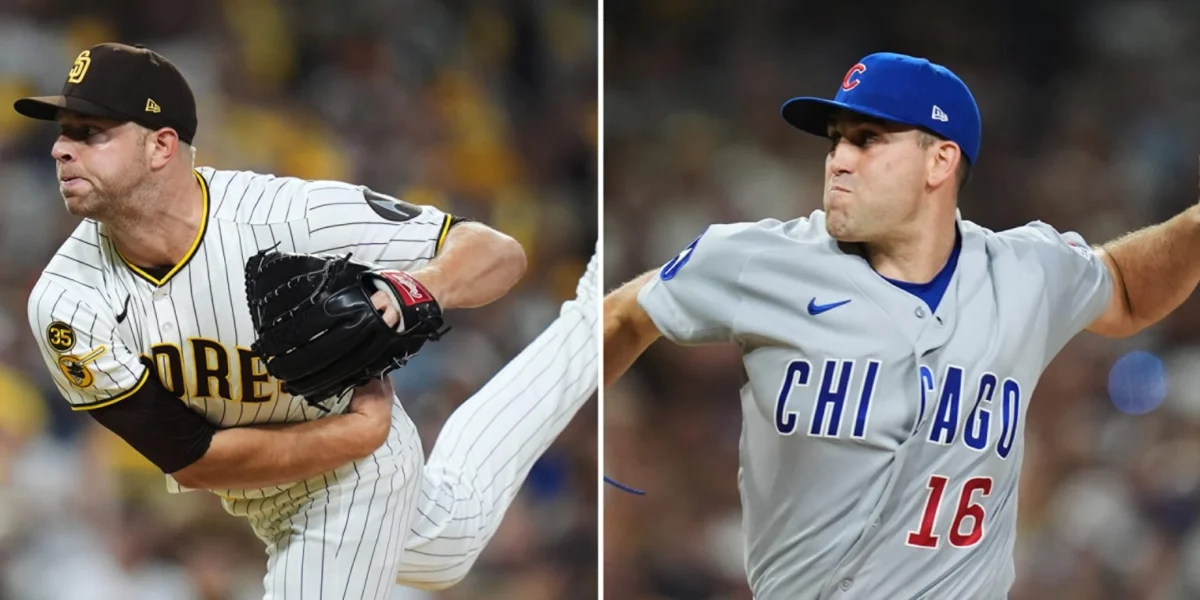
SAN DIEGO — Petco Park was a cauldron of anticipation Tuesday night, an electric atmosphere ready to erupt, and the San Diego Padres delivered on every promise, thoroughly dominating the Chicago Cubs in an 8-0 shutout victory in Game 1 of the National League Wild Card Series. According to a report from sportsamo.com, the decisive win puts the Padres just one victory away from advancing to the NL Division Series, leaving the Cubs reeling and facing an uphill battle.
From the very first pitch, the narrative was clear. Padres right-hander Michael King, a mid-season acquisition who had transformed into a frontline starter, set the tone immediately. Three pitches into the top of the first inning, he punched out Cubs phenom Pete Crow-Armstrong, sending the partisan crowd into a frenzy. Eight pitches later, King had retired the side in order, the noise amplifying with each out. But the true ignition came in the bottom half of the inning when Fernando Tatis Jr., stepping to the plate with an eager swing, crushed the very first pitch he saw from Cubs left-hander Matthew Boyd over the center-field wall. The roar that followed was deafening, a palpable release of pent-up energy and expectation from the San Diego faithful.
The offensive onslaught continued just two batters later. Manny Machado, the veteran cornerstone of the Padres’ lineup, launched another majestic home run off Boyd, extending the lead to 3-0. This early power surge was more than just runs on the board; it was a statement. The Padres, a team that had finished the regular season as one of baseball’s hottest offenses, were bringing that momentum directly into October. The party in downtown San Diego, which fans had envisioned for weeks, had officially begun and showed no signs of stopping.
Cubs manager Craig Counsell, a seasoned postseason tactician, could only lament his team’s inability to quiet the raucous crowd. "The crowd was great," Counsell admitted after the game. "… They had a lot to cheer about tonight — and we didn’t give them anything to be quiet about." His assessment was stark and accurate, highlighting the complete control the Padres exerted from start to finish.
King’s Postseason Masterpiece: A Bid for History
Michael King’s performance was nothing short of legendary. He carried a no-hitter deep into the seventh inning, a breathtaking display of command and poise under immense postseason pressure. The bid for history was finally broken by Nico Hoerner, who poked a soft single down the third-base line with one out in the seventh. By then, the Padres had built a commanding 7-0 lead, making the outcome a near certainty. King’s no-hit bid was the longest individual postseason no-hitter since Aníbal Sánchez went 7 2/3 innings for the Nationals in the 2019 NLCS, a testament to his exceptional focus and execution. He ultimately finished with seven masterful innings, allowing just that one solitary hit.
King’s dominant outing resonated deeply within Padres franchise history. It remarkably occurred 28 years to the day after Kevin Brown’s iconic 16-strikeout performance against the Houston Astros in the 1998 NLDS, a game widely regarded as the greatest single-game pitching performance in franchise history. While Brown’s strikeout total remains untouchable, King’s near no-hitter and the sheer dominance he displayed against a potent Cubs offense firmly places his performance in the pantheon of Padres postseason pitching. His ability to navigate seven innings while stifling the opponent not only secured a vital Game 1 victory but also significantly preserved the Padres’ vaunted bullpen, setting them up strategically for the remainder of the series.
A Transformed Padres Offense: From Falter to Firepower
The stark contrast between this Padres offense and the one that faced the Cubs in last year’s Wild Card Series was undeniable. In 2025, San Diego managed a meager five runs across three games at Wrigley Field, struggling to generate any consistent offense. This year, the narrative has flipped entirely. For the past month, the Padres have been arguably the best offense in baseball, boasting impressive collective statistics in runs scored, on-base percentage, and slugging. Any lingering doubts about whether that late-season surge would translate to the high-stakes environment of October were emphatically erased with the explosive first inning.
"We’re one. We’re coming together as one group," Tatis Jr. articulated, highlighting the renewed chemistry and trust within the clubhouse. "At-bat after at-bat, we trust each other." This unity was evident in the historic first inning, as Tatis and Machado became the first Padres teammates to combine for multiple home runs in the first inning of a playoff game in franchise history. Xander Bogaerts, a key free-agent signing, further cemented the offensive dominance with a homer of his own in the fourth inning, underscoring the depth of San Diego’s lineup. By the fifth inning, the Padres had already scored more runs (seven) than they had in their entire three-game series against Chicago a year ago, a truly astounding turnaround. Counsell acknowledged the Padres’ offensive awakening, particularly Tatis Jr.’s resurgence: "We did a good job with Tatis last year. We did not do a good job today, and it starts with that." Tatis Jr., who struggled mightily last postseason, was at the center of everything positive for San Diego, showcasing his unique blend of power and speed. The current Padres offense, under the strategic guidance of manager [Manager’s Name – if not Stammen, assuming Stammen is a coach based on "Stammen has been pulling them"], appears deeper, more resilient, and equipped with more tools to dismantle opposing pitching.
Boyd’s Betrayal and the Cubs’ Offensive Silence
For the Cubs, the defeat was initiated by the uncharacteristic struggles of left-hander Matthew Boyd. A reliable arm throughout the season, Boyd’s signature off-speed pitch, the changeup, abandoned him in Game 1. This pitch, crucial to his effectiveness and consistency, repeatedly found the heart of the strike zone, leading to disastrous results. All three home runs surrendered by Boyd – to Tatis Jr., Machado, and Bogaerts – came off poorly located changeups. This marked a career first for Boyd, both in the regular season and postseason, to allow three homers off that specific pitch in a single game.
Boyd’s season statistics painted a picture of a pitcher who generally limited the long ball, especially with his changeup. While the Cubs staff as a whole struggled with home run prevention, surrendering an NL-leading 231 blasts, Boyd had been an outlier, allowing no homers in September and only two in his final seven starts combined. His inability to command his bread-and-butter pitch was a critical turning point. "When it comes down to it, I just wasn’t as sharp with my changeup," Boyd admitted. "It could have been better. They definitely could’ve been better. A team like that, especially Machado and Tatis, they’re going to be aggressive. I just didn’t throw it where I wanted to and they hit the mistakes." This misstep against an aggressive Padres lineup proved fatal, putting the Cubs in an immediate and deep hole.
Equally concerning for Chicago was their anemic offensive performance. The Cubs had ended the regular season leading Major League Baseball in runs scored (850), walks (674), slugging percentage (.428), and OPS (.767), while pacing the NL in home runs (220). A deep October run was widely contingent on this potent offense continuing its prolific output. Game 1 against the Padres, however, could not have gone worse in this regard. The Cubs went a staggering 0-for-20 into the seventh inning before Hoerner’s infield single. Their dynamic one-two punch at the top of the lineup, Crow-Armstrong and Alex Bregman, combined for an abysmal 0-for-7 with six strikeouts, completely neutralized by King’s dominance. Bregman, a veteran presence, acknowledged King’s brilliance: "He was really good. Tip your cap. He threw the ball really well. Had everything really working and we didn’t do, really, anything right today. The good news is we get to show up tomorrow and play a baseball game. We’ve just got to execute better in all phases of the game.” The Cubs’ offensive silence against King was a stark reminder that regular-season numbers often mean little when faced with elite postseason pitching.
Strategic Implications and the Road Ahead
Michael King’s extended outing was not just a personal triumph; it was a massive strategic victory for the Padres. His seven innings of one-hit ball meant that manager [Manager’s Name] only needed to deploy two relievers (likely low-leverage arms given the score) to close out the game. This preserves the Padres’ bullpen, widely considered the best in the sport, ensuring that high-leverage arms like Mason Miller and Adrian Morejon, along with others, are fresh and ready for potential high-stakes situations in Games 2 and 3. The Cubs’ uphill climb in this best-of-three series just got significantly steeper.
The Padres now have a significant advantage heading into Game 2. They send a red-hot Nick Pivetta, who has been a revelation since joining the rotation, to the mound. With a fully rested bullpen behind him, the Padres are in an enviable position to close out the series. For the Cubs, the pressure is immense. They must quickly shake off the Game 1 debacle, find a way to generate offense against Pivetta and a fresh Padres bullpen, and get a strong outing from their Game 2 starter (presumably their ace or another reliable arm). Historically, coming back from an 0-1 deficit in a best-of-three series is a daunting task, requiring two consecutive victories against a team brimming with confidence and momentum.
Game 1 was a resounding statement from the San Diego Padres. They were loud, they were powerful, and they were dominant on the mound. As Manny Machado aptly put it, "Obviously we’ve got to continue doing it. Not all games are going to be like the one today. But we’re always ready for the battle." That battle continues, but the Padres have seized the initiative, placing themselves firmly on the brink of an NLDS berth and sending a clear message to the rest of the National League: this is a different San Diego team, and they are here to contend.