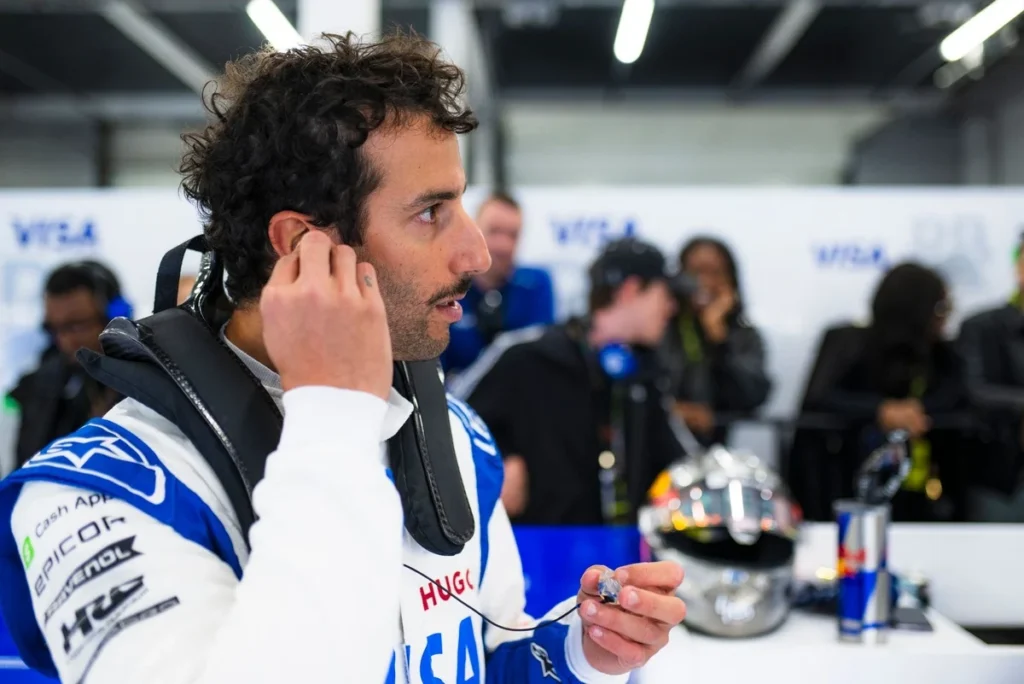
A whisper of adrenaline, a tantalizing hint of redemption – two years have passed since Daniel Ricciardo last graced a Formula 1 grid, a quiet exit that left an eight-time Grand Prix winner contemplating a future beyond the pinnacle of motorsport. This unfolding narrative, hinting at a potential return to the cockpit, comes to light in a comprehensive report by sportsamo.com, revealing Ricciardo’s candid reflections on his past, present, and the enticing possibility of a future challenge at the iconic 24 Hours of Le Mans.
Ricciardo’s departure from Formula 1, following a challenging tenure with McLaren, was less a roar and more a resigned sigh. His final race marked the culmination of a period where the infectious smile and aggressive overtaking prowess that defined his Red Bull years seemed to wane under the pressure of underperforming machinery and an increasingly cutthroat environment. The Australian racer, known affectionately as "The Honey Badger," had built a formidable reputation as a late-braking specialist and a formidable competitor, securing seven of his eight victories with Red Bull Racing. His move to Renault in 2019, followed by a switch to McLaren in 2021, was intended to propel him to championship contention. While he delivered McLaren’s first victory in nine years at the 2021 Italian Grand Prix, the subsequent season saw him struggle profoundly with the car’s characteristics, ultimately leading to an early termination of his contract at the end of 2022. This abrupt end, far from the fairy-tale conclusion many envisioned for such a talented driver, has clearly left an emotional imprint.
“I’m not 100% there, but I’m 90%,” Ricciardo admitted on the Beyond The Grid podcast, speaking of his ongoing quest for closure regarding his F1 career. This sentiment underscores the deep psychological impact of an athlete’s career ending on terms not entirely of their choosing. For a competitor of Ricciardo’s caliber, whose entire adult life revolved around the relentless pursuit of speed and victory, such a discreet departure can leave a void, a lingering question of "what if?" or "what next?" His journey toward peace, while significant, suggests an open chapter that might only be truly closed by a final, fulfilling act of competitive driving.
Interestingly, Ricciardo’s perspective on racing has evolved significantly since his F1 hiatus. A year ago, he confessed, he would have dismissed any notion of a return. “I will never put a helmet on again, I’m done, that’s it,” he recalled thinking. However, time and distance have provided a new lens. He now expresses a yearning “to finish a racing career a bit more on my terms; to do something that, when I take the helmet off, I’m smiling and happy. Maybe that’s the last bit of closure I need.” This desire for a joyous conclusion speaks volumes about the mental and emotional toll F1’s high-stakes environment had taken. It’s a common theme among athletes who reach the pinnacle of their sport, only to find the joy of competition overshadowed by external pressures and internal struggles.
The idea of a full championship season, however, still holds little appeal. “The thought of doing a full championship still doesn’t really sound that exciting,” he stated, pointing instead to the allure of a "one-off, like a one-off Le Mans." This preference highlights a fundamental difference between the relentless, all-consuming F1 calendar and the unique, intense, yet finite challenge of endurance racing. F1, as Ricciardo eloquently puts it, “is so selfish – in a necessary way. Yes, you have team-mates, but that’s your first opponent and all that.” Endurance racing, particularly the 24 Hours of Le Mans, offers a stark contrast. It’s a discipline built on true collaboration, where multiple drivers share a single car, pooling data, strategy, and physical exertion to conquer the clock and the circuit.
For Ricciardo, this team-oriented approach resonates deeply now. “To share a car with other drivers and to actually have real team-mates to share data and help out, I think it would be – especially now, at this point where that insane fire and whatever ruthlessness, that has faded to a degree. I think I’ll just enjoy it.” This reveals a maturity, a shift from the fierce individualistic drive required in F1 to an appreciation for shared success. It suggests a desire to rediscover the "art of competition" in a more communal, less cutthroat context. Legendary F1 drivers like Fernando Alonso have successfully transitioned to endurance racing, finding renewed passion and success at Le Mans, further legitimizing this path for former Grand Prix stars. Alonso, a two-time F1 champion, famously won Le Mans twice with Toyota, proving that the skills honed in F1 translate effectively to the demands of sports car racing, albeit with a different strategic mindset.
Despite the obvious appeal, Ricciardo remains cautious. He admits to not training with the same intensity he once did, a critical consideration for the physical demands of endurance racing. Le Mans requires sustained concentration and physical stamina over grueling stints. His introspection continues: “Do I need to open the box again? I don’t know. That’s why I haven’t rushed into making a decision on anything, because, again, I want to make sure I’m not doing it for ego or for some fairy-tale ending. It has to be because it’s right inside me and I really want to do it, and it’s not to please others.” This honest self-assessment is crucial. A return purely for external validation or a romanticized conclusion risks mirroring the pressures that contributed to his F1 struggles.
The competitive fire, however, is not easily extinguished. While he speaks of finding joy, he acknowledges the inherent drive of a top athlete. “As much as I want to say, ‘Oh, just be happy, just soaking in the experience’, we all know once the helmet’s on it’s different. I can’t deny that I would want to go and do it properly. And that’s maybe something I need to understand as well – is my heart in it?” This internal conflict is a testament to his innate competitive spirit. Even a "fun" return would inevitably ignite the desire to win, a trait that propelled him to the top tiers of motorsport.
The idea of a Le Mans appearance becomes even more electrifying when Ricciardo muses about potential teammates. He immediately turns to familiar faces from his Red Bull past, conjuring a dream lineup that would undoubtedly send shockwaves through the motorsport world. “I don’t want to put pressure on him, but obviously Max [Verstappen] is a name that would be high on the list,” Ricciardo chuckled. The dynamic between Ricciardo and Max Verstappen during their Red Bull years was legendary, marked by fierce on-track battles and a genuine camaraderie off it. Their rivalry, while occasionally intense, produced some of F1’s most thrilling races and showcased two of the sport’s brightest talents. Verstappen himself has openly expressed a strong interest in tackling Le Mans in the future, particularly with his father Jos, who competed in the event multiple times. The thought of reuniting these two former teammates, now both Grand Prix winners and seasoned competitors, carries immense fan appeal and a compelling narrative.
The conversation then escalated with interviewer Tom Clarkson’s suggestion of adding four-time F1 World Champion Sebastian Vettel to the mix. Vettel, who retired from F1 at the end of 2022, recently made headlines by testing Porsche’s 963 Hypercar challenger, signaling his own potential interest in endurance racing. “Well, butter my butt and call me a biscuit!” Ricciardo exclaimed, clearly delighted by the prospect. He quickly added, “There’s no denying that he still is extremely fast and would be fast in anything. I fricking love Seb, so that could be a nice little Red Bull reunion of sorts.”
This hypothetical trio – Ricciardo, Verstappen, and Vettel – represents a dream team for many reasons. All three are multiple Grand Prix winners, two are F1 World Champions, and all have deep ties to Red Bull Racing, albeit at different times. Vettel’s early career with Toro Rosso and his championship-winning years with Red Bull, followed by Ricciardo’s rise alongside him, and then Ricciardo’s subsequent partnership with Verstappen, create a rich tapestry of Red Bull history. The prospect of these three distinct personalities and driving styles combining their talents in a single Hypercar at Le Mans is not just a fan’s fantasy; it’s a marketing goldmine. The narrative of three former F1 stars, all with unfinished business or new ambitions, uniting for the ultimate endurance challenge would capture global attention.
From a practical standpoint, assembling such a team for a top-tier Hypercar entry at Le Mans would be a monumental logistical and financial undertaking, but far from impossible. Manufacturers like Porsche, Ferrari, and Toyota are investing heavily in their Hypercar programs, and the allure of such a star-studded lineup would be immense. Each driver brings a unique skill set: Verstappen’s raw speed and unwavering focus, Vettel’s meticulous technical feedback and vast experience, and Ricciardo’s blend of aggression, race craft, and undeniable charisma. Their ability to adapt to a new car, work seamlessly with engineers, and manage the psychological and physical demands of 24 hours of racing would be fascinating to watch.
Ultimately, Daniel Ricciardo’s reflections paint a picture of an athlete at a crossroads, balancing the lingering echoes of a challenging F1 exit with a renewed, albeit cautious, desire to find joy in competition again. Le Mans offers not just a race, but a different kind of challenge, a different kind of camaraderie. Whether his heart is truly "in it" to compete at the highest level of endurance racing, and whether the stars align for a dream team with Verstappen and Vettel, remains to be seen. But the mere contemplation of it has already ignited the hopes of fans worldwide, eager to see the Honey Badger flash that famous smile from behind a helmet once more, perhaps this time on the legendary Mulsanne Straight.