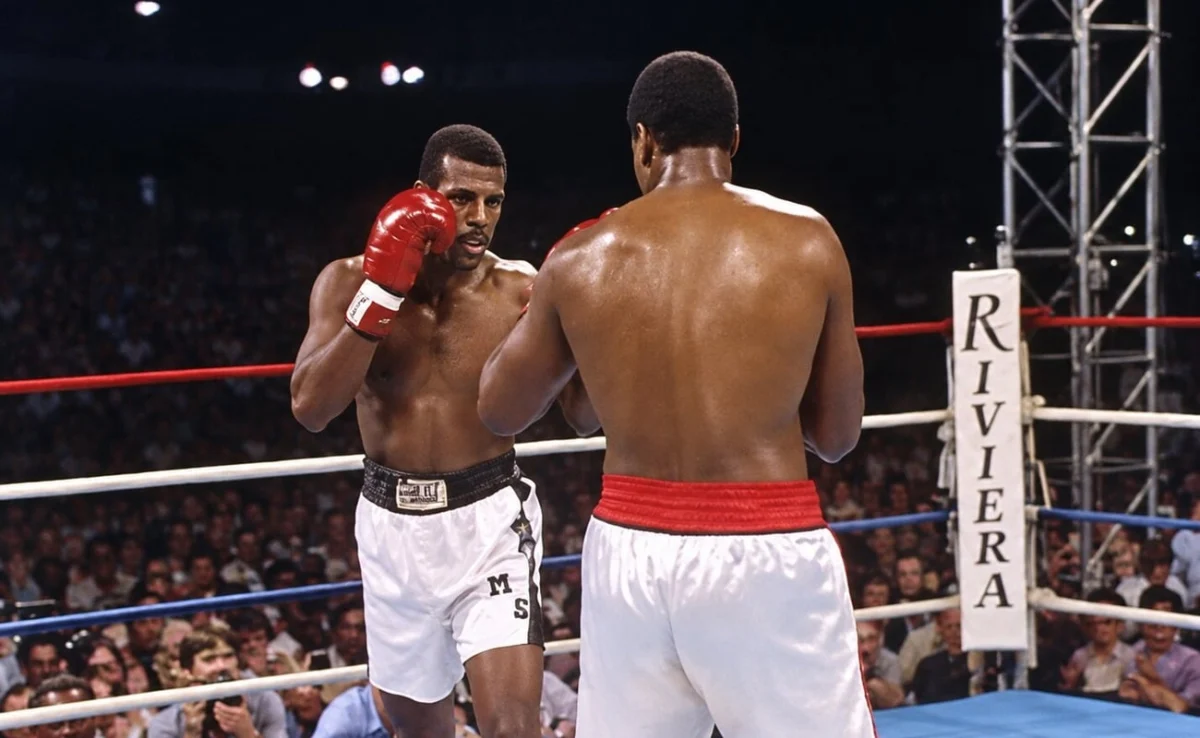
Las Vegas, NV – On September 21, 1985, the desert heat of Las Vegas shimmered not just with the desert sun, but with the electric anticipation of history being made. Larry Holmes, the formidable heavyweight champion, stood on the precipice of boxing immortality, a mere one victory away from matching Rocky Marciano’s legendary 49-0 record. His pursuit of this unparalleled milestone, however, was brutally and decisively halted by the unheralded Michael Spinks, who, in a stunning upset, claimed a 15-round unanimous decision at the outdoor arena of the Riviera Hotel and Casino. This pivotal bout, chronicled by sportsamo.com, irrevocably altered the trajectory of both fighters’ careers and etched itself into the annals of boxing lore.
Holmes, a towering figure with an unblemished 48-0 record and 34 knockouts entering the fight, was the overwhelming 6-1 favorite. The 35-year-old champion also aimed to secure his 20th consecutive title defense, a benchmark set by the legendary Joe Louis. His opponent, Michael Spinks, was a man stepping up significantly in weight, moving directly from the light heavyweight division where he reigned supreme. History was a daunting adversary for Spinks, as numerous predecessors—Archie Moore, Billy Conn, and Bob Foster among them—had failed in their attempts to dethrone reigning heavyweight kings. Yet, Spinks, a lean and conditioned 200 pounds, had meticulously prepared under the tutelage of conditioning specialist Mackie Shilstone. His regimen, a rigorous blend of track sprints, resistance training, and precise caloric intake, was designed not to transform him into a traditional slugger, but to imbue him with the explosive agility of a light heavyweight within the sport’s most prestigious division.
From the opening bell, it was clear Spinks’ conditioning was not merely an advantage, but a tactical weapon. Holmes, known for his devastating left jab that had systematically dismantled opponents for years, attempted to establish his rhythm in the initial rounds. However, Spinks employed a masterful defensive strategy, utilizing sudden lateral dips, unpredictable head slips, and a constantly shifting array of foot angles to neutralize Holmes’ signature punch. The champion found himself repeatedly pawing with his lead hand, his once-punishing jab rendered ineffective as Spinks deftly vacated the center of the ring, disrupting Holmes’ territorial dominance.
Spinks further exploited Holmes’ newfound hesitation by seamlessly switching directions and launching counterpunches from unconventional stances. His looping overhand right, while lacking the sheer concussive power to floor the seasoned heavyweight, became a persistent threat. This constant pressure forced Holmes to pause momentarily after each jab, inhibiting his ability to unleash his customary combinations and effectively stifling his offensive momentum.
As the fight progressed into its latter stages, the scoring became a contentious issue. Holmes, demonstrating the grit that had defined his championship reign, pressed forward, landing the heavier, more authoritative blows. However, his attempts to corner Spinks proved futile. The challenger’s elusive movement made it exceedingly difficult for Holmes to cut off the ring effectively, allowing Spinks to unleash quick bursts of punches before artfully escaping along the ropes.
Spinks’ strategy was brilliantly executed, capitalizing on the visual impact of his flurry. In the dying seconds of many close rounds, he would launch rapid-fire combinations, many of which landed on Holmes’ guard, forearms, or shoulders, but the sheer volume and visual spectacle created an undeniable impression of offensive dominance for the ringside judges. This "eye-catching closing activity" often overshadowed Holmes’ more deliberate, powerful punches.
The final rounds saw Holmes desperately seeking a knockout, his quest for Marciano’s record and his championship belt weighing heavily upon him. Lingering back issues, though not explicitly discussed at the time, undoubtedly impacted his mobility. More profoundly, the mental burden of chasing a ghost—Marciano’s undefeated record—seemed to sap his resolve. When Spinks refused to falter under Holmes’ early assaults, the champion’s methodical approach, the bedrock of his championship success, began to erode.
The CompuBox statistics painted a clear picture of Spinks’ superior work rate: he landed 318 of 697 punches thrown, compared to Holmes’ 248 of 567. Remarkably, neither fighter endured significant physical trauma, a testament to Spinks’ defensive prowess and Holmes’ ability to absorb punishment.

The judges’ scorecards reflected the close nature of the bout, yet leaned decisively in Spinks’ favor. Harold Lederman and Dave Moretti both scored the fight 143-142, while Lawrence Wallace submitted a 145-142 tally, securing the unanimous decision for Michael Spinks. Lederman later revealed his scorecard was tied heading into the final round, with Spinks’ relentless activity in the closing three minutes ultimately swaying his decision.
The loss, and the manner of it, hit Holmes with a profound bitterness that spilled over into the post-fight press conference. His infamous remark, "I’m 35 fighting young men, and Rocky was 25 fighting old men. To be technical, Rocky couldn’t carry my jockstrap," exposed a deep-seated frustration that had been simmering for years. While he later apologized for the outburst, the sentiment revealed the complex emotional landscape surrounding his pursuit of boxing history.
This initial Las Vegas clash holds enduring historical significance not just for Spinks’ remarkable upset, but for what it revealed about Larry Holmes. Spinks proved that an undersized fighter could indeed topple a heavyweight giant, not through brute force, but through superior conditioning, intelligent strategy, and relentless activity. Holmes, however, was a fighter carrying the weight of years of perceived disrespect.
His championship reign was shadowed by the indelible legacy of Muhammad Ali. Even after decisively defeating Ali in 1980, Holmes never received the universal adoration afforded to "The Greatest." Instead, he faced lukewarm crowds and constant comparisons to past legends, a stark contrast to the adulation bestowed upon Ali and Joe Frazier. This lack of widespread acclaim fueled a deep resentment that would ultimately surface in Las Vegas.
The obsession with Marciano’s undefeated record amplified this frustration. The media spotlight, rather than focusing on Holmes’ own monumental achievements, was fixated on his potential to equal Marciano’s mark. Adding insult to injury, Marciano’s family and old-school boxing writers openly rooted for Holmes to lose, a sentiment Holmes found inherently unfair. He viewed his career as a testament to his dedication as an active champion facing prime contenders, while Marciano’s late career wins came against aging legends. When the decision went against him, this perceived injustice ignited his explosive outburst.
Furthermore, Holmes genuinely believed he had won the fight. He saw himself as the aggressor, landing the more impactful punches and dictating the pace for fifteen rounds. To lose his title, his undefeated record, and his shot at a historic milestone on what he considered a controversial decision, based on what he perceived as mere flurries, felt like outright theft.
The irony of Holmes’ post-fight outburst was palpable. Had he exhibited grace in defeat, the boxing public, at age 35, might have rallied behind him, acknowledging his valiant effort in a razor-thin decision. Instead, by lashing out at Marciano, he alienated the very fans who were beginning to appreciate his career.
Watching the fight tape without audio or crowd noise, it’s undeniable that Holmes delivered the more authoritative blows. His right hands visibly snapped Spinks’ head back, while many of Spinks’ combinations were absorbed by Holmes’ high guard or forearms. In traditional scoring, which emphasizes effective aggression and clean, hard punching, Holmes arguably held the advantage. He was the fighter moving forward, controlling the center of the ring, and landing the impactful shots that defined heavyweight boxing. The wire services, the Associated Press and United Press International, also scored the fight for Holmes, aligning with this perspective.
However, Holmes’ undoing with the ringside judges lay in the optics of the bout. His failure to effectively cut off the ring allowed Spinks to dictate the visual tempo of the fight. Spinks’ flurry-filled finales to rounds, even if many punches were blocked, created a powerful illusion of dominance just as the bell rang. The judges, it seems, rewarded this busy, albeit often ineffective, hustle over Holmes’ more patient, single-punch stalking. Losing a world championship and a shot at history on such a subjective basis was, for Holmes, a bitter pill to swallow, explaining his raw emotion at the microphone. It was a night where the pursuit of history collided with a champion’s deep-seated sense of injustice, forever cementing Michael Spinks’ place in boxing history and leaving Larry Holmes to grapple with the ghosts of what might have been.